
The June 2026 decision
On 18 June 2026, Norges Bank held Norway’s rate at 4.25%. Reuters reported May core inflation of 3.4%, up from 3.2% in April. The krone weakened to 11.06 per euro at 0803 GMT, from 11.04 before the announcement. All 26 polled economists expected the hold; a majority forecast another quarter-point increase to 4.5% later in 2026. Governor Ida Wolden Bache expected further tightening.
- Next meeting: August.
- Following meeting: September.
2023
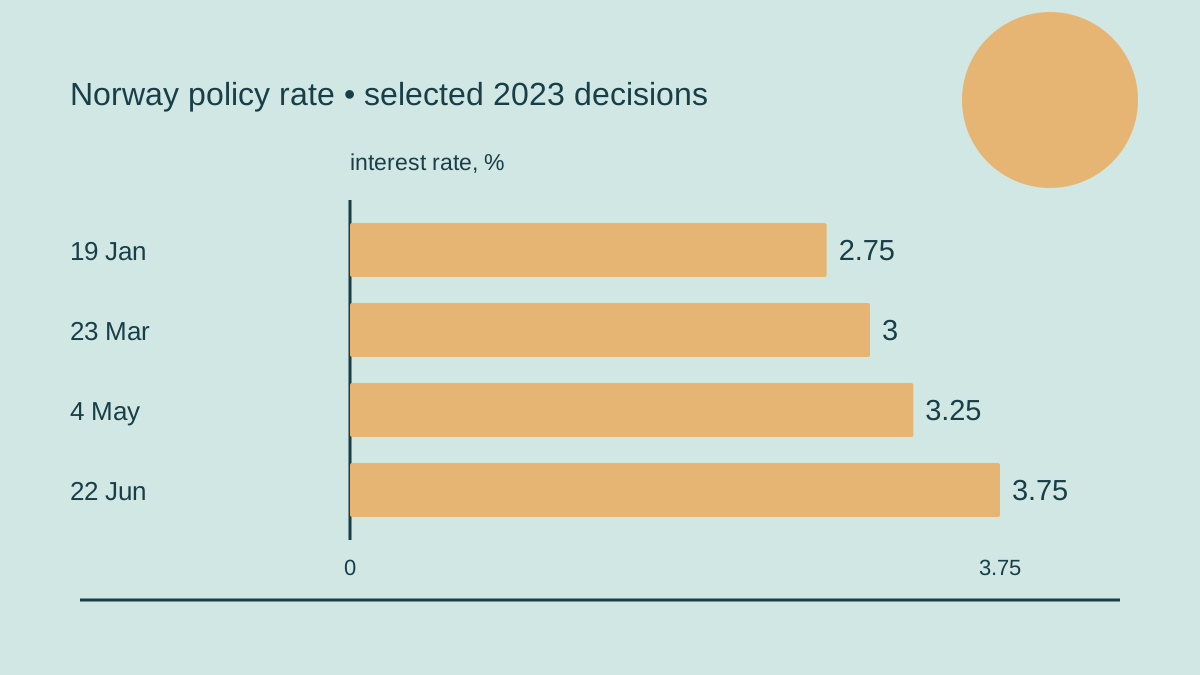
19 January 2023
The January 2023 decision left the rate at 2.75%. The committee reported sharply rising consumer prices, high economic activity and a tight labour market, while households were losing purchasing power to inflation and interest costs. Its assessment balanced a labour market tighter than previously projected against prospects for lower energy prices and easing global inflation pressures. Because earlier increases were already restraining activity, the bank considered a more gradual pace appropriate. Governor Ida Wolden Bache nevertheless signalled that another increase would most likely follow in March, depending on economic developments.
23 March 2023
In March, the committee raised the rate to 3%. Energy prices had fallen substantially and consumer inflation was below the December projection. Yet unemployment was also lower than expected, and the bank judged that the economic slowdown would be less pronounced. Higher prospective wages and a weaker krone shifted its inflation outlook upward. The published path pointed to roughly 3.5% during summer, with another increase likely in May. The bank explicitly linked a higher path to persistent domestic pressure or currency weakness, and a lower path to faster disinflation or rising unemployment.
4 May 2023
The May increase brought the rate to 3.25%, with the committee expecting another step in June. Its assessment described slower economic growth alongside still high activity and a tight labour market. Wage growth was expected to exceed the previous year’s rate. Activity and underlying inflation had evolved broadly as forecast in March, but depreciation of the krone and stronger wages were expected to sustain price pressure. Bache said a currency weaker than projected, or continuing economic pressure, could require a higher rate than envisaged earlier. The statement retained the 2% inflation target.
22 June 2023
June produced a larger, half-percentage-point increase to 3.75%. Inflation had substantially exceeded the March projection, international interest rates had risen more than expected, and wages and the exchange rate added to the pressure identified by the bank. Bache attributed the larger step to the risk that rapid price and wage increases would make inflation entrenched and more costly to reduce. The revised forecast pointed to 4.25% during autumn. At the same time, the committee acknowledged that earlier increases had not yet shown their full effects and that the impact on household consumption remained uncertain.
17 August 2023
August’s quarter-point increase took the rate to 4%. The committee reported that economic developments broadly matched the June assessment: activity remained high and labour supply was tight, while monetary restraint was beginning to ease pressure in the economy. Consumer inflation had edged down but remained well above target, and underlying inflation was elevated. Bache signalled a further increase in September if developments followed the expected course. The bank maintained alternative conditions for that path: a weaker krone or persistent pressure could require more tightening, whereas a sharper slowdown or faster disinflation could justify less.
21 September 2023
September’s decision raised the rate to 4.25%. The bank’s updated path suggested around 4.5% through 2024, with one additional increase most likely in December. The committee connected persistent inflation to the substantial accumulated rise in business costs and a labour-cost outlook stronger than previously projected. It also reported slower growth while labour conditions remained tight. Its statement placed two considerations together: prolonged inflation could become entrenched, but the earlier rapid increases were already restricting activity. Bache said tight policy would probably need to remain in place for some time, rather than promising an early reversal.
2 November 2023
November interrupted the increases with a hold at 4.25%. Since September, inflation had fallen more than expected and activity was somewhat below projection. A weaker krone, however, could sustain inflation. The committee judged the rate close to the level required and said this gave it more time to assess the need for another increase. Bache still expected a December rise, but allowed a hold if the bank became more confident that underlying inflation was declining. No new forecasts were prepared for November; the next full report was scheduled alongside the December decision.
14 December 2023
December’s increase established a 4.5% rate. The bank saw a cooling economy and inflation below its previous expectation, but still substantially above target. High business costs, prospective wage growth and further krone depreciation remained obstacles to disinflation in its assessment. The new path kept the rate around that level until autumn 2024 before a gradual decline. Bache said the increase reduced the risk of inflation staying high for a long period. The committee balanced incomplete transmission of earlier increases against continuing price pressure, retaining both further tightening and earlier easing as conditional possibilities.
2024
25 January 2024
January 2024 opened with the rate unchanged at 4.5%. Underlying inflation had declined further, unemployment remained low and economic growth was weak. Inflation and activity broadly matched the December projections, while the krone was stronger than expected. The committee considered the existing rate sufficient to return inflation to target within a reasonable horizon. It nevertheless cited high wage growth and the previous year’s currency depreciation as forces likely to slow disinflation. No new forecast was issued, and the bank kept the option of an earlier reduction if activity weakened or inflation fell faster.
21 March 2024
The March hold retained the 4.5% rate and a forecast of gradual reductions after autumn. Compared with December, activity was higher and inflation lower than expected. The committee warned that an early reduction could prolong inflation, including through a weaker krone, but that excessive restraint could suppress activity unnecessarily. Its projections put inflation near 2% towards the end of 2027 and anticipated a slight unemployment increase, smaller than previously expected. Differences between industries featured in the risk discussion. The path was therefore presented alongside changing sector conditions, cost growth and exchange-rate risks.
3 May 2024
May’s decision again kept the rate at 4.5%, but the committee said the information could justify restrictive policy for longer than previously envisaged. Inflation had been slightly below the March projection. In contrast, activity was slightly stronger, wage growth could be higher, foreign interest-rate expectations had increased and the krone was somewhat weaker. These developments formed the bank’s assessment ahead of a new June forecast. Bache continued to describe the current rate as likely to persist for some time. The bank issued no new projections at this meeting, reserving its fuller update for June.
20 June 2024
The June forecast moved the prospective start of reductions further out: Bache said the rate would remain at 4.5% until year-end if the economy followed the expected course. Inflation had been slightly below the March forecast and unemployment had increased as expected. Yet Regional Network businesses reported improved prospects, and wage growth appeared likely to be higher. The committee judged those developments capable of lifting future inflation above the earlier projection. It still expected inflation near 2% towards the end of 2027, while economic growth would pick up slightly and unemployment edge higher.
15 August 2024
August retained the rate at 4.5% without a new forecast. Inflation was below the June projection, unemployment a little higher and international rate expectations lower. The krone, however, had depreciated beyond the assumed level. The committee gave particular attention to the exchange rate and its potential inflation effects. It maintained that considerable past business-cost increases could slow further disinflation, despite the reduction from peak inflation. The next forecast was due in September. Its statement again weighed the risk of a premature reduction against the risk of unnecessarily restraining an economy already recording low growth.
19 September 2024
September’s hold included a forecast for reductions from the first quarter of 2025, with a slightly faster decline during that year than the June path. Inflation had been lower than expected and international rates appeared to be falling faster. The krone had depreciated, while labour-market developments broadly matched projection. Bache said the time for easing was approaching but maintained that the rate should remain unchanged for a period. The committee anticipated slightly stronger future growth and higher unemployment. Inflation was still forecast to approach 2% towards the end of 2027, subject to wage and currency developments.
7 November 2024
November left the rate unchanged, with Bache expecting 4.5% through the end of 2024. The committee judged that the overall outlook had not materially changed since September. Inflation had slowed faster than expected over the preceding year and September’s reading was below projection. Against this, international rate expectations had increased and the krone was a little weaker than assumed. The September plan for gradual reductions from early 2025 remained the reference forecast. No new projections were prepared; the bank expected a fuller set of information before the December meeting and its accompanying report.
19 December 2024
December narrowed the expected timing: the committee said a reduction would most likely come in March 2025. It held the rate at 4.5% as activity appeared stronger than projected, while inflation pressures seemed slightly more subdued. The new path envisaged smaller reductions in later years than September’s forecast. Inflation was projected to remain slightly above 2% at the end of 2027, and unemployment to increase somewhat less than previously expected. The committee discussed higher international trade barriers, judging their impact on global growth negative but their implications for Norwegian price prospects uncertain.
2025
23 January 2025
The January 2025 hold repeated the expectation of a March reduction. Underlying inflation and unemployment were broadly as projected in December, and headline inflation was lower. Fewer cuts abroad were now expected, providing a different international backdrop from the previous assessment. The committee continued to see the start of easing as near, while warning that accumulated business-cost growth could sustain inflation. It discussed the risk that higher trade barriers would weaken global growth, without assigning a certain direction to their effect on Norwegian prices. New forecasts were deferred to the March meeting.
27 March 2025
The March decision did not deliver the anticipated reduction. The bank held at 4.5% after inflation increased substantially beyond expectations and the previous year’s wage growth exceeded projection. Bache said an early cut could let prices continue rising rapidly. The revised path pointed to 4% by year-end and inflation close to 2% towards the end of 2028. Although activity had fallen below expectations late in 2024, Regional Network businesses reported improvement during winter and unemployment was lower than projected. The committee consequently maintained restraint for longer than it had previously signalled.
8 May 2025
In May, Deputy Governor Pål Longva presented another hold at 4.5%. Domestic developments broadly matched March’s assessment, but trade barriers had become more extensive. The committee described opposing influences on its rate outlook: weaker global growth prospects, lower oil prices and expectations of more foreign cuts on one side, and a krone weaker than assumed on the other. It still expected a reduction during 2025 and judged inflation above target. No fresh forecasts were prepared. The bank would receive additional information before June, when the next monetary policy report was due.
19 June 2025
June finally brought a quarter-point reduction to 4.25%. The committee reported underlying inflation falling somewhat faster than expected and a lower inflation outlook for the following year. It described the move as cautious normalisation while policy remained restrictive. Its path declined to just below 4% by the end of 2025 and approximately 3% towards the end of 2028. Bache also projected average residential mortgage interest from 5.6% to 4.6% over that horizon. She did not foresee a return to borrowing costs typical of the decade before the pandemic.
14 August 2025
The August meeting held at 4.25% after June’s cut. Oil prices had fallen, but the krone was slightly weaker than assumed. The committee judged the overall outlook broadly unchanged and said continued normalisation would probably be appropriate. Bache described June’s forecast as indicating one or two additional reductions during the year. The bank issued no new forecast and retained the previous conditional path. Inflation still exceeded target, and the committee said it was balancing the risk of cutting too quickly against unnecessarily restraining an economy with output already close to its potential.
18 September 2025
September reduced the rate again, to 4%, while raising the forecast path relative to June. The committee reported stronger 2025 growth than previously projected and less spare capacity. Inflation had followed expectations, but was now expected to remain elevated slightly longer. It considered holding the rate before deciding a cautious reduction was appropriate. Bache said subsequent cuts would probably be slower than envisaged before summer. The new path suggested a rate somewhat above 3% towards the end of 2028, and was consistent with one reduction per year over the following three years.
6 November 2025
November kept the rate at 4%. The committee reported no information indicating a material shift from September’s outlook. Underlying inflation had been close to 3% for some time, unemployment had increased somewhat and capacity utilisation had declined to a normal level. Bache said the bank was not in a hurry to reduce rates further. September’s path, consistent with one annual cut over three years, remained the reference. The committee again made future easing conditional on inflation and labour conditions, with faster disinflation or a weaker labour market potentially permitting faster reductions.
18 December 2025
December’s hold retained the 4% rate and a forecast broadly unchanged from September. A weaker krone raised prospective inflation, while a little more spare capacity pushed in the opposite direction in the committee’s assessment. The path was consistent with one or two cuts during 2026 and a decline to somewhat above 3% by late 2028. Average mortgage interest was projected just above 4.5% at that horizon. Bache stressed that large reductions were not expected. The committee continued to anticipate inflation close to target in 2028, conditional on gradual easing in wage growth.
2026
22 January 2026
January 2026 kept the rate at 4% and still anticipated further easing during the year. The committee judged that the outlook had not materially changed from December, whose path implied one or two reductions. Bache observed that inflation excluding energy had remained close to 3% since autumn 2024. Capacity utilisation was near normal and unemployment had increased somewhat. The bank continued to describe policy as restrictive and to warn against hurried cuts. Geopolitical uncertainty featured in its assessment, but it deferred new projections until March rather than announcing a revised rate path.
26 March 2026
March changed the direction of the forecast without immediately changing the 4% rate. Inflation had substantially exceeded projection, wage growth was expected to be higher and energy markets had become volatile during the Middle East war. A stronger krone was expected to restrain imported inflation. The committee wanted more information about underlying price pressure, but judged tightening likely at a forthcoming meeting. The revised path indicated 4.25%–4.5% by year-end, with inflation returning to 2% in 2029. Registered unemployment was expected to edge higher as tighter policy cooled the economy.
7 May 2026
May put the reversal into effect, raising the rate from 4% to 4.25%. Bache said recent inflation information supported March’s analysis. The committee reported March consumer inflation of 3.6%, while the measure adjusted for tax changes and excluding energy remained at 3%. The manufacturing wage-settlement norm was close to the bank’s projected overall wage growth. A stronger-than-assumed krone would restrain imported prices, but external price pressure appeared slightly greater than expected. Employment continued increasing, registered unemployment was unchanged and survey-based unemployment had risen slightly. No new forecast was prepared for this meeting.






Leave a comment