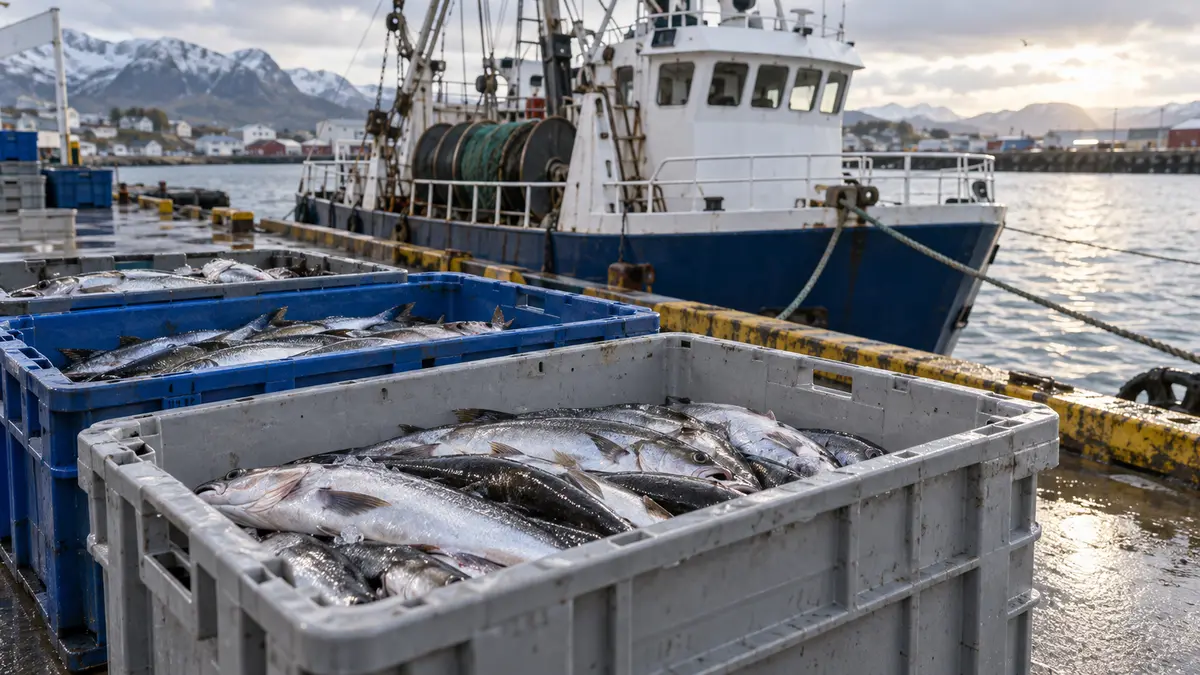
Russia caught 4.7 million tonnes of fish in 2025, below the preceding year, while export revenue increased almost 20%, Interfax reported on April 8, 2026, citing Deputy Prime Minister Dmitry Patrushev. These measures describe different results. Earlier reports reveal how species, fishing basins and reporting periods shaped the national picture.
The 2024 starting point
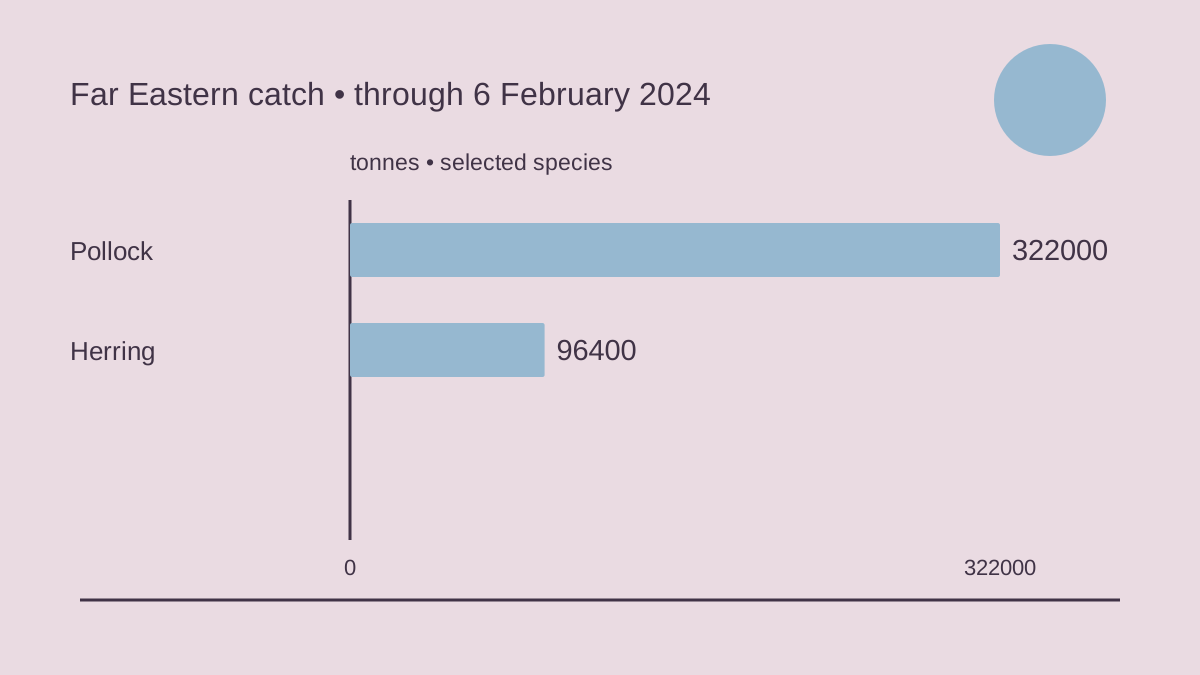
The early 2024 record began with growth concentrated in particular basins. A February 7 agency report put the national catch through February 6 at 516,600 tonnes, 14% above the corresponding date a year earlier. The Far East accounted for 465,000 tonnes, with pollock at 322,000 tonnes and herring at 96,400 tonnes. The agency identified the Far Eastern and Azov–Black Sea basins as the sources of positive momentum. Its figures describe the season’s opening, when the location and composition of catches already mattered alongside the national total.
Export coverage requires a separate starting point. On February 12, 2024, the agency reported preliminary exports for 2023 of 2.2 million tonnes, up 12%, excluding trade outside customs jurisdiction. Frozen fish represented 76% of the reported export mix; fillets and other fish meat accounted for 9%, and non-food meal and pellets for 6%. Pollock was the principal exported species. This statement establishes both product composition and a statistical boundary. Its total cannot be treated as interchangeable with an export figure covering transactions beyond that stated customs scope.
- Customs coverage limits comparisons.
By March 28, 2024, the national catch had reached 1.38 million tonnes. The Far Eastern basin supplied 1.15 million tonnes, 6.7% more than a year earlier, with gains in pollock, flatfish and herring. The Northern basin reached 134,000 tonnes, an increase of almost 14%. Within that basin, capelin more than doubled, crab rose 79%, and flatfish tripled. The agency’s account therefore described growth through several species and regions. A rising national figure was accompanied by a varied composition of gains, rather than the same proportional movement in every fishery.
The August 27, 2024 report used an explicit monitoring cutoff: August 26. By then, national catches exceeded 3.42 million tonnes. The Northern basin contributed 344,000 tonnes, including 183,700 tonnes of cod and 51,700 tonnes of capelin. In the Far East, herring reached 313,800 tonnes, while iwashi sardine catches in Russian exclusive economic-zone waters were 164,600 tonnes. More than 335,700 tonnes came from foreign economic zones, convention areas and the open ocean. These geographical categories preserve where the catch occurred, making the basin and external-water totals parts of the same monitoring record.
The October 29, 2024 update combined catches with a logistics snapshot. National extraction exceeded 4.2 million tonnes, including 3,209,700 tonnes in the Far Eastern basin. Iwashi sardine catches in Russian exclusive economic-zone waters reached 402,400 tonnes, while the Northern basin recorded 388,400 tonnes across its fisheries. Separately, the agency counted 32 vessels approaching Primorye ports on October 26 with 21,701 tonnes of fish products aboard. The cargo observation describes material moving toward port at one moment; it is a transport measure within the wider fishing year, with its own explicit date.
A new fishing season
The opening of 2025 showed how an overall increase could coexist with falling catches in individual fisheries. An Interfax report republished by the agency on January 17 used a January 13 cutoff: total catches were 157,800 tonnes, up 2.8%. Far Eastern herring reached 47,700 tonnes, increasing by 18,800 tonnes, but pollock declined by 9,100 tonnes to 86,200 tonnes. The Northern basin fell to 7,400 tonnes. Growth in the headline total therefore contained differences between species and basins from the beginning, rather than establishing a uniform direction for the season ahead.
Fleet operating conditions
The March 6, 2025 pollock report added operating conditions to the catch record. Through March 4, Far Eastern fishers had taken 574,200 tonnes of pollock, with more than 423,000 tonnes in the Sea of Okhotsk, where 80 vessels were fishing. Pacific herring catches reached 133,500 tonnes. The agency said transport and refrigeration capacity met fishing needs; 36 vessels approaching Primorye carried more than 41,000 tonnes of products. It also warned of storms and icing risks. The same dated account thus placed extraction alongside handling capacity and the weather conditions under which the fleet worked.
The March 13, 2025 national report put cumulative catches at 1,036,600 tonnes. The Far Eastern basin contributed 872,000 tonnes, including 660,500 tonnes of pollock and 136,800 tonnes of Pacific herring. The Northern basin recorded 61,400 tonnes. Smaller basins also had distinct movements: the Western basin increased 8.3% to 19,500 tonnes, while the Volga–Caspian basin rose 17.6% to 17,700 tonnes. These basin totals show where fishing activity was accumulating. Their percentage gains belong to the named regions, whose absolute contributions remained very different in the national monitoring account.
The March 26, 2025 update reached a cumulative national total of 1,275,700 tonnes. Pollock alone accounted for 833,100 tonnes in the Far Eastern basin, whose full catch was 1,067,300 tonnes. Northern catches were 77,700 tonnes, including 54,700 tonnes of cod and 12,100 tonnes of haddock. The agency separately reported 69,600 tonnes from foreign economic zones, convention areas and the open ocean. This observation expands the geographical record beyond domestic basins. Each component retains its stated coverage, allowing the source’s national, regional and external-water figures to be read together without treating them as equivalent categories.
Support and research
Policy support entered the record on April 8, 2025. Interfax reported agency head Ilya Shestakov’s statement that funding earmarked for the year exceeded 40.2 billion rubles, compared with more than 32.4 billion rubles allocated in 2024. The expenditure categories covered regional support, infrastructure, artificial reproduction, resource conservation, science and rescue-vessel repairs. Shestakov also called for careful analysis of forecasts and fishing organization following the previous year’s weak salmon season. The announcement describes planned public resources and priorities; its funding amount does not by itself measure money spent or additional fish harvested.
A separate April 8, 2025 Interfax account described the export and research agenda. Fish export value had declined to $5.2 billion in 2024 from $5.8 billion in 2023. Patrushev reported 1.9 million tonnes shipped abroad in the later year and called for wider market access. He also pointed to almost a thousand research expeditions during 2024 and 2.2 billion rubles allocated to the Great African Expedition. Research was presented as a route toward understanding and developing fishing opportunities. The reported allocation and expected recommendations establish an intended programme, rather than a measured increase in commercial catches.
By the April 23, 2025 report, cumulative national catches were 1,711,000 tonnes. The Far Eastern basin reached 1,399,900 tonnes, including 1,040,100 tonnes of pollock and 229,900 tonnes of Pacific herring. The Northern basin total was 107,700 tonnes. Fishing in foreign economic zones, convention areas and the open ocean supplied 120,400 tonnes, 42.3% above the corresponding period a year earlier. The report places growth outside domestic basins beside the much larger Far Eastern contribution. It also keeps the location of extraction visible within the national total at this stage of the year.
Fleet renewal also involved rebuilding existing vessels. On April 28, 2025, the agency described the modernised small seiner-trawler Nikolai Nechai, handed to the Marfish group. Work included a replacement main engine, greater electrical capacity, a changed bow, new accommodation and an onboard processing workshop. The vessel received new fishing and lifting equipment and a revised trawling arrangement. Its design provided for catches of up to a thousand tonnes per month. That figure describes projected capability: the announcement documented an engineering handover, without reporting a month of commercial catches achieved by the rebuilt vessel.
- Design capacity precedes recorded performance.
The May 20, 2025 monitoring account recorded national catches of 1,936,300 tonnes. Far Eastern extraction was 1,518,000 tonnes, including 1,095,100 tonnes of pollock and 245,000 tonnes of Pacific herring. Northern catches reached 132,200 tonnes; within that basin, haddock increased by 1,300 tonnes to 22,800 tonnes. Foreign economic zones, convention areas and open-ocean fishing contributed 179,300 tonnes, up 12.4% against the corresponding 2024 period. This report again identifies growth within particular components. A basin total, one species’ increase and the external-water comparison each answer a different question about the season’s progress.
Summer species shifts
The June 27, 2025 salmon report used a different comparison year. Through June 23, catches exceeded 6,900 tonnes against 4,300 tonnes in 2023, an increase of 2,600 tonnes. Kamchatka contributed 2,500 tonnes, while Primorye supplied 2,200 tonnes. Pink salmon and sockeye led the species breakdown. Strong pink-salmon runs prompted a 9,100-tonne adjustment to the Primorye forecast. The adjustment belonged to the expected catch, whereas the regional figures described fish already taken. Reading the report therefore requires keeping both the historical comparator and the distinction between an updated forecast and a realised result.
By the July 8, 2025 account, cumulative national catches were 2,498,400 tonnes. The Far Eastern basin supplied 1,894,700 tonnes, including 1,315,400 tonnes of pollock and 274,600 tonnes of Pacific herring. Herring was 6,000 tonnes ahead of the corresponding 2024 level. Northern haddock increased by 3,200 tonnes to 33,300 tonnes. The Azov–Black Sea basin rose 47.3% to 24,200 tonnes. The figures display the difference between a large contribution to total extraction and a fast regional growth rate: the percentage increase belongs to a basin whose tonnage is explicitly stated alongside it.
The agency’s July 11, 2025 industry overview moved from catches to construction and exports. It reported more than 40 modern fishing vessels and 27 processing plants built under the modernisation programme. Exports in January–May reached about 975,000 tonnes, up 4%, with value of $2.4 billion, up 13%. The agency described increased processing of export products as a result of the reform. That interpretation remains its stated assessment. The reported export period covers five months, and its physical volume and monetary value are separate measures within the agency’s account of industrial change.
- Export volume and value differ.
The July 23, 2025 monitoring update put national catches at 2,795,900 tonnes. Far Eastern catches reached 2,138,400 tonnes, with pollock at 1,405,500 tonnes and Pacific herring at 299,900 tonnes. Herring exceeded the corresponding 2024 volume by 24,700 tonnes. The Northern basin supplied 209,500 tonnes, including 118,600 tonnes of cod. Fishing in foreign economic zones, convention areas and the open ocean produced 305,800 tonnes, up 12.7%. These dated totals locate the contributions geographically and by species. The comparisons apply to the particular component named, preserving the structure of the monitoring report.
The August 28, 2025 report estimated national catches at about 3,379,500 tonnes. Far Eastern extraction reached 2,619,900 tonnes. Pollock stood at 1,593,400 tonnes, 9,800 tonnes above the corresponding 2024 level, while Pacific herring reached 372,200 tonnes, ahead by 58,700 tonnes. Northern catches were 239,000 tonnes. External-water fishing exceeded 362,800 tonnes, increasing 8.9%. The species figures make clear that even within the largest basin, the absolute increases differed substantially. The national estimate and its component comparisons describe the stage recorded in this late-August publication, with the year still under way.
Processing and export measures
The September 10, 2025 agency report discussed products rather than fishing basins. By mid-August, exports exceeded 1.3 million tonnes, up 5%, while export value rose 12%. Fillet shipments reached 104,000 tonnes, increasing 16%. The agency linked higher revenue to products with greater added value and described factory vessels and shore plants producing fillets, mince, steaks and canned goods. This is an attributed explanation of industrial change. The figures establish different growth rates for export tonnage, value and fillets; they do not quantify how much of the revenue increase was caused by processing alone.
The September 11, 2025 monitoring report returned to extraction, estimating national catches at about 3,570,000 tonnes. Far Eastern catches were 2,768,200 tonnes, only 5,000 tonnes above the corresponding 2024 level. Within that basin, pollock increased by 46,100 tonnes to 1,687,300 tonnes and Pacific herring by 62,700 tonnes to 383,300 tonnes. Those species gains exceeded the basin’s net increase. The published figures therefore show why increases in selected fisheries cannot stand in for the overall regional result: the basin total incorporates other fisheries as well, each contributing to the combined balance.
The year-end outlook
An October 29, 2025 TASS report republished by the agency made the contrasting directions explicit. Shestakov forecast annual catches of about 4.7 million tonnes; catches so far exceeded 4 million tonnes, 4% below the corresponding 2024 period. He said pollock, herring and Far Eastern salmon were ahead, while Barents Sea cod and Far Eastern iwashi sardine were lower, citing stock biology and hydrology. This account supplied an attributed explanation for the divergent fisheries. Its annual number was still a forecast on that date, alongside a separately reported cumulative result and comparison.
A December 10, 2025 fleet announcement documented another industrial milestone. The Onega shipyard built the crab vessel Alexander Sapozhnikov for the Russian Crab group, and the national flag was raised aboard. The vessel was designed to catch and transport live crab, with a two-level hold and equipment monitoring water temperature, salinity and oxygen. Live-crab tanks had a volume of 440 cubic metres; the specified crew was 24 and autonomy 40 days. These particulars describe a vessel’s construction and technical provisions, while leaving its eventual commercial catch outside the results reported at delivery.
The December 16, 2025 monitoring report recorded cumulative catches of 4,492,900 tonnes. The Far Eastern basin supplied 3,468,700 tonnes, with pollock at 2,085,700 tonnes, up 153,800 tonnes, and Pacific herring at 551,300 tonnes, up 131,200 tonnes against the corresponding 2024 period. Northern catches reached 306,800 tonnes. External-water extraction was 488,200 tonnes, up 2.9%. These component gains remained visible near year-end. The publication was nevertheless an in-year monitoring point: its cumulative total describes the position reported in December, and retains a different time coverage from the completed-year figure announced the following April.






Leave a comment