Deployment figures and the national programme
The Ministry of Industry and Trade put Russia’s installed industrial robot stock at 21,857 for 2025, up 10.9%, Kommersant reported on 25 August 2026. Density remained 29 per 10,000 workers. Kept’s Nikolai Chernetsov cited investment delays, limited awareness and skills shortages. TeDo’s Roman Rufov cited his firm’s research identifying financing as a barrier for 89% of companies, insufficient expertise and integrators for 41%, and uncertain investment returns for 33%.
Four federal projects
A ministry programme explanation published in March 2025 placed robotics within the national project for production equipment and automation. Its four federal projects covered machine tools, industrial robotics and automation, foundry and thermal equipment, and the development of personnel and scientific capacity. Support extended to manufacturers of components and additive equipment as well as finished machines. The stated 2030 objectives included at least 95% technological independence in production equipment, staffing provision of at least 90%, and a position among the leading 25 countries by robot density.
Localised production and the product register
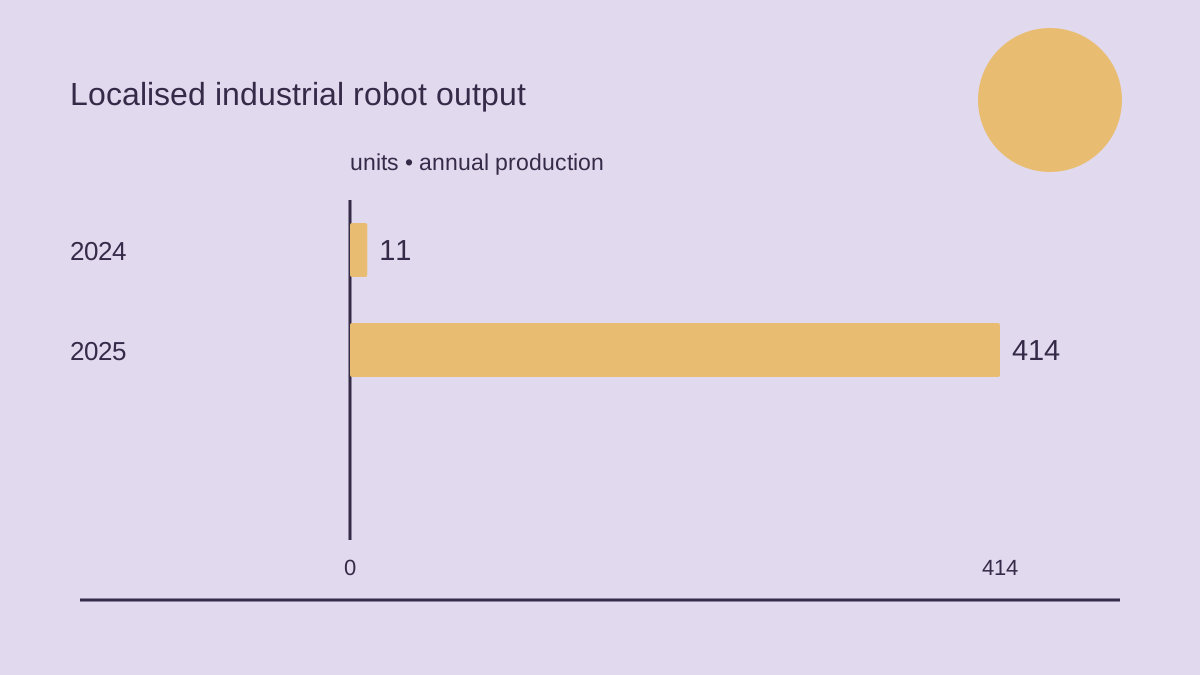
Deputy minister Mikhail Ivanov presented a separate measure at Data Fusion in April 2026: output of localised Russian industrial robots. Production reached 414 units worth RUB 2.33 billion in 2025, compared with 11 units worth RUB 60 million a year earlier. The industrial product register expanded from one model supplied by one manufacturer in 2024 to 16 models from five manufacturers at the end of 2025. Ivanov said more enterprises manufactured robots, but some had yet to reach the localisation criteria used for recognition as Russian industrial products.
Regional centres and adjustable funding
At Innoprom in July 2026, ministry department director Valery Piven said funding would support 13 additional robotics development centres that year and another ten in 2027. He described the centres as a mechanism for extending regional participation in robotisation. His rounded support-budget figures were RUB 10 billion for 2026, RUB 11 billion for 2027 and RUB 23 billion for 2028. Piven said the budget could be adjusted upward as industry demand grew. The Innopolis University centre, opened in 2024, was assigned the coordinating role for subsequent satellite centres.
Components and workforce programmes
The ministry’s June 2025 account of a St Petersburg economic forum discussion described work on common specifications for robot components. Ivanov said the ministry and manufacturers were preparing requirements around standard robot types and payloads, with the intention of making components more interchangeable. Chelyabinsk Forge and Press Plant chief Andrei Gartung outlined a group-wide plan to install more than 1,500 robots by the end of 2026. Gazprom Neft’s Anton Dumin also announced plans for an autumn launch of a corporate master’s programme in robotic industrial automation with Tyumen State University.
From grant selection to an agreement
A January 2025 report described the selection of a second federal robotics centre and a grant of at least RUB 183 million. Innopolis University director Iskander Bariev said the selection had finished, while the documents were still awaited. He also described the existing Innopolis centre’s activity: cooperation with 36 partners, 23 solutions under development and two intellectual property results. A shared equipment centre formed part of that infrastructure. The report therefore recorded a completed selection alongside an existing centre’s work, before the new recipient’s grant agreement was reported.
Promobot’s grant agreement
The ministry’s March 2025 account of a Perm regional meeting recorded a subsequent contractual step. Ruslan Akhmedov said Innopolis University had signed a grant agreement with Promobot in February to establish a robotics development centre at the company. Federal funding was to support personnel training, reverse engineering, automation solutions and high-precision prototyping. Innopolis, acting as programme operator, would monitor achievement of the centre’s targets. The announcement identified the recipient and planned functions of the funded centre, alongside the ministry’s broader work on regional technological infrastructure.
How centre activity was to be recorded
The monitoring rules dated 6 June 2025 specified reporting at six, nine and twelve months, supported by an annual activity plan and expert review. Their indicators addressed protected intellectual property, organisations purchasing centre services and eligible receipts. Intellectual property results and paying users were to be counted once under the applicable programme rules. Contracts and completion documents supported service records, while payments supported receipts. For relevant income, centre employees had to represent at least half of the performers. These provisions defined the documentation through which centre activity would be monitored.
Nizhny Novgorod’s selected project
In August 2025, a report on Nizhny Novgorod State Technical University named it as a recipient of RUB 295 million for a robotics centre. Its application ranked first among 28 submissions from universities and companies in 18 cities. Four projects were selected. The programme allocated RUB 1.1 billion for solutions, deployments and personnel preparation, with phased funding extending through 2027 and initial payments envisaged in 2025. The university planned a full-cycle research and production complex, engineering projects, and the development and commercialisation of domestic robotic solutions.
The university centre opens
The centre opened at the university on 23 June 2026. Its laboratories had domestic collaborative robots, laser-cutting machines and automated storage systems. Logistics robots were intended for testing warehouse and transport automation. Governor Gleb Nikitin said university and centre specialists would visit factories to identify suitable areas for robotic cells; the announced audit plan covered up to 15 plants annually. The university reported that the centre followed the methodology developed by Innopolis. Institute director Sergei Mantserov described the first phase as providing industrial access to equipment also used in student preparation.
Factory diagnosis and another centre selection
A December 2025 Nezavisimaya Gazeta report described the Federal Competence Centre’s factory diagnosis service. Following an application and agreement, specialists examined production on site and prepared recommendations; the process took approximately two months and was financed federally. Subsequent integration remained the enterprise’s responsibility. The same report recorded a November selection of further robotics centres at Tesvel in Samara, VPG LaserONE in Fryazino and Tomsk State University. The winners were to receive grants totalling RUB 208.3 million, extending the geography of the programme beyond its earlier selections.
A proposed engineering network
In January 2026, Association of Innovative Regions of Russia director Alexander Smekalin proposed a state engineering network to make integration services more accessible. He suggested using existing structures, including the Federal Competence Centre or the Agency for Technological Development. Smekalin argued that individual robots needed to fit into a digitised production chain and called support for engineering companies and integrators an important part of that task.
Measures proposed by the competence centre
A June 2026 account of an industry discussion attributed a proposed performance framework to Federal Competence Centre director Svetlana Gorchakova. She identified operation duration, downtime, productivity, quality and changes in employee tasks as relevant measures of robotisation. Gorchakova also described a sequence beginning with production diagnosis, followed by team formation and solution selection. Her presentation addressed the effects enterprises should measure alongside the installation of equipment.
Legislation under discussion
At a robotics meeting on 5 February 2026, State Duma deputy Sergei Morozov said a robotics bill was nearly prepared and would be submitted for public discussion that month. The ministry’s account described proposed rules across the lifecycle of robotic solutions, retaining human control and legal responsibility irrespective of autonomy. The outlined principles covered safety, personal data, support for developers and experimental legal regimes. Robotics Consortium chair Yevgeny Dudorov separately proposed incorporating robotic solutions into the design of new factories and said a submission to the ministry was planned.
A regional index of supply and demand
An April 2026 TASS report described a Technored study supported by the Federal Competence Centre. Researchers examined 54 regions and combined two measures: actual robotisation based on Rosstat data and recorded enterprise demand. The leading group comprised Kaluga, Samara, Moscow and Leningrad regions, St Petersburg, Tatarstan and Krasnodar Territory. VEB.RF’s account also described an industrial robotics incubator within Skolkovo’s GreenTech programme. Skolkovo representative Nikolai Bulatov said it connected industrial customers with domestic technologies and supported their further development through targeted grants and other mechanisms.
A new welding-cell production site
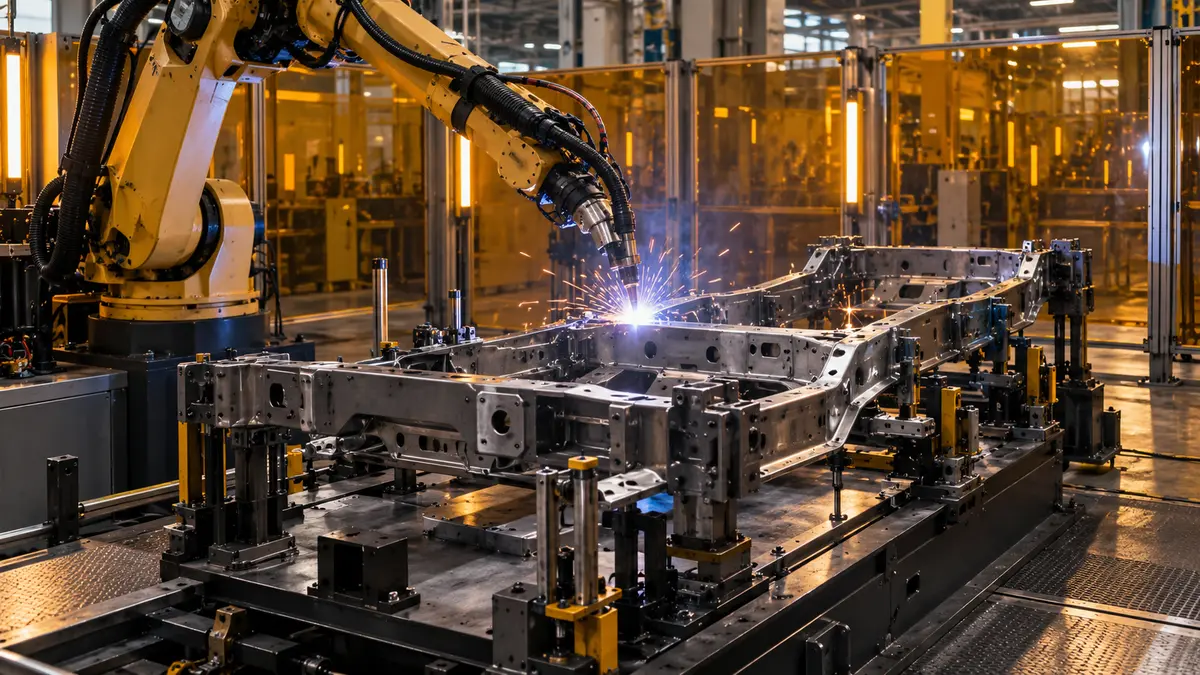
In May 2026, VR Robotics opened a production site in Nizhny Novgorod for Velam-Rus’s robotic systems. Investment exceeded RUB 100 million, and ten jobs were organised. The site’s design capacity was up to 200 robotic welding cells annually, alongside other industrial and collaborative robot solutions. It included a showroom where enterprises could examine equipment. Founder Alexei Smirnov said the company had delivered more than 100 industrial robots to customers in Russia and Belarus. He also outlined plans to train specialists at the new premises.
Chelyabinsk’s welding installations
An April 2026 regional industry report recorded 24 robotic complexes at DST-Ural, attributing a 60% acceleration in welding and a reject level of 1.8% to their use. Engineering Competence Centre director Gleb Tumanov said his company had completed more than 80 integration projects. At Chelyabinsk Compressor Plant, a welding complex used two independent zones for welding and preparation. ZEOTEK’s installation had three fixture sets covering approximately 30 products. The integrator also provided employee training and operated a certified training centre and a demonstration workshop opened in 2025.
Altai’s production projects
April 2026 reporting described robotised equipment across several Altai factories. More than half of Martika’s injection-moulding machines had robots removing finished products; a central raw-material feeding project was nearing completion. Tonar Plus reported three fully robotised production processes and preparation of another welding operation. At the Altai Tyre Plant, two automated chemical-component dosing lines entered service in early April. The company said eight operators now serviced work previously involving 16 employees, with released staff retrained for other sections. The dosing project began a modernisation programme scheduled through 2027.
Welding supports for nuclear equipment
Rosatom reported in February 2026 that ZiO-Podolsk had commissioned a welding robot for supports used in nuclear power plant heat-exchange equipment. Its 2026 programme envisaged 164 supports, each with approximately 80 welds. The company compared up to 16,000 standard labour hours for that volume before robotisation with up to 4,000 using the new equipment. ZiO-Podolsk was also a pilot site for production-flow audits under Rosatom’s production system. The engineering division had selected 30 robotisation projects expected to save approximately 500,000 standard labour hours.
Severstal’s scheduled installations
In October 2025, Vedomosti reported that Severstal planned RUB 500 million of robotics investment that year and completion of 16 projects in 2026. Fifteen robotic complexes had already operated at its enterprises since 2015. The programme included work around hazardous production processes. One application removed dross from molten metal at approximately 460 degrees Celsius, replacing manual handling with a 15-kilogram ladle. Another involved a demolition robot with a nine-metre reach. The company connected the programme with reducing employee exposure to difficult and dangerous operations at its production sites.
An integrator within Rosatom
A July 2026 account described AtomIntelMash’s development into an industrial robotics integrator after joining Rosatom’s structure in 2022. Commercial director Alexander Petrov said its work included factory audits and turnkey projects with a pool of nearly 50 integration partners. The company discussed development of controllers, reducers and motors and an objective of producing its own robot meeting domestic industrial-product requirements. The report also described a foundry application for a Roscosmos enterprise, with a claimed lifting capability of 1,200 kilograms. The product-development objective remained distinct from that reported integration project.
Funding a Perm production complex
At Innoprom in July 2025, the federal and Perm regional industrial development funds signed a financing agreement with Robotech. The federal fund would provide RUB 41.6 million and the regional fund RUB 4.6 million for a project worth RUB 58.6 million. The company planned a machining complex for robot components and additive printing installations, equipped with its own Russian-language software. Its printers were intended to produce sand-polymer casting moulds. The announcement identified UEC, MAZ and KAMAZ among prospective customers for the planned equipment and production capabilities.
Reported production openings and financial results
In April 2026, Kommersant reported Robotech’s financial figures for 2025: revenue of RUB 818 million, up 113% from RUB 383 million, and net profit of RUB 211 million. The company attributed growth to major automation projects and expanded production capabilities. It said it had opened industrial Binder Jetting printing, foundry and machining operations during 2025, adding mould printing, casting and machining services. Chief executive Alexei Paduchev outlined an intention to increase research and development spending in 2026, focusing on new robot models and improvements to additive installations.
Warehouse robots as a separate application
Rosnano presented Ronavi Robotics’ S30 logistics robot at Startup Village in May 2025. The company described a payload of up to 30 kilograms and a conveyor belt for loading and unloading parcels. Navigation used QR markers, with floor and platform configurations and a conveyor height adaptable to customer requirements. Rosnano also described a product range carrying loads of up to two tonnes. Ronavi’s offering covered internal transport, picking and sorting, from design through integration and service. These were warehouse applications presented alongside the wider industrial automation programme.
A laboratory for collaborative robot training
LETI and InduTech opened a collaborative robotics training centre on 13 March 2025 with support from the university’s Priority 2030 programme and advanced engineering school. The laboratory contained four domestically manufactured ROBOPRO collaborative robots. InduTech supplied teaching materials as well as equipment for learning robot programming and interaction. Vice-rector Sergei Galunin described provision for 16 continuing-education learners and plans to train more than 100 people annually. The university linked the centre with preparation of engineers and access to domestic robotic equipment within its educational and industrial partnership.
Online programmes announced in 2025
In September 2025, the Innopolis robotics centre announced another online training cycle.
- Its basic robotics course was scheduled for 15 September, educational robotics for 22 September, technical and technological audit methods for 30 September, and industrial robot programming for 6 October.
The audit course covered production readiness and selecting solutions for particular tasks. The centre described the programmes as serving specialists and educational organisations, combining basic and applied robotics knowledge. Registration was open when the announcement appeared; the published dates identified the planned starts of the four programmes.


Leave a comment