The ministry’s July market account
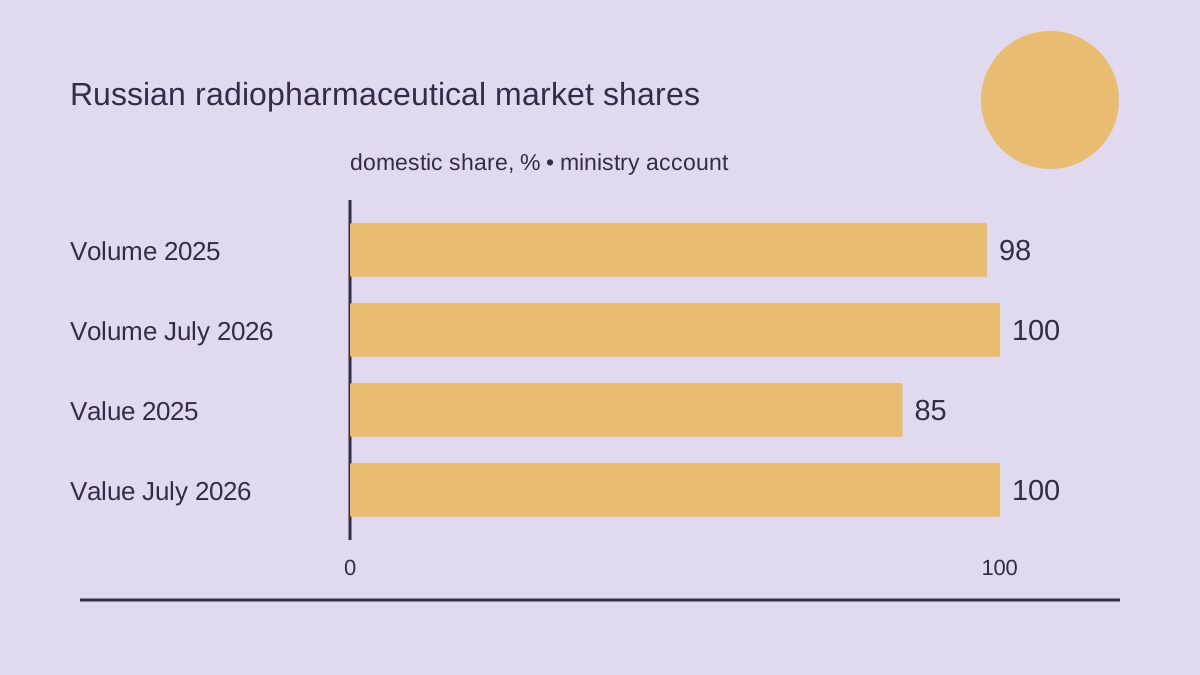
On 8 July 2026, Interfax reported Deputy Industry and Trade Minister Ekaterina Priyezzheva’s account of domestic radiopharmaceutical manufacturing. She said Russian products had reached 100 percent of the market by volume and value, compared with 98 percent of packages and 85 percent of value in 2025. The new Obninsk factory remained a planned opening. She also described most licensed manufacturers as operating full production cycles.
Obninsk’s original construction programme
Rosatom began construction in Obninsk, Russia, in January 2023. Interfax’s correspondent attended the foundation ceremony. Planned investment exceeded nine billion roubles, with twenty-one lines and an anticipated 2025 opening. The proposed range covered established iodine, samarium and molybdenum products alongside prospective lutetium, actinium and radium preparations. A separate atomic and medical technology park had an eighteen-billion-rouble investment portfolio for 2020–2026. That broader programme included research, medical-device processing and sterilisation infrastructure, in addition to the pharmaceutical factory. Its investment figure described the park’s portfolio rather than the individual plant.
Equipment installation and a revised launch schedule
An April 2026 Rosatom Science update described equipment installation at the Karpov Institute’s new Obninsk production building. Initial lines were expected by year-end, with full operation in 2028. The current scheme specified sixteen technological lines and one research line for finished medicines, active pharmaceutical substances and medical devices. Physicochemical and microbiological laboratories, vial sterilisation and packaging, liquid radioactive-waste handling and specialised ventilation formed parts of the design. The building would supply both finished preparations for clinics and active substances used as components in subsequent pharmaceutical production.
A development agreement links research and production
Tomsk Polytechnic University and Rusatom Healthcare signed a strategic cooperation agreement at the St Petersburg International Economic Forum in June 2022. The document covered innovative radiopharmaceutical development, preclinical research and marketing. Healthcare division head Igor Obrubov connected the agreement with the research base needed for a planned GMP pharmaceutical factory. Acting university rector Dmitry Sednev described long-term cooperation across radiation technologies.
Tomsk’s generator and laboratory foundations
At a March 2023 roundtable, Tomsk Polytechnic reviewed laboratory No. 31, founded in 1973. Its researchers had developed technologies and conducted preclinical studies for about twenty radiopharmaceuticals, with products at different registration and research stages. Consultant Viktor Skuridin reported thirty-two patents and more than 230 publications. The university had obtained a medical-device registration certificate for technetium generators and intended to begin production using a waste-free technology in 2024. Earlier work had produced an extraction-generator design and 1989 registrations for technetium and thallium preparations supplied to Tomsk clinics.
A cyclotron product serves nearby clinics
In December 2020, Tomsk Polytechnic reported the start of registered thallium-199 chloride production and deliveries to the Tomsk medical centre’s cardiology institute. Specialists irradiated a thin gold target with alpha particles in a cyclotron, producing the isotope for delivery in physiological solution. Daily preparation used packs with activities of 925 or 1,850 megabecquerels. Production manager Evgeny Nesterov identified a 7.4-hour half-life as a transport constraint. The university’s local medical infrastructure enabled regional use of this short-lived product, linking the accelerator and radiochemical preparation with a nearby clinical recipient.
Contract production for a registered microsphere product
A July 2020 university report described planned autumn production of yttrium microspheres at Tomsk’s research reactor. The Moscow industrial partner owned the technology and registration certificate, while the university would provide contract manufacturing. Nesterov said test deliveries to Moscow clinics had already occurred. The partner was negotiating supplies to Russian and European clinics. This arrangement assigned technology ownership and reactor production to separate organisations, with the commercial manufacturing start still ahead.
Sentiscan moves from validation to shipments
By October 2023, Tomsk Polytechnic reported 1,200 vials of Sentiscan produced during that year. Developed with the Tomsk oncology institute, the preparation used technetium-99m-labelled aluminium oxide for sentinel lymph-node imaging. Researcher Elena Stasyuk identified recipients in Tomsk, Moscow, St Petersburg, Tyumen, Vladivostok and Yuzhno-Sakhalinsk. Vladimir Chernov described production optimisation, validation, reproducibility checks and quality control completed before registration and serial production at the university reactor. Development had received Pharma-2020 and Priority 2030 support, with MedikorPharma-Ural participating as an industrial partner in the university’s broader product programme.
Shielded equipment supports a new lutetium route
- In September 2023, Tomsk Polytechnic had purchased shielded-box equipment costing approximately eighty million roubles, with commissioning expected by year-end.
- Its carrier-free lutetium-177 route irradiated ytterbium-176 oxide for a week, followed by radiochemical separation. The university described a mercury-free process reducing chemical treatment to four days.
- Installation in clean rooms would enable prospective production of up to one hundred therapeutic-isotope doses per cycle. Initial production would supply active pharmaceutical substance to clinics; finished preparations using targeting molecules required further development and registration before market entry.
Radium targets connect irradiation and separation sites
An April 2022 agreement envisaged irradiation of Mining and Chemical Combine radium-226 targets at Tomsk Polytechnic. The powder would be enclosed in aluminium containers and exposed to neutrons for several months. Shielded transport would return irradiated targets to the combine for separation into thorium, actinium and radium fractions. Radium would return to irradiation; thorium could undergo further enrichment towards thorium-229. University reactor director Artem Naimushin said theoretical calculations were complete, while transport systems, protective equipment and target preparation still required work over the following six months.
A patent records the separation technology
In February 2025, the Research Institute of Atomic Reactors in Dimitrovgrad announced a patent for separating radium, actinium and thorium in actinium-225 production. Researcher Pavel Butkalyuk described development and practical implementation, supported by the institute’s intellectual-property team during patent preparation. The work had received a Ministry of Industry and Trade research subsidy following competitive selection. The announcement concerned a production technology developed within the institute’s radionuclide sources and preparations department.
A terbium test batch reaches a research centre
The Institute of Reactor Materials in Zarechny announced development of terbium-161 production technology in December 2024. Isotop sent a test batch to the Granov radiology and surgical technologies centre in St Petersburg. The institute intended to develop a wider range of preparations from the radionuclide, while the recipient investigated potential applications. Deputy research director Andrey Stanzhevsky described preclinical studies, and institute director Evgeny Seleznev linked the work to access to domestic radiation technologies. Its starting material was gadolinium-160, produced by Rosatom’s Elektrokhimpribor plant.
Iridium sources require remote assembly and approval
In November 2024, the Zarechny institute had manufactured prototype iridium-192 sources for brachytherapy. A reactor-irradiated needle was placed inside a small capsule, with a specially manufactured cable welded to it. Manipulators performed assembly remotely in a hot cell. Radiation technologies head Denis Butakov said clinical testing would precede planned 2025 certification and medical-device registration. Market entry would follow the necessary permissions. The proposed production would supply clinics operating the Russian Brachium gamma-therapy system, linking a domestically assembled source with an existing equipment platform.
Registration is followed by a documented first delivery
Rosatom Science’s January 2026 update reported state registration and the start of supplies of a radium-223 preparation developed in Dimitrovgrad. The Federal Medical and Biological Agency’s radiology and oncology centre had worked with the local nuclear research institute. Isotop made the first delivery on 29 December 2025 to a Medscan clinic in Voronezh. The radionuclide was produced using the institute’s own technology.
The clinical partner visits the production infrastructure
In June 2025, a delegation led by acting clinical-centre director Andrey Belostotsky visited the Dimitrovgrad institute. The tour covered the SM-3 reactor and production areas for lutetium-177, iodine-131 and molybdenum-99. Participants discussed pharmaceutical technologies and joint radiological programmes. They also examined the future research opportunities associated with the MBIR reactor under construction. The meeting concluded with agreement to expand bilateral cooperation into additional areas, connecting the clinical centre’s research needs with isotope-production facilities and prospective experimental infrastructure.
An early trial precedes wider pharmaceutical development
A September 2020 Tomsk Polytechnic report described first-phase testing of a technetium-labelled ADAPT6 scaffold-protein preparation targeting HER2 receptors. The Tomsk oncology institute had enrolled twenty-nine patients during the preceding year. Researchers studied distribution and accumulation using scans at two, four, six and twenty-four hours after administration. The project, supported by a government megagrant, still required additional clinical phases and certification. Chernov said further investigations could take several years before access at other clinics.
A consortium investigates three diagnostic candidates
By November 2022, the Tomsk oncology clinic was investigating three scaffold-protein preparations for HER2-targeted breast-cancer diagnostics. The Engineering Health consortium connected Tomsk Polytechnic, the Tomsk medical centre and Siberian State Medical University with Moscow research organisations and Uppsala University in Sweden. Researchers sought to assess tumour distribution and molecular characteristics together, including differences between primary and metastatic lesions. Olga Bragina identified such heterogeneity as a research concern. Substitution of therapeutic isotopes remained a possible future direction, while the reported work concerned diagnostic candidates undergoing clinical investigation.
One targeting compound supports two development routes
Tomsk Polytechnic’s March 2025 update described patented BQ-PSMA preparations using technetium-99m for diagnosis and lutetium-177 for therapy. The compound was a urea derivative with affinity for the prostate-specific membrane antigen. Development included selecting candidate molecules, establishing synthesis and quality-analysis methods and devising isotope-labelling procedures. The diagnostic preparation had undergone a first-phase pilot study in 2023, followed by the therapeutic compound in 2024. Project head Roman Zelchan said direct comparative studies against foreign preparations were the next task, after the reported pilot work and patenting.
An alternative molecular target enters a pilot study
In November 2025, Tomsk Polytechnic described a different diagnostic candidate combining technetium-99m with the DB8 peptide, a GRPR antagonist. Its first-phase study at the Tomsk oncology institute enrolled sixteen patients. The investigators monitored imaging, vital functions, laboratory results and possible adverse events. The collaboration included Uppsala University, Siberian State Medical University and Greece’s Demokritos research centre. Chernov presented GRPR targeting as a possible alternative or complement where PSMA expression was insufficient. The update concerned a small clinical study and parameters for further investigation of the new preparation.
A replacement supplier restores weekly iodine-drug deliveries
Weekly deliveries of iodine-123 MIBG to Moscow clinics resumed on 25 July 2024 after raw-material production there had stopped for technical reasons in early 2023. The Granov centre became an alternative irradiation supplier, while the Khlopin Radium Institute manufactured the finished preparation. Isotop’s specialised transport delivered it weekly without additional processing at the receiving clinics. Institute director Konstantin Vergazov described this division of work between target irradiation and final-product manufacture. The short-lived iodine isotope made prompt delivery important within the restored supply chain, according to the institutions’ announcement.
Samarium supplies extend to the northwest
In August 2025, Isotop reported regular samarium-153 preparation deliveries to the Granov centre in St Petersburg, extending a service previously available in other federal districts. The centre reported twenty to twenty-four patients receiving it monthly. Starting material was irradiated in Leningrad nuclear station’s RBMK reactors, following production and logistics tests begun in 2024. The Karpov Institute manufactured the finished solution and raw isotope, with drug production dating to 2004 and chloride shipments to 2016. Commercial deputy director Anton Shargin identified the 46.5-hour half-life as a logistical constraint.
A generator programme supports Kyrgyzstan’s nuclear medicine
A May 2025 announcement outlined regular supplies of GT-5K technetium-99m generators and cold kits to Kyrgyzstan’s National Oncology and Haematology Centre in Bishkek. Isotop would supply products made by the Karpov Institute under the International Atomic Energy Agency’s technical-cooperation project to restore nuclear medicine in the country and its Rays of Hope programme. The generators supplied a diagnostic radionuclide used in single-photon emission imaging.
Brazil’s contract follows isotope qualification
In June 2021, Isotop announced a five-year contract with Brazil’s IPEN nuclear research institute for lutetium-177 and actinium-225. Monthly carrier-added lutetium chloride supplies followed registration of the Zarechny institute’s isotope and Brazilian sanitary regulator approval supporting subsequent DOT-IPEN-177 drug registration. Actinium test batches from Obninsk’s Physics and Power Engineering Institute had reached the Brazilian customer since October 2020 for quality and peptide-use evaluation. The relationship followed a 2017 agreement for molybdenum and iodine supplies, adding new isotope qualification and pharmaceutical-development work to the existing trading route.
A joint venture combines supplies and customer service
The Beijing CIAE-NIIAR isotope joint venture marked thirty years in April 2023. Its technical discussions covered planned 2023–2024 introduction of lutetium and actinium preparations for Chinese customers, alongside existing medical isotopes and industrial sources. Participants reported radium-product deliveries starting in 2022. They linked possible supply expansion from 2025 to successful SM-3 reactor modernisation in Dimitrovgrad. Deputy development director Andrey Shikunov described a full customer-service offering alongside product supplies. The meeting ended with a protocol confirming readiness to expand activities in Southeast Asia through the existing joint organisation.
Production methods meet regulatory and workforce questions
At the August 2025 Technoprom forum in Novosibirsk, Ekaterina Chaban identified GMP production, clinical-research regulation and specialist training as priorities for radiopharmaceutical development. Natalia Ayrapetova described the Obninsk institute’s proposed photonuclear method for actinium production, intended to increase quantities and achieve the required purity. These were attributed development objectives. Granov centre researcher Stanzhevsky discussed work on targeting compounds, synthesis into finished pharmaceutical forms and reducing toxicity.
A proposed platform covers purification and clinical transfer
During World Atomic Week in September 2025, Rosatom Science’s Sergey Surov proposed a multinational expert platform for terbium-based medicine. Its intended work covered isotope production, purification, pharmaceutical development and clinical transfer. The proposed term was three years with possible extension, joint activities and annual scientific publications. Surov called for multi-purpose, multicentre research. Stanzhevsky reported a stable terbium preparation at the Granov centre and plans for preclinical studies the following year. The discussion also addressed harmonising registration approaches and legislation across countries to support collaborative pharmaceutical work.
Training and bioequivalence remain industry discussion points
At the December 2025 nuclear medicine congress in St Petersburg, specialists discussed interdisciplinary radiopharmacist training and existing educational programmes. Rosatom Science adviser Irina Svyato proposed harmonising Russian professional classifications with international terminology and expanding exchanges with India. Production expert Vyacheslav Sukhov identified bioequivalence studies as an issue in developing domestic versions of registered preparations. He called for cooperation between pharmacologists, radiation-medicine specialists, oncologists and other clinicians.



Leave a comment