
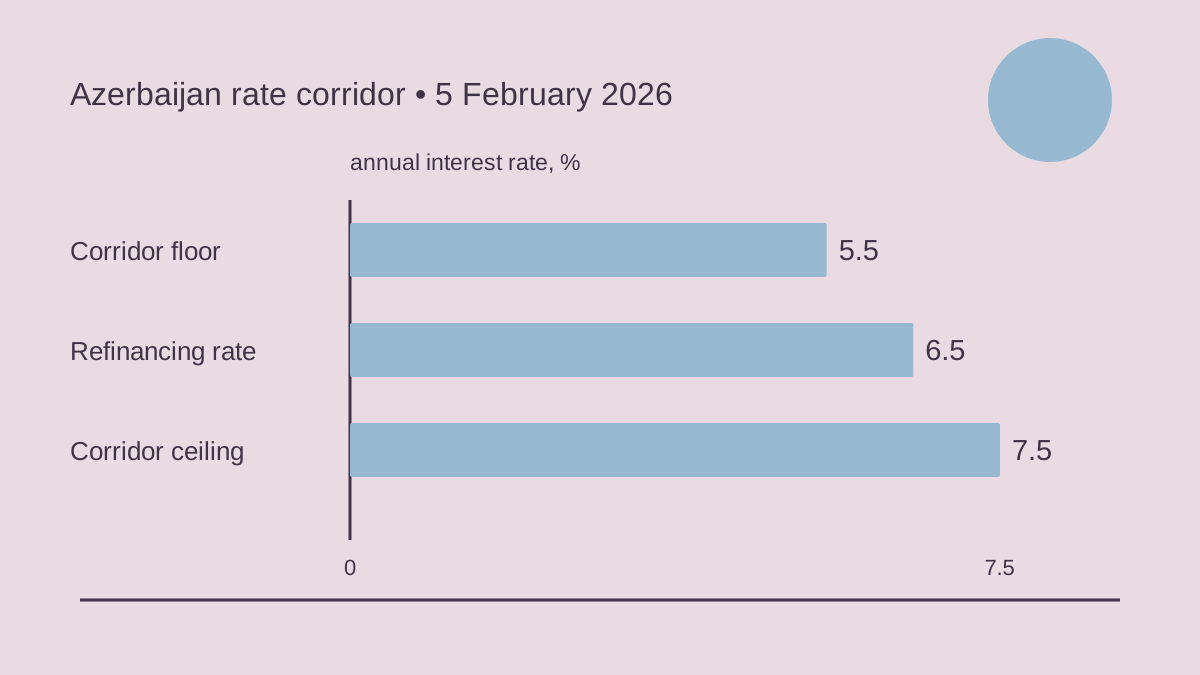
On 4 February 2026, Azerbaijan’s central bank cut its refinancing rate from 6.75% to 6.5%, Interfax reported. The corridor floor fell from 5.75% to 5.5% and the ceiling from 7.75% to 7.5%, effective 5 February. The report cited the bank’s inflation target of 4%, plus or minus two percentage points. Interfax said ING Group analysts had expected an unchanged rate.
Preparing a new framework
On 29 July 2022, the central bank kept its refinancing rate at 7.75%, with corridor limits of 6.25% and 9.25%. Its statement placed the new operational framework in the final preparation stage: standing facilities and a wider range of open-market operations were planned. June annual inflation was 14.2%, while average annual inflation was 12.9%; food prices had risen 20.6% over twelve months. The bank also reported that resident individuals' savings dollarization had fallen to 37.5%, three percentage points below the start of the year. Loan dollarization stood at 23%, down 2.8 percentage points over that period.
The 16 September decision again left the refinancing rate at 7.75%, with a 4% floor and 9.25% ceiling. The bank said the new operational framework had begun on 1 September. Demand for its standing deposit facilities was high amid surplus banking liquidity, and banks began maintaining reserves under revised ratios on 15 September. The new trading platform was already recording activity: twelve unsecured transactions worth 101 million manat had been completed during the elapsed part of September. August annual inflation was 14.2%, and annual core inflation was 12.1%. The bank attributed the principal inflation pressures to foreign cost factors.
On 28 October, the bank raised the refinancing rate by 0.25 percentage points to 8% and the corridor floor by one point to 5%, while keeping the ceiling at 9.25%. It connected the narrower corridor with improvements to the operational framework. September annual inflation had reached 15.6%, with a 3.1% monthly increase. From early October, sterilization operations used notes with maturities of one, three, six and nine months. Unsecured trading had produced 69 transactions worth 788 million manat in September; the elapsed October period recorded 124 transactions worth 1,426 million manat. These figures covered different reporting periods.
Tightening and reserve requirements
On 1 February 2023, the bank raised its refinancing rate to 8.5%, the floor to 6.75% and the ceiling to 9.5%, effective the following day. December annual inflation had been 14.4%, with food inflation at 19%. Banks were instructed to maintain required reserves under new norms from February. The statement also reported that average monthly consumer-loan portfolio growth had slowed from 2.3% to 1.6% after July 2022. The bank attributed this moderation to earlier reserve and prudential tightening. Its baseline forecast put annual inflation around 8% in 2023, conditional on the underlying assumptions remaining stable.
The 29 March decision raised the refinancing rate to 8.75%, the floor to 7% and the ceiling to 9.75%, effective 30 March. February annual inflation was 14.1%. Alongside the rate decision, the bank described changes in liquidity management. Required reserves maintained in manat were 371 million manat higher in March than in January, an increase of 57%. The quota for one-day standing deposit facilities had been expanded from 27 February, and seven-day repo operations had begun. The bank presented these measures as ways to regulate demand-driven inflation through monetary conditions. Its annual inflation forecast remained around 8%.
On 3 May, the bank increased the refinancing rate by 0.25 percentage points to 9%. The floor rose by 0.5 points to 7.5%, and the ceiling by 0.25 points to 10%; the changes took effect on 4 May. March annual inflation was 13.6%, including food inflation of 16.8%. The bank also widened eligibility to hold its notes: specified resident commercial legal entities in non-oil and non-government sectors could participate alongside banks, within limits. Financial and insurance businesses were excluded. The regulator said the broader investor base was intended to strengthen competition at auctions and support the short-term securities market.
Benchmarks and market participation
The 21 June decision held the refinancing rate at 9%, with corridor limits of 7.5% and 10%. May annual inflation was 11.5%, alongside monthly deflation of 0.4%. The statement described approval of regulations for calculating and publishing AZIR, the Azerbaijan Interbank Rate. Since May, the bank’s website had published weighted average rates, numbers and volumes for unsecured manat transactions between banks on the Bloomberg platform. The Baku Stock Exchange had also amended its repo-index rules to permit frequent publication. Non-bank legal entities owned more than 7% of outstanding central-bank notes, according to the regulator.
On 26 July, the bank again held the refinancing rate at 9%. June annual inflation had fallen to 10.6%, with food inflation at 11.5% and monthly deflation of 0.9%. The regulator announced revised differentiation of reserve requirements according to the size of corporate deposits. Banks were to calculate reserves under the new rules from July and maintain them from the period beginning 15 August. The bank said this approach was intended to reduce liquidity concentration and absorb excess funds. It also reported increases since January of 1.87 percentage points in one-day AZIR and 1.04 points in its one-week counterpart.
On 20 September, the bank held the refinancing rate at 9%. August annual inflation was 8%, and the monthly price decline was 0.4%, the fourth consecutive month of deflation. The statement reported an implementation result from the revised reserves: banks had begun maintaining them in August, absorbing an additional 350 million manat of excess liquidity. The regulator had also held 93 note auctions across different maturities during nine months. Its analysis linked tighter monetary conditions with increased manat savings and declining dollarization. The bank said subsequent policy decisions would consider the balance of domestic and external inflation risks and updated forecasts.
The turn toward easing
On 1 November, the bank cut its refinancing rate from 9% to 8.5%, with a 7% floor and 9.5% ceiling, effective 2 November. September annual inflation was 5.1%, and core inflation was 5.2%. The regulator reported that its sterilization portfolio, including manat required reserves and standing deposit facilities, had grown by 3.9 billion manat to 6.4 billion since the framework began in September 2022. October's one-week interbank repo rate was 8.38%, within the corridor. The bank linked the easing decision to changed inflation factors and excess foreign-currency supply, while retaining concern about excessive money-supply growth.
The 20 December decision lowered the refinancing rate from 8.5% to 8%, the floor to 6.5% and the ceiling to 9%, effective 21 December. November annual inflation had fallen to 2.6%, while prices declined 0.2% over the month. The bank said annual inflation had remained within its target band for three consecutive months. The current-account surplus for nine months was $6.7 billion, or 12.5% of GDP. During the elapsed part of December, one-day AZIR averaged 7.7% and the one-week interbank repo rate was 7.84%. The regulator identified excessive money-supply expansion as a domestic inflation risk.
Further cuts in 2024
On 31 January 2024, the bank cut its refinancing rate from 8% to 7.75%, the floor from 6.5% to 6.25% and the ceiling from 9% to 8.75%, effective 1 February. It reported annual inflation of 2.1% at end-2023. Household surveys showed that the share expecting higher inflation had fallen from 81% in the third quarter to 69% in the fourth. Currency purchases had added to banking liquidity, it said. The manat monetary base increased 19.6% in 2023, including a December contribution of 14.6 percentage points. The bank used monetary instruments to counter autonomous liquidity effects.
The 28 March decision reduced the refinancing rate from 7.75% to 7.5% and the ceiling from 8.75% to 8.5%, while leaving the floor at 6.25%. The bank said the unchanged floor was intended to optimize corridor width. February annual inflation was 0.8%, core inflation 1.4%, and food prices had declined 0.3% over twelve months. One-day AZIR averaged 6.52% during the elapsed part of March, compared with 6.29% in February. The statement retained a January forecast of 5.3% annual inflation for 2024, while indicating that subsequent analysis could lead to a downward revision. The rate changes became effective on 29 March.
On 1 May, the bank cut the refinancing rate from 7.5% to 7.25% and the ceiling from 8.5% to 8.25%, keeping the floor at 6.25%. It said maintaining the floor would help reduce volatility in interbank interest rates. March annual inflation was 0.4%, core inflation 1%, and annual food deflation 1.1%. The statement set out April forecasts of 3.5% inflation in 2024 and 4.2% in 2025, conditional on unchanged conditions. It also reported a first-quarter trade surplus of $2.3 billion and one-day AZIR of 6.66% during the elapsed part of April. The rate decision took effect on 2 May.
The 21 June decision held the refinancing rate at 7.25% and retained corridor limits of 6.25% and 8.25%. May annual inflation was 0.3%, core inflation 0.4%, and food prices had fallen 1.4% over twelve months. The bank said rising government-account balances, associated with the budget surplus, were reducing banking liquidity. One-day AZIR averaged 6.75% during the elapsed June period, compared with 6.88% in May. The regulator described inflation's upward and downward risks as balanced. Its assessment gave an elevated likelihood to another unchanged corridor at the next meeting, rather than announcing a future decision. The hold became effective on 24 June.
On 31 July, the bank held the refinancing rate at 7.25%. June annual inflation was 1.1%, with core inflation at 0.8%. Its updated baseline forecasts put inflation at 5.4% in 2024 and 5.5% in 2025 if conditions remained unchanged. The bank attributed the upward revision chiefly to slower expected appreciation of the manat's nominal effective exchange rate and changes in regulated prices and tariffs. It projected a 1.5-percentage-point direct and indirect contribution from regulated-price increases, including one point in 2024. These were forecast effects. The statement separately reported central-bank reserves of $11.7 billion and national strategic reserves of approximately $69.7 billion.
Currency operations and liquidity
On 18 September, the refinancing rate remained 7.25%. August annual inflation was 3.5%, with core inflation at 2.4%. The bank said foreign-currency demand at its auctions had been fully met over eight months. It envisaged possible currency sales later in the year to support government expenditures denominated directly in foreign currency, including COP29-related spending. Such operations would use currency acquired through purchases in 2022–2023. It reported that note volume fell 45.6% in eight months as government-account changes affected banking liquidity. August one-day AZIR averaged 7.28%, compared with 6.96% in July.
On 1 November, the bank held the refinancing rate at 7.25% and reported September annual inflation of 3.5%. It confirmed a special currency sale of $424 million in October to support government expenditures in foreign currency. It said the sales drew on currency purchased in 2023 and absorbed part of the money supply generated by earlier purchases. Central-bank reserves had declined by $241 million over ten months. October one-day AZIR averaged 7.48%, and the average volume of one-day unsecured transactions was 673 million manat. The regulator identified lending growth as a demand risk: total banking loans had risen 19.9% year-on-year.
The 18 December decision kept the refinancing rate at 7.25%. November annual inflation was 4.4%, with services inflation at 6%. The bank confirmed that planned currency sales had continued in November to cover one-time government expenditures; its reserves stood at $10.9 billion at November's end. It reported a $4 billion current-account surplus, equivalent to 7.2% of GDP, for nine months. The volume of central-bank notes had declined more than 4.6-fold during the elapsed year. One-day AZIR averaged 7.66% in November and 7.79% during the elapsed December period. The bank linked reduced liquidity absorption to changing government-account balances.
Treasury balances and market rates
On 22 January 2025, the bank held the rate at 7.25%, between corridor limits of 6.25% and 8.25%. December annual inflation was 4.9%, and core inflation was 4.4%. Its statement connected December budget spending with a 1.7% increase in base money. AZIR averaged 6.39% during the elapsed part of January. The bank reported that the volume of its notes had decreased 6.3 times during 2024, as government account movements influenced liquidity management. Under the January baseline and prevailing policy, it forecast annual inflation of around 5.5% in 2025 and 3.8% in 2026.
The 23 April decision kept the rate at 7.25%. March annual inflation was 5.9%, with core inflation at 4.5%. The bank described a specific treasury operation: on 11 April, the finance ministry auctioned available unified treasury account balances for placement in national currency at systemically important banks. According to the bank, this increased banking liquidity and lowered AZIR. The index averaged 7.68% during April’s first ten days and 7.21% during the second ten. The April baseline forecast put annual inflation at around 5.3% in 2025 and 4.3% in 2026, under prevailing policy.
Seven-day deposit operations
On 11 June, the bank again held the rate at 7.25%. April annual inflation was 6.3%, and core inflation was 4.8%. The statement announced an operational adjustment: seven-day repo operations had been replaced with seven-day deposit operations to improve liquidity absorption. It also reported approval of more advanced index calculation rules developed with European Bank for Reconstruction and Development experts. Over the first five months of 2025, unsecured market transaction volume was 1.6 times its year-earlier level, and transaction numbers were 1.8 times the year-earlier count. The bank said reduced external inflation uncertainty could permit a rate cut at the next meeting.
On 23 July, the bank cut the rate from 7.25% to 7%, lowering the corridor limits to 6% and 8%, effective the following day. June annual inflation was 6%, with core inflation at 4.8%. The bank linked easing to inflation forecasts matching the target and continued currency-market stability. Its July baseline forecast was 5.7% inflation in 2025 and 5.3% in 2026. The statement retained imported inflation and excessive domestic demand among risks.
- Unsecured market transaction volume had risen 26% during the first half of 2025 compared with a year earlier, while transaction numbers increased 55%.
The 10 September decision held the rate at 7%. July annual inflation was 5%, and core inflation was 4.6%. The bank reported that AZIR had averaged 6.97% in August and 6.98% during the elapsed part of September, with its gap from the refinancing rate reaching historical lows. Unsecured market transaction numbers rose 19% over the first eight months compared with a year earlier. Resident individuals’ savings dollarization fell to 29.3% in August, down 1.5 percentage points over twelve months. The bank attributed this decline to optimistic exchange-rate expectations and identified import prices as the principal external inflation risk.
Benchmark bonds and revised forecasts
On 22 October, the bank kept the rate at 7%, between a 6% floor and 8% ceiling. September annual inflation was 5.7%, and core inflation was 4.9%. The statement highlighted manat bonds issued by the European Bank for Reconstruction and Development linked to AZIR, describing this as reinforcing the index’s benchmark role. Its October baseline forecasts put annual inflation at 6% in 2025 and 5.7% in 2026. The upward revision reflected supply-side factors. Initial 2026 budget parameters and slower annual credit growth were, in the bank’s assessment, reducing the risk of demand overheating.
On 10 December, the bank cut the rate to 6.75%, with corridor limits of 5.75% and 7.75%, effective 11 December. October annual inflation was 5.9%, and core inflation was 5%. The current account had recorded a $3 billion surplus over nine months, equivalent to 5.4% of GDP. The bank reported declining yields on its notes and a lower yield curve since the previous meeting, while deposit and lending rates had shown no substantial changes. It assessed upside inflation risks as relatively reduced, but continued to flag geopolitical and global trade uncertainty affecting commodity and financial markets.





Leave a comment