
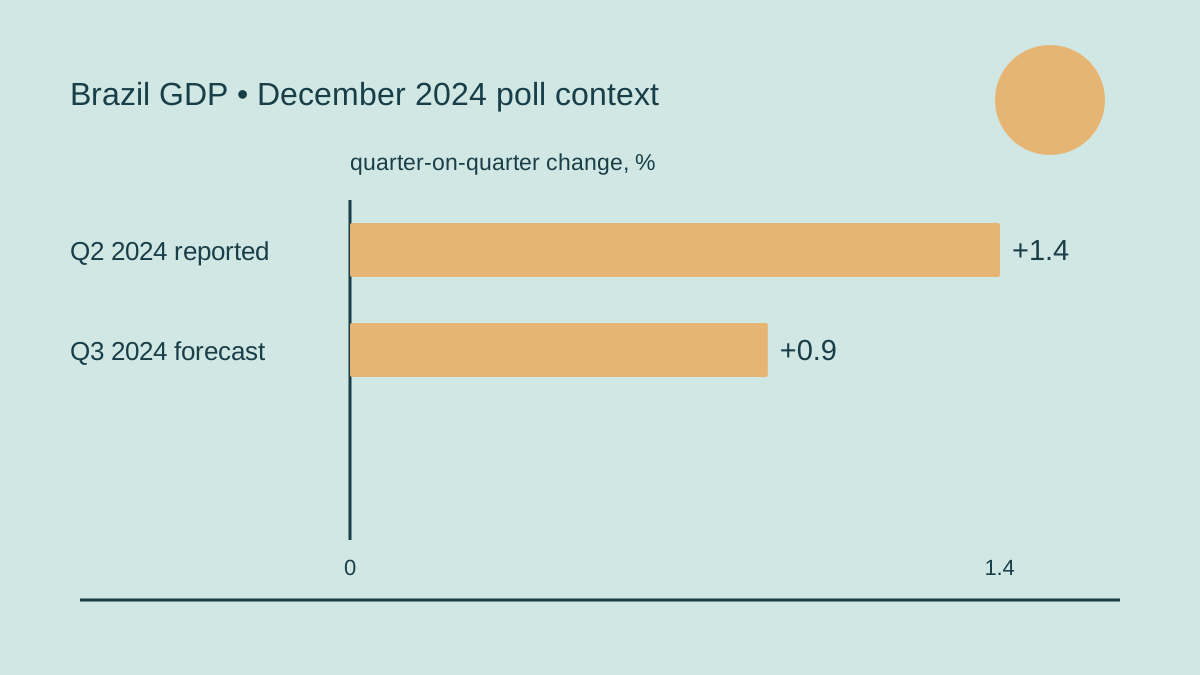
A Reuters poll published on 2 December 2024 expected Brazil’s GDP growth to slow in the third quarter while remaining strong. Seventeen economists surveyed on 27–29 November forecast 0.9% quarterly growth, following 1.4% in April–June. Official figures were still due. Goldman Sachs also warned that revisions to the previous six quarters increased uncertainty around the forthcoming GDP release.
- Quarterly GDP forecast: +0.9%.
- Annual comparison forecast: +4.0%.
Earlier recovery and the pandemic
The earlier forecast landscape was markedly weaker. On 28 May 2019, Reuters reported a poll predicting a 0.2% quarterly contraction in January–March. Eighteen economists supplied that median; individual estimates ranged from a 1.4% fall to a 0.2% rise. A separate twenty-economist median put annual growth for the quarter at 0.5%. The central bank’s weekly survey then forecast 1.2% growth for the entire year after thirteen consecutive downward revisions. Reuters connected weak investment and confidence to uncertainty over the government’s pension reform, while also describing unemployment and expensive credit as constraints.
The next quarterly release delivered a positive surprise. Reuters reported on 29 August 2019 that second-quarter GDP had expanded 0.4% from the previous quarter, twice the poll’s 0.2% median. Industry grew 0.7% and services 0.3%, while agriculture contracted 0.4%. Manufacturing increased 2.0% and construction 1.9%; capital spending rose 3.2%. Government expenditure fell 1.0%. Annual GDP growth reached 1.0%, exceeding the expected 0.7%. In that August report, the preceding quarter’s contraction was recorded as 0.1%. The release therefore described renewed quarterly expansion alongside continuing weakness in agriculture and public spending.
On 2 December 2020, the International Monetary Fund described a much more severe disruption. Its consultation release recorded a 7% contraction in economic activity during the first half of the year, September unemployment of 14.4% and eleven million workers leaving the labour force. Retail and industrial activity had returned to pre-pandemic levels in the third quarter, but services remained depressed. The Fund projected a 5.8% GDP decline for 2020 and a partial 2.8% recovery in 2021. It credited the authorities’ fiscal, liquidity and interest-rate response with cushioning income losses and preventing a deeper downturn.
By 1 June 2021, Reuters reported that first-quarter GDP had grown 1.2%, beating the poll’s 1.0% forecast and restoring activity to its end-2019 level. Agriculture expanded 5.7%, industry 0.7% and services 0.4%. Fixed investment rose 4.6%, while household consumption slipped 0.1% and government spending fell 0.8%. Manufacturing contracted 0.5%. Annual GDP growth was 1.0%, above the expected 0.8%. This was the third consecutive expanding quarter, although activity remained 3.1% below its 2014 peak. Following the release, Citi and Goldman Sachs raised their annual growth forecasts to 5.1% and 5.5%, respectively.
That momentum weakened in the following quarter. The 1 September 2021 Reuters report recorded a 0.1% quarterly GDP decline, against expectations of 0.2% growth. It described restrictions during April and May’s second pandemic wave as a drag on consumption and manufacturing. Government spending and services helped offset weaker investment and agriculture. Output nevertheless stood 12.4% above its level a year earlier, below the poll’s 12.8% forecast. The Economy Ministry still expected annual growth above 5%, while economists’ latest weekly consensus was 5.2%. Drought and possible energy constraints were additional concerns identified by the report’s sources.
The IMF’s release of 22 September 2021 likewise said the recovery had exceeded expectations. It forecast 5.3% real GDP growth for the year, citing the policy response, favourable terms of trade and strong private credit growth. Output had regained its pre-pandemic level in the first quarter, but employment recovery lagged and unemployment remained high, particularly among vulnerable groups. Currency depreciation and commodity prices had lifted inflation and expectations. The Fund supported continued monetary tightening and described growth risks as broadly balanced amid unusually high uncertainty. Its outlook therefore combined a strong annual rebound with continuing labour-market and price pressures.
Growth surprises and a slowing quarter
On 14 July 2022, the Economy Ministry raised its annual GDP growth forecast from 1.5% to 2.0%, citing stronger monthly indicators, employment and private investment. Its 2023 projection remained 2.5%. Private economists in the central bank’s weekly survey were less optimistic, expecting 1.59% for 2022 and 0.5% for 2023. The ministry lowered its current-year inflation forecast from 7.9% to 7.2%, incorporating tax reductions on fuel and energy, but raised its following-year estimate from 3.6% to 4.5%. Economic Policy Secretary Pedro Calhman defended the growth outlook; the inflation figures still exceeded the corresponding official targets.
The second-quarter release on 1 September 2022 strengthened that picture. GDP increased 1.2% sequentially, above the 0.9% poll forecast, and 3.2% annually, exceeding the expected 2.8%. Services grew 1.3%, industry 2.2% and agriculture 0.5%. Investment jumped 4.8% and household consumption 2.6%, while government expenditure fell 0.9%. Activity was 3% above its pre-pandemic level after four consecutive growing quarters. Bank of America raised its annual projection from 2.5% to 3.25%; Goldman Sachs moved from 2.2% to 2.9%. The report also recorded unemployment of 9.1% for the three months through July.
The 1 December 2022 report showed a slower third quarter: GDP rose 0.4%, missing the poll’s 0.7% forecast. Household consumption increased 1.0%, fixed investment 2.8% and government expenditure 1.3%. Agriculture fell 0.9%, while industry and services expanded 0.8% and 1.1%. Annual GDP growth reached 3.6%, against expectations of 3.7%. IBGE revised second-quarter growth down from 1.2% to 1.0% and first-quarter growth up from 1.1% to 1.3%. Reuters attributed weaker domestic demand to higher borrowing costs; the central bank had paused after twelve rate increases that brought its benchmark to 13.75%.
A different indicator supplied an early annual view on 16 February 2023. Reuters reported that the central bank’s IBC-Br activity index had risen 2.9% in 2022. December’s adjusted monthly increase was 0.29%, above a 0.1% forecast, and its annual gain was 1.42%. However, the fourth-quarter index fell 1.46% against the preceding quarter. Services and employment had supported annual activity, while high borrowing costs weighed on recent months. Economists’ weekly consensus anticipated 3% GDP growth for 2022 and 0.76% for 2023. The official national-accounts result was still scheduled for 2 March.
The Finance Ministry took a more cautious position on 17 March 2023, cutting its growth forecast for that year from 2.1% to 1.61%. Its following-year estimate fell from 2.5% to 2.34%. The economic policy secretariat cited the effects of high interest rates on activity and credit. Inflation projections moved in the opposite direction, rising to 5.31% for 2023 and 3.52% for 2024. Secretary Guilherme Mello emphasised expensive funding for companies and expected monetary easing later in the year. The central bank’s benchmark remained at 13.75%, following the tightening cycle begun in March 2021.
Agriculture changes the 2023 outlook
Agriculture then delivered a large first-quarter surprise. Reuters reported on 1 June 2023 that GDP grew 1.9% sequentially, against a 1.3% forecast, after a revised 0.1% contraction in the preceding quarter. Farm output surged 21.6%, services rose 0.6% and industry slipped 0.1%. Household consumption increased 0.2% and government spending 0.3%. Annual GDP growth was 4.0%, beating the expected 3.0%. Goldman Sachs raised its full-year forecast from 1.75% to 2.6%, citing additional support from net exports and inventories. The Finance Ministry said the figures could prompt an increase to its then-current 1.9% projection.
On 29 June 2023, the central bank raised its annual GDP growth projection from March’s 1.2% to 2.0%. It cited first-quarter surprises in industrial and service activities, together with a better agricultural outlook. Private economists’ weekly consensus was slightly higher at 2.18%. The bank nevertheless expected domestic monetary tightening and slower global growth to restrain subsequent activity. It widened its forecast current-account deficit from $32 billion to $45 billion and lowered the expected trade surplus from $62 billion to $54 billion. Expected bank lending growth edged up from 7.6% to 7.7% for the year.
The IMF’s consultation release on 31 July 2023 projected growth of 2.1% for the year, following 2.9% in 2022. It described very strong agricultural output early in the year, with manufacturing and services more subdued, and saw slowing private consumption and falling investment as signs of subsequent moderation. Headline inflation had declined rapidly, but core inflation and expectations remained elevated. The Fund’s outlook anticipated inflation reaching 5.4% by year-end and converging to target by mid-2025. It identified commodity volatility, tighter global financial conditions and renewed fiscal uncertainty among the downside risks to that dated assessment.
By 18 September 2023, the Finance Ministry had increased its annual growth estimate from July’s 2.5% to 3.2%. It cited unexpectedly strong second-quarter activity, a more robust harvest, positive early third-quarter indicators and an anticipated recovery in a major trading partner. Its 2024 GDP forecast remained 2.3%. Private economists’ weekly estimates were lower at 2.89% for 2023 and 1.50% for 2024. Finance Minister Fernando Haddad argued that tax reform and the government’s ecological programme could strengthen growth potential. The report described those initiatives and bond issuance as plans still requiring further implementation or legislative steps.
The government trimmed that outlook on 21 November 2023. Its annual GDP forecast fell from 3.2% to 3.0%, while the 2024 projection declined from 2.3% to 2.2%. The economic policy secretariat pointed to geopolitical conflicts, slower growth in a major trading partner and expectations of prolonged high overseas interest rates. Economists’ weekly forecasts stood at 2.85% and 1.5%, respectively. The central bank had reduced its benchmark by 150 basis points since August to 12.25%. The ministry lowered its current-year inflation projection from 4.85% to 4.66%, while increasing the following-year estimate from 3.40% to 3.55%.
Demand in 2024
The 1 March 2024 national-accounts report put full-year 2023 GDP growth at 2.9%. Agriculture, commodity exports, resilient employment and welfare-supported consumption had contributed, Reuters reported. Fourth-quarter GDP was flat sequentially, slightly below the expected 0.1% increase, and expanded 2.1% annually against a 2.2% forecast. Industrial growth, led by extraction, offset further agricultural weakness; services rose moderately. The government reaffirmed its 2.2% growth forecast for 2024. Economists expected weaker agricultural output and still-high borrowing costs to constrain the next year’s performance. The benchmark rate stood at 11.25% after 250 basis points of cuts since August.
On 4 June 2024, Reuters reported first-quarter GDP growth of 0.8%, matching economists’ median and following a revised 0.1% decline in the previous quarter. Annual expansion was 2.5%, above the expected 2.2%. Household consumption rose 1.5%, fixed investment 4.1% and government expenditure was unchanged. Services increased 1.4%, agriculture 11.3% and industry slipped 0.1%. The report described growth as broader than the harvest-centred expansion of 2023. However, economists and the ministry warned that May’s flooding in Rio Grande do Sul created uncertainty for subsequent activity. Government and market annual forecasts then stood at 2.5% and 2.05%.
The central bank raised its 2024 growth forecast from 1.9% to 2.3% on 27 June, citing a stronger first quarter, falling unemployment and rising wages. Its inflation report also described signs of recovery after the southern floods. Policymakers said stronger-than-expected activity was the principal reason for higher inflation projections and now assessed the output gap as approximately neutral. The bank had halted easing at 10.50% after cumulative cuts of 325 basis points. Inflation forecasts were 4.0% for 2024, 3.4% for 2025 and 3.2% for 2026, all above the 3% target in that report’s scenario.
The IMF’s 11 July 2024 consultation release projected 2.1% growth for the year. It cited restrictive monetary policy, a smaller fiscal deficit, the southern flood calamity and normalisation of agricultural output. Its medium-term growth estimate rose by half a percentage point to 2.5%, reflecting expected efficiency gains from VAT reform and increasing hydrocarbon output. The Fund considered risks somewhat tilted downwards, including commodity volatility and more severe flood-related supply disruptions. Stronger household consumption and faster productivity reforms were potential upside factors. It expected headline inflation to return to the 3% target in the first half of 2026.
September revisions and policy expectations
The second-quarter release on 3 September 2024 changed expectations again. GDP expanded 1.4% sequentially, beating the poll’s 0.9% forecast; annual growth was 3.3%, above expectations of 2.7%. The first-quarter increase was revised from 0.8% to 1.0%. Industry grew 1.8% and services 1.0%, while agriculture fell 2.3%. Fixed investment rose 2.1%; household and government consumption each increased 1.3%. Reuters reported that the strength of industry and services offset flood impacts. The data increased expectations of monetary tightening after the bank had held its benchmark at 10.50% since June. The ministry signalled an upward growth revision.
Finance Minister Fernando Haddad anticipated that revision on 11 September 2024. He told reporters the government expected to lift its annual growth forecast above 3%, replacing the existing 2.5% projection, and regarded 3% as a practically secured floor. He also expressed concern about food and energy prices following severe droughts and wildfires. Haddad argued that higher interest rates could not resolve price pressures arising from those climate conditions. The central bank was due to meet on 17–18 September, with economists expecting a 25-basis-point increase after its two preceding decisions had left the benchmark at 10.50%.
The formal ministry forecast followed on 13 September: 2024 GDP growth of 3.2%, up from July’s 2.5%. The revision incorporated the second-quarter surprise and stronger expected performance later in the year, although at a slower pace. Secretary Guilherme Mello highlighted investment and industry. The ministry also raised its inflation forecast from 3.9% to 4.25%, attributing the adjustment to external factors, particularly drought-related food and energy pressures. Private economists’ weekly growth consensus was 2.68%. For 2025, the ministry reduced expected growth from 2.6% to 2.5% and lifted projected inflation from 3.3% to 3.4%.
The central bank’s September inflation report also raised its 2024 GDP projection to 3.2%, from 2.3%, primarily reflecting the second-quarter surprise. Its forecast box described smaller-than-expected flood impacts and stronger household consumption and investment. It expected a slower second half and 2.0% growth in 2025, citing reduced fiscal stimulus, interrupted monetary easing and limited external impetus. For 2024, forecast growth in household consumption rose from 3.5% to 4.5%, government consumption from 1.8% to 2.7% and fixed capital formation from 4.5% to 5.5%. Those were annual scenario estimates rather than measured third-quarter outcomes.
October outlook
At an event on 14 October 2024, central bank director Gabriel Galipolo called strong activity a central input into policy decisions. Reuters reported that August activity had again exceeded expectations. Finance Minister Haddad said the annual GDP forecast might need another increase after September’s move to 3.2%. Galipolo linked economic strength to inflation and expectations, arguing that rates should remain restrictive long enough to return inflation to target. The bank had begun tightening in September with a 25-basis-point increase to 10.75%. At that October event, market expectations pointed to a faster, 50-basis-point move at the November meeting.
The IMF updated its international outlook on 22 October 2024, raising Brazil’s annual growth forecast from July’s 2.1% to 3.0%. It cited stronger first-half private consumption and investment, a tight labour market, government transfers and less disruption from floods than anticipated. Its Latin America and Caribbean projection rose by 0.3 percentage point to 2.1%, with 2.5% growth expected in 2025. Brazil’s revision contrasted with a lower forecast for the region’s other large economy. Reuters described different monetary-policy directions accompanying that divergence. The improved Brazilian projection remained an expectation for the full year, ahead of the third-quarter national-accounts publication.






Leave a comment