
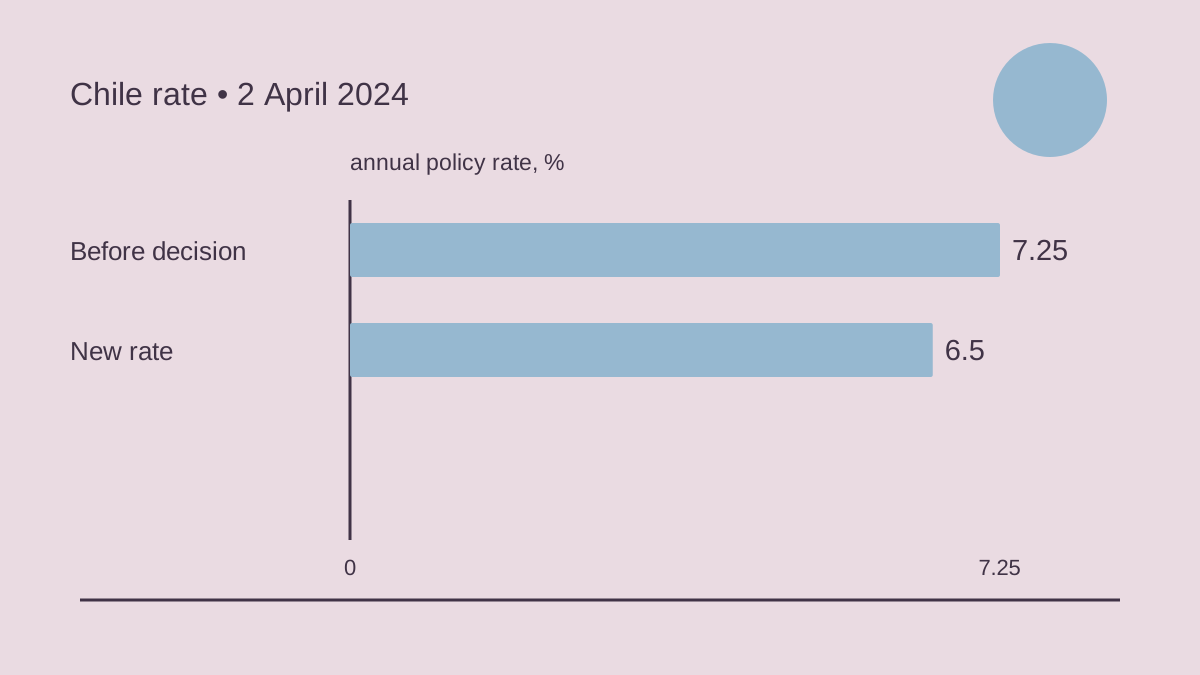
On April 2, 2024, Chile’s central bank lowered its policy rate by 75 basis points to 6.5%, with all board members supporting the decision. Reuters reported that further reductions were envisaged, while their size and timing would depend on economic developments and the inflation outlook. The board judged that earlier macroeconomic imbalances had been closed and inflation expectations were aligned with its 3% target. It nevertheless stressed the need to monitor renewed price increases and imported costs. The decision followed the easing cycle that began in July 2023.
Pandemic support
The earlier policy response had addressed a very different problem. On March 31, 2020, the board unanimously cut the rate by 50 basis points to 0.5%, which it described as the technical minimum. Pandemic restrictions were disrupting supply and demand, and the bank assessed that medium-term inflation pressures had weakened substantially. Liquidity and lending facilities were already operating. The board also expanded its bank-bond purchase programme by $4 billion and removed maturity restrictions on eligible securities, leaving purchase capacity of up to $5.5 billion. These figures described available capacity rather than completed purchases.
By June 16, 2020, the bank considered additional support necessary as quarantines affected areas containing nearly half the population. It held the rate at 0.5% and announced a second phase of its conditional lending facility, with $16 billion available over eight months. Incentives would favour lending to smaller businesses and non-bank credit providers. A separate asset-purchase programme envisaged $8 billion over six months. Existing facility resources were nearly 83% drawn, while commercial credit was expanding and consumer lending was slowing. The new programme amounts were commitments, with operational details still to follow.
The July 15, 2020 decision maintained both the 0.5% rate and unconventional support. May’s activity index had fallen 15.3% from a year earlier, with losses across almost every sector, while employment, working hours and wages had deteriorated sharply. The second phase of the lending facility was now accessible. The bank’s lending survey showed: June headline inflation was 2.6%, with the measure excluding volatile items at 2.5%.
- Tighter supply conditions across credit categories.
- More corporate demand for working capital and less for investment financing.
- Weaker household borrowing demand.
Uneven recovery
By September 1, the bank saw signs of stabilization, although activity remained well below its level a year earlier. Retail and manufacturing were recovering more visibly than businesses dependent on face-to-face contact. Employment and labour incomes remained badly affected. Commercial lending had grown by more than 10% annually in real terms, contrasting with falling consumer credit. The statement attributed that countercyclical lending performance to liquidity facilities, government guarantees and regulatory changes. With both headline and core inflation at 2.5% in July, the board retained the 0.5% policy rate and its unconventional measures.
The recovery still differed sharply across sectors at the October 15 meeting. August activity was down 11.3% annually but had risen 2.8% from July after seasonal adjustment. Retail sales improved, while services and construction continued to face severe disruption. Commercial credit growth remained above its pace at the start of the year, although it had slowed recently. September headline inflation reached 3.1% and core inflation 2.9%. The bank linked the price increases mainly to temporary goods consumption supported by pension withdrawals and short-term supply constraints, while judging medium-term inflationary pressures limited.
At the December 7, 2020 meeting, the bank estimated that roughly one-third of the jobs lost during the pandemic had been recovered. The improvement was weaker in some services, formal salaried work and female employment. November headline inflation had fallen to 2.7%, while core inflation remained at 3.2%. The board kept the rate at 0.5% and retained unconventional support. It planned to maintain about $8 billion in acquired bank bonds over the following six months by reinvesting maturing coupons, excluding purchases under a separate programme.
Recovery and tightening
On March 30, 2021, the board again held the rate at 0.5% without changing its unconventional measures. Trade and manufacturing were recovering more quickly than services and construction, while employment still lagged. The third phase of the conditional financing facility had drawn around 15% of its available resources. The bank also reported renewed commercial lending flows linked to the expanded government guarantee programme. Headline inflation was around 3%. Its low-rate guidance remained conditional: recovery needed to extend over several quarters to the demand components that were still behind.
The June 8, 2021 statement described stronger consumption of durable goods and recovering machinery investment, but an uneven labour-market picture. Formal salaried employment had recovered more than informal employment and women’s participation. April activity had declined after seasonal adjustment by less than anticipated. The board unanimously kept the rate at 0.5%. Meanwhile, the third phase of its financing facility had been completed, and coupon reinvestment on bank bonds ended in early June. The remaining asset holdings would decline as they matured, a gradual operational change alongside the still expansive policy rate.
On July 14, 2021, the board began withdrawing stimulus with a unanimous 25-basis-point increase to 0.75%. May activity had risen 18.1% annually and 2.6% from April after seasonal adjustment. The bank linked particularly strong consumption to fiscal transfers and pension withdrawals. June headline inflation reached 3.8%, while core inflation remained slightly above 3%. Employment was still below pre-pandemic levels despite a recovery in formal salaried work. The board expected gradual normalization and, at that stage, envisaged the policy rate remaining below its neutral value throughout the two-year horizon.
The pace changed at the August 31 meeting, when all members supported a 75-basis-point increase to 1.5%. July headline inflation was 4.5% and core inflation 3.8%, while second-quarter GDP had expanded 18.1% from a year earlier. The board judged that the activity gap had virtually closed and that household consumption had exceeded expectations, supported by substantial liquidity injections. It warned that commodity prices, supply difficulties and currency depreciation could make inflation more persistent. These assessments supported a stronger withdrawal of stimulus rather than the smaller step taken in July.
Inflation persistence
A further acceleration followed on October 13, with a unanimous 125-basis-point rise to 2.75%. September headline inflation had reached 5.3% and core inflation 4.2%; survey expectations two years ahead were above the 3% target. The bank also described pronounced domestic financial-market deterioration, attributing it partly to political and legislative uncertainty, including proposals for further pension withdrawals. The board projected that the rate would reach neutrality sooner than envisaged in September. It separately suspended the reserve-accumulation programme begun that January, citing financial-market developments and the reserves already accumulated.
On December 14, 2021, the board unanimously increased the rate by another 125 basis points, to 4%. November headline inflation stood at 6.7%, while core inflation was 4.7%. Third-quarter GDP had risen 17.2% from a year earlier, illustrating the strength of the rebound. The bank nevertheless described tighter conditions for longer-term mortgage borrowing, alongside inflation expectations above the target. Its guidance envisaged further rate increases and a stance above the nominal neutral rate for much of the policy horizon. That was the board’s assessment at the meeting, conditional on the evolving economic outlook.
Rising price pressures
The January 26, 2022 meeting brought a 150-basis-point increase to 5.5%, supported by all board members present. December headline inflation had reached 7.2% and core inflation 5.2%, exceeding both market expectations and the previous policy report’s forecast. Price increases were widespread across the consumer basket. Private inflation expectations remained above 3% two years ahead, while lending rates were rising across credit categories, particularly consumer loans. The board judged that stronger domestic activity and inflation, together with international price pressures, warranted a short-term rate path near the upper edge of its published corridor.
On March 29, 2022, all board members backed another 150-basis-point rise, taking the rate to 7%. February inflation was 7.8%, almost one percentage point above the December report’s forecast, largely because core goods prices had increased more than expected. Revised national accounts put GDP growth in 2021 at 11.7%. By the time of the meeting, however, spending was retreating from its earlier high levels, particularly durable-goods consumption. Lending flows were slowing and access conditions had tightened. The board suggested smaller subsequent increases if its central scenario proved correct, keeping that guidance explicitly conditional.
The May 5, 2022 decision raised the rate by 125 basis points to 8.25%, unanimously. March headline inflation had reached 9.4%, with core inflation at 7.6%, significantly exceeding the latest policy report’s assumptions. Consumption remained resilient, while investment weakened and construction indicators continued to decline. Employment growth was slowing, and business and household confidence had deteriorated. The bank attributed stronger price pressures to international energy and food costs, currency depreciation and continuing supply problems. It moved the policy rate towards the upper boundary of its corridor, with a new assessment of the path still to come.
On June 7, the board unanimously increased the rate by 75 basis points to 9%. April headline inflation was 10.5% and core inflation 8.3%, with food prices again contributing to an upside surprise. The economy was slowing less quickly than expected because consumption remained strong. Seasonally adjusted non-mining GDP had fallen only 0.2% from the previous quarter in the first quarter, a smaller decline than projected in March. Investment continued to weaken, while credit flows were low and financing conditions tight. The board envisaged additional rate adjustments, although smaller in magnitude.
The July 13 meeting delivered another unanimous 75-basis-point increase, to 9.75%. June headline inflation had climbed to 12.5%, while core inflation reached 9.9%. The bank reported a gradual decline in activity: the seasonally adjusted non-mining activity index fell 0.9% in May from April. Employment growth was slowing and annual real wage growth remained negative. Copper was trading around $3.3 per pound after a substantial decline. The board judged that worsening global financial conditions and domestic uncertainty had contributed to peso depreciation, creating further short-term price risks despite weakening commodity prices.
The restrictive plateau
The September 6, 2022 decision showed disagreement about the appropriate pace. Three members supported a 100-basis-point increase to 10.75%, while one preferred 125 basis points and another 75. July headline inflation was 13.1% and core inflation 10%. Meanwhile, seasonally adjusted non-mining GDP had declined 0.5% from the previous quarter in the second quarter, with both investment and consumption falling. Job creation and vacancies weakened, and real wages continued to decline annually. The board emphasized inflation’s high level and two-year expectations above 3%, leaving future rate movements dependent on the economic scenario.
On October 12, the board unanimously raised the rate by 50 basis points to 11.25%. It assessed that this was the maximum level of the cycle begun in July 2021 and said the rate would remain there for as long as necessary to secure inflation’s convergence. September headline inflation was 13.7%, slightly lower than in August, but core inflation had risen to 11.1%. Food-price increases had contributed to inflation exceeding the policy report’s estimates. Credit was decelerating, job creation had stalled and consumption indicators continued to decline, alongside persistent inflation expectations above target.
The December 6 meeting kept the rate at 11.25%, unanimously. October headline and core inflation had eased to 12.8% and 10.8%, respectively, but the board judged inflation still very high and convergence subject to risks. Seasonally adjusted non-mining GDP fell 0.8% quarter on quarter in the third quarter. Capital formation had surprised positively, partly through renewable-energy investment, although the bank considered most investment fundamentals weak. Consumption continued to adjust as liquidity normalized and employment growth remained slow. The board conditioned any change in the hold on evidence that inflation convergence had consolidated.
Holding for convergence
At the January 26, 2023 meeting, the board unanimously maintained the 11.25% rate. December headline inflation was 12.8% and core inflation 10.7%. Although both had declined from November, cumulative inflation over the two months exceeded the December policy report’s projection. The seasonally adjusted non-mining activity index had fallen 0.2% in November from October. Credit remained constrained, especially commercial lending, with tight supply conditions and weakening demand. Job creation was low and annual real wage growth negative. The board retained its requirement that inflation convergence become consolidated before changing the restrictive rate setting.
The April 4, 2023 decision again held the rate at 11.25%, unanimously. Revised national accounts had changed the composition of earlier demand: consumption was higher and investment lower than previously reported, while GDP growth revisions were limited. The bank judged that the economy’s adjustment was slower than expected. February headline inflation had declined to 11.9%, but core inflation remained at 10.7% and had been relatively stable for several months. Household consumption had fallen only 0.7% quarter on quarter after seasonal adjustment in the fourth quarter. The board consequently anticipated a longer convergence process than in December.
On May 12, the board unanimously left the rate at 11.25%. April headline inflation had fallen to 9.9%, while core inflation declined more slowly to 10.3%. The statement described price developments as consistent with the March report’s forecasts, but most measures of two-year inflation expectations remained above 3%. Consumption indicators continued adjusting downwards and investment remained weak. Unemployment reached 8.8% in the moving quarter ending in March, reflecting lower employment and a larger labour force among other factors. Real wages were recovering, yet households and firms still viewed the economy pessimistically.
Conditions for easing
The June 19, 2023 meeting marked a change in the discussion even though the rate stayed at 11.25%. Three members supported the hold, while two preferred a 50-basis-point cut. May headline inflation had fallen to 8.7% and core inflation to 9.9%. Both principal surveys placed two-year inflation expectations at 3%. The board judged that inflation risks were becoming more balanced and that recent economic developments were moving in the required direction. If those trends continued, it said, a downward rate process would begin soon, with its scale and timing dependent on the economic outlook.
On July 28, the board unanimously began the easing cycle with a 100-basis-point cut to 10.25%. June headline inflation was 7.6% and core inflation 9.1%, declining faster than projected in the previous report, principally because of goods prices. Two-year survey expectations remained at 3%. Activity and demand were broadly consistent with the bank’s scenario, while credit supply conditions were tight and demand weak. May’s seasonally adjusted non-mining activity index was unchanged from April. The board envisaged somewhat greater near-term reductions than previously projected, while retaining its dependence on economic developments and inflation.
The September 5 decision reduced the rate by another 75 basis points to 9.5%, unanimously. July headline inflation had declined to 6.5% and core inflation to 8.5%, with services prices slowing less quickly than goods and volatile components. Two-year survey expectations were still at 3%. Second-quarter non-mining GDP fell 0.5% quarter on quarter after seasonal adjustment, while private consumption stabilized and investment remained weak. The bank’s September scenario projected inflation reaching its target in the second half of 2024. Further cuts remained conditional on that scenario and its implications for the price trajectory.
Further reductions
On December 19, 2023, the board unanimously cut the rate by 75 basis points to 8.25%. November headline inflation was 4.8% and core inflation 6%, although volatile prices had produced an upside surprise. Seasonally adjusted non-mining GDP grew 0.2% quarter on quarter in the third quarter. Investment and job creation remained weak, and mortgage rates stayed high even as short-term rates declined. The bank still projected headline inflation reaching 3% in the second half of 2024, while moving its forecast for core convergence to the first half. Further policy cuts remained dependent on the evolving scenario.
The January 31, 2024 decision lowered the rate by 100 basis points to 7.25%. Four members supported that reduction, while one preferred 125 basis points. December headline inflation had fallen to 3.9% and core inflation to 5.4%, with monthly price changes below the previous report’s expectations. Commercial lending rates continued to fall, but mortgage rates remained historically high and credit supply conditions tight. The board judged that inflation convergence could arrive sooner than previously forecast and envisaged a neutral rate in the second half of 2024. Both remained assessments at that meeting, with subsequent cuts conditional on incoming developments.





Leave a comment