
Kasri Orifon brings a village setting to Bukhara pilgrimage and village travel programmes, close to the memorial associated with Bahauddin Naqshband. The Tourist Village opened in Choloki mahalla, Bukhara region, in July 2025. Its facilities included twenty family guesthouses, a hotel, restaurants and services connected with pilgrimage and rural tourism. The village stands near the memorial associated with Bahauddin Naqshband.
The programme included One Day in Kasri Orifon and Naqshband Days, with crafts, food and folklore presented at the opening. The news therefore concerned both visitor facilities and a cultural programme tied to a named community. The nearby shrine provides the central historical relationship, while the village adds accommodation and household-scale encounters beyond a short monument stop.
The July opening and its visitor facilities
Kasri Orifon’s Tourist Village opened in Choloki mahalla in July 2025. Twenty family guesthouses, a hotel and food services formed part of its visitor facilities. The village is close to the Bahauddin Naqshband memorial, connecting accommodation with a named pilgrimage destination. Rooms and meals are provided through individual properties within the community, alongside the wider cultural programme introduced at the opening.
One Day in Kasri Orifon and Naqshband Days formed part of the village’s cultural programme. Their themes connect local visitor activity with Bahauddin Naqshband’s heritage. Crafts, food and folklore appeared during the opening presentation. The programmes have their own organisers and schedules, while the nearby memorial has a continuing role as a place of pilgrimage and remembrance.
The proximity of the Bahauddin Naqshband memorial gives the village a specific pilgrimage connection. A guesthouse stay and a shrine visit are nevertheless separate arrangements. Accommodation has a host and property address; the memorial has its own spaces and uses; an organized cultural programme has a schedule and participants.
Craft, food and folklore activities accompanied the opening ceremony. Makers and participants presented practices within the named village initiative, alongside accommodation and other services. A later visitor programme has its own booked encounters and providers. Homes and workshops remain working spaces within the community, with visits arranged through the people who use them rather than through unrestricted public access.
Bahauddin Naqshband and the memorial landscape
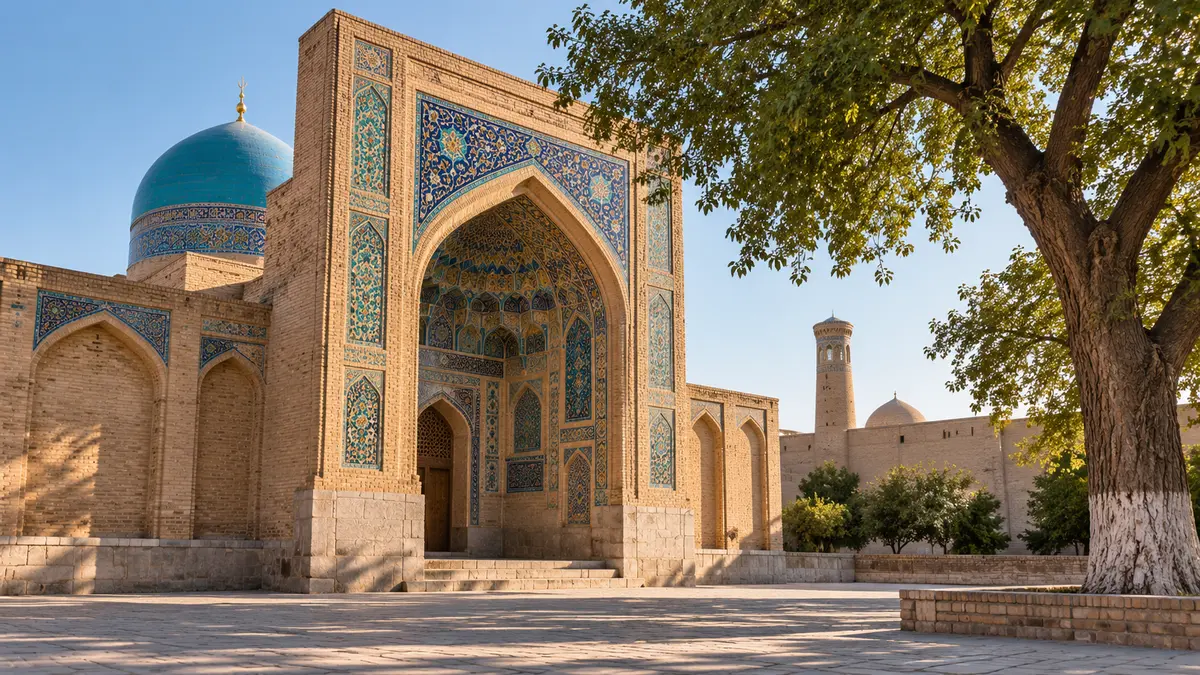
Bahauddin Naqshband is associated with the Naqshbandi Sufi tradition. His memorial near Bukhara developed around the burial place, with buildings added during later periods. The teacher’s religious association and the surviving architecture have separate histories. Mosques, courtyards and other spaces form parts of a destination used for visitation, remembrance and the study of its religious and built heritage.
A scholar or religious teacher can be associated with a place long before the present buildings were constructed. A mausoleum commemorates a burial, while a mosque, courtyard or other structure may belong to a subsequent phase. Reading the complex through those separate dates avoids assigning all visible architecture to the teacher's lifetime.
The memorial is a place of visitation and religious remembrance. Its architecture can also be studied by cultural travellers, with attention to the functions of its different spaces. A mosque remains a worship space, while a museum or interpretive display supplies another form of information. Their presence together does not make them interchangeable.
Devotional traditions preserve stories about teachers alongside accounts of their lives and remembered work. Within the Seven Saints route, those stories accompany named memorial places and biographies. Their status remains traditional rather than independently established historical events. Buildings and later construction campaigns have their own dates, supplying another chronology within the regional pilgrimage setting.
Kasri Orifon's tourism programme draws on this memorial relationship. The village adds a setting in which visitors may stay, eat and encounter local crafts, while the shrine remains a distinct destination. The administrative opening date of the Tourist Village does not become the founding date of the religious tradition.
The Seven Saints route and its named places
The Seven Saints route names Abdulkhaliq Gijduvani, Arif Rivgari, Mahmud Anjir Fagnavi, Ali Ramtani, Muhammad Baba Sammasi, Sayyid Amir Kulal and Bahauddin Naqshband. Their memorials occupy different places in the Bukhara area. English transliteration varies, while the identity of each teacher remains connected with a particular site. The sequence introduces several communities beyond the historic centre of Bukhara itself.
The sequence introduces several locations beyond central Bukhara. Gijduvan is associated with Abdulkhaliq Gijduvani; Arif Rivgari's memorial is connected with the Shafirkan area; other teachers are linked with Vabkent, Romitan and nearby settlements. These are distinct destinations, not seven rooms within a single compound.
Teacher biographies within the Seven Saints tradition include occupations such as weaving, carpentry and pottery. These belong to remembered accounts of the individuals and their lives. Modern craft workshops have their own makers and teaching relationships. A regional journey can encounter both religious biographies and contemporary production, with each subject tied to its particular person, place and practice.
A pilgrimage sequence differs from a simple list of nearby attractions. Its order and significance can be explained through the tradition and its teachers. A cultural itinerary may study the same places through architecture and local history. The two approaches can overlap, while their purposes remain identifiable.
Names and locations in a pilgrimage itinerary
- Keep the teacher's name attached to the correct memorial.
- Identify the settlement or district rather than using Bukhara for every address.
- Separate a biographical date from the date of a surviving building.
- Distinguish a devotional story from a documented construction record.
- Confirm which stops are included in the arranged route.
These details are particularly useful where English spellings differ between signs, maps and published accounts. Similar-looking names should be checked against the person and place, rather than assumed to identify the same stop.
Guesthouses and the scale of village hospitality
Twenty family guesthouses were part of Kasri Orifon’s visitor provision at the opening. Each has its own rooms, hosts and household setting. Family accommodation sits alongside the separately mentioned village hotel and restaurants. A stay therefore takes place at an individual property, with its meals, room arrangements and any included activities forming the programme for the booked visit.
Courtyards connect rooms, shaded sitting areas and household activity in Bukhara-region residential architecture. A veranda provides a covered edge, while the open centre admits daylight. Guesthouse layouts and furnishings vary between properties. The room and household spaces used for a stay belong to the individual accommodation, alongside the village’s wider pilgrimage and cultural setting near the Naqshband memorial.
Food arrangements also differ between properties. A meal may be included in a booking or offered separately. A cooking demonstration is another service, with its own timing and participant arrangements. The opening's food presentation does not establish a fixed menu for all twenty guesthouses.
The relationship with pilgrimage can affect the programme of a stay. Some guests may make an early shrine visit; others may spend more time with the village's crafts and food activities. A host's practical information concerns the room and meals, while a guide's interpretation concerns the memorial and route. Those roles can be coordinated without assuming that every host supplies specialist historical guidance.
The village hotel provides a separate accommodation category alongside the twenty family guesthouses. The guesthouse figure counts properties rather than beds. Restaurants and other food services form another part of the village provision. Each property has its own facilities, with the room, meal and service arrangements supplied by the provider for a particular stay or visit.

Craft encounters in the wider Bukhara area
The opening included craft displays, while the wider Bukhara region contains established ceramic and textile practices. Gijduvan provides a relevant connection because it appears in both a craft route and the Seven Saints geography. The two subjects concern different activities within the same town: pottery production and religious visitation.
The Narzullaev family workshop and museum in Gijduvan present ceramics and embroidery. Green and yellow decoration, geometric and floral designs, and family teaching form part of the regional ceramic tradition. Gijduvan also appears within the Seven Saints geography through Abdulkhaliq Gijduvani. Craft production and religious visitation occupy different settings within the town, with their own makers, buildings and practices.
A workshop visit can show making, while a museum display can present older forms and collected pieces. An opening fair presents products or demonstrations during an event. These settings give different kinds of access to a craft. A completed bowl and a potter decorating a bowl are related encounters, but only the latter shows that particular stage of work.
Embroidery introduces another material process. Thread is worked into or onto cloth, with the pattern organized through stitches. A woven patterned textile has another production sequence. A village craft display can include both without making them identical techniques. The maker's explanation and the object's label identify the relevant process.
Gijduvan provides a craft destination within the wider Bukhara area, with the Narzullaev family workshop and museum among its named places. A journey from Kasri Orifon can connect accommodation and pilgrimage with pottery and embroidery elsewhere in the region. The transfer and workshop encounter have their own arrangements. A demonstration, museum visit and lesson each provide a different form of access to the craft.
Historic Bukhara and the village's urban connection
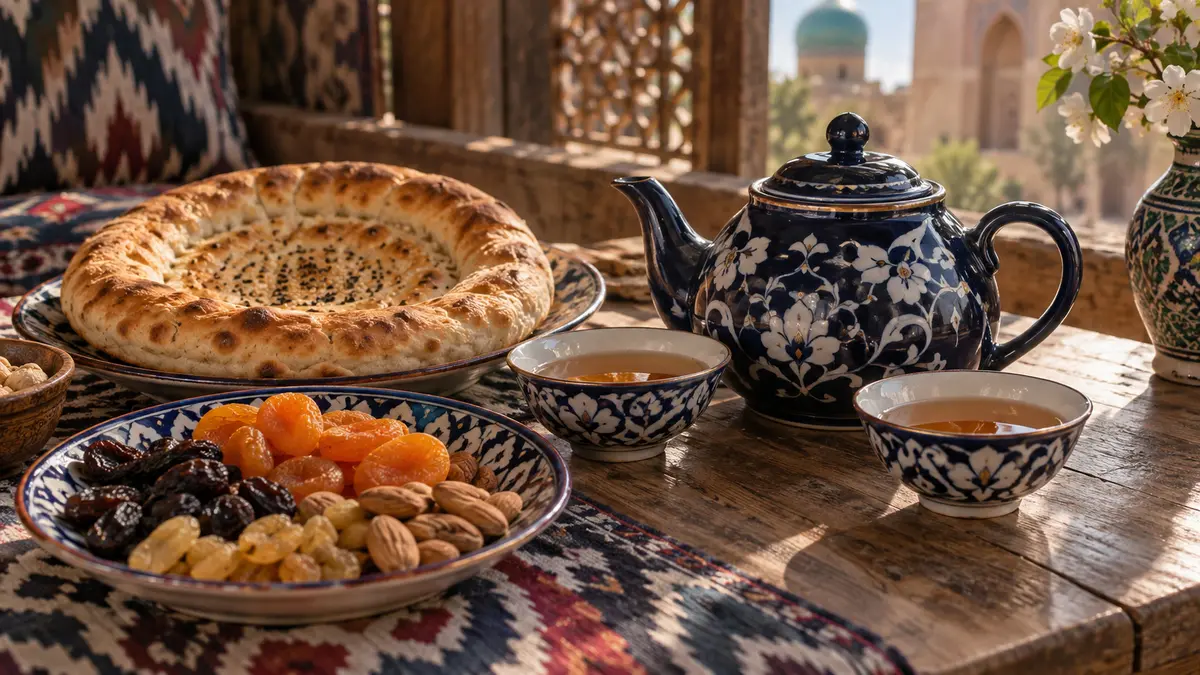
Bukhara's historic centre is a UNESCO World Heritage property, with religious, commercial and domestic architecture preserved within an urban fabric. The city includes ensembles such as Poi Kalyan and Lyabi Hauz, trading buildings and madrasas. Kasri Orifon's village setting belongs to a different scale of visit outside that central urban sequence.
A city route often moves between several public monuments. A village stay concentrates attention on a smaller place and the arrangements of a host or programme. The two can be combined geographically while remaining different experiences. A brief excursion from Bukhara is not the same as an overnight stay in the village.
Bukhara’s historic-centre listing concerns a defined UNESCO World Heritage property. Kasri Orifon’s Tourist Village status belongs to the national tourism initiative announced in July 2025. These designations concern different places and activities. The historic city contains religious, commercial and domestic architecture, while the village combines household accommodation with a pilgrimage connection and local cultural programmes.
Domestic architecture can connect the two settings. Courtyards, rooms and shaded spaces organize household life in ways that differ from a madrasa's teaching rooms or a mosque's prayer area. A similar architectural element can serve different functions depending on the building. Describing the use of a space makes that relationship more precise than assigning a single meaning to every courtyard.
Food services, transport and accommodation provide practical parts of the city-and-village route. A transfer connects the property with a memorial or workshop, while meals and overnight stays take place through their respective providers. The monuments have their own historical setting and visitor arrangements. A programme joins these components through the actual sequence of destinations and activities booked for the journey.
Ali Ramtani is associated with weaving and Sayyid Amir Kulal with pottery in the Seven Saints tradition. Muhammad Baba Sammasi is connected with the Romitan area, while Arif Rivgari’s memorial lies in the Shafirkan area. The sequence involves individual teachers and separate communities. Their occupations and places provide several regional subjects alongside the memorial associated with Bahauddin Naqshband.
The craft references also belong to the remembered biographies. A modern pottery workshop can be studied through its maker and technique, while a saint's occupation appears within a religious historical account. The two subjects can meet in a regional journey without being presented as an unbroken documented workshop lineage.
One Day in Kasri Orifon as an itinerary theme
One Day in Kasri Orifon connects the village with its nearby memorial, local food and crafts. The programme’s name identifies a theme rather than a fixed minute-by-minute schedule. A booked day can include the actual encounters arranged by its providers. Accommodation, meals and the shrine visit take place in separate spaces, with transfers and activity time forming parts of the itinerary.
A day can include different forms of attention. The memorial visit concerns religious heritage and architecture. A meal concerns the table and kitchen. A craft encounter concerns a maker and material. Moving between them requires time for the transfer and for the activity itself. Listing all three does not establish how much time is allotted to each.
Naqshband Days is another named cultural programme introduced with the village opening. It draws on the teacher’s heritage and the community presentation. Event dates and activities are set by its organisers. The memorial remains a distinct pilgrimage destination nearby, while the village supplies accommodation, food and cultural encounters through its own properties and visitor programmes.
A wider Seven Saints journey can place Kasri Orifon within several visits across the Bukhara region. That route requires the correct locations and a distinction between each memorial. The village may provide a base or a separate stop, depending on the itinerary, but it should not be described as containing all seven shrines.
Kasri Orifon’s Tourist Village opening took place on Jul 23, 2025, with twenty family guesthouses and activities centred on pilgrimage and local culture. The Naqshband memorial provides the older religious connection. Crafts in nearby Gijduvan and architecture in historic Bukhara add other regional settings. ABA Travel’s Bukhara programmes can place these destinations within a wider itinerary of city and village visits.


















Leave a comment