
The June 2026 increase
Reuters reported the Czech Republic's first rate increase since June 2022: 25 basis points to 3.75%. The Czech National Bank's statement recorded six votes for the increase and one for no change. Core inflation had remained just below 3% for six months. Further action depended on incoming data.
- The latest cuts ended in May 2025.
- The inflation target remained 2%.
2022
3 February 2022
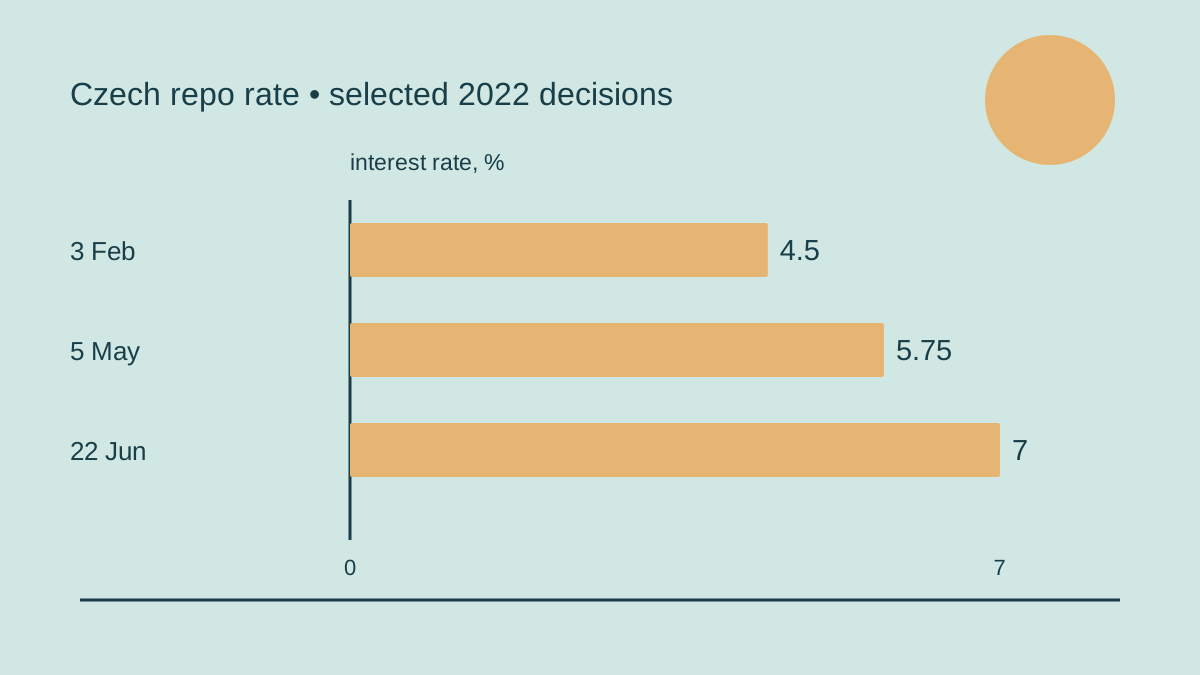
The February 2022 statement raised the repo rate by 75 basis points to 4.5%, with five votes in favour and two for no change. The board cited price pressures arriving from both the domestic and foreign economies. Its forecast expected inflation above 9% at the beginning of the year and a return near the target in the first half of 2023. Production and logistics problems were still constraining the international recovery.
5 May 2022
In May, another 75 basis point increase took the repo rate to 5.75%, again by five votes to two. The board considered a baseline forecast and a scenario allowing a later return to the inflation target. It chose a smaller increase than the baseline implied, but more tightening than the alternative scenario suggested. The forecast expected inflation approaching 15% in late spring and early summer, while anticipated economic growth for the year remained below 1%.
12 May 2022
The extraordinary meeting on 12 May addressed the currency rather than announcing another repo-rate increase. The minutes describe the recent weakening of the koruna as an unwanted easing of monetary conditions during high and rising inflation. The board decided to begin foreign-exchange interventions to prevent a longer-lasting depreciation. It also suspended sales of part of the income earned on international reserves while intervention continued, describing its reserve holdings as large even by international comparison.
22 June 2022
The June decision increased the repo rate by 125 basis points to 7%, with five members supporting the move and two preferring unchanged rates. Inflation had reached 16% in May, about one percentage point above the forecast. More than half of that deviation reflected unexpectedly strong core inflation. The statement highlighted imputed rent and restaurant prices within services inflation, alongside energy and commodity risks. The bank maintained its existing foreign-exchange intervention strategy.
2023
2 February 2023
By February 2023, the board was holding the repo rate at 7%. Five members supported the hold; two preferred a 50 basis point increase. The statement reported a 60% fall in the volume of new mortgages during 2022 and an 81% annual decline in December. A stronger koruna had also tightened conditions. The new forecast envisaged average inflation of 10.8% in 2023 and 2.1% in 2024, while the board favoured keeping rates unchanged for longer.
29 March 2023
The March hold at 7% was approved six votes to one, with the dissent favouring a 25 basis point increase. Annual inflation had eased from 17.5% in January to 16.7% in February, slightly above the forecast. Household consumption had fallen for five successive quarters; the fourth-quarter decline was 2.8%, the deepest outside the pandemic. The board considered market expectations about an early rate cut premature and identified financial-market volatility as an additional source of uncertainty.
3 May 2023
The May 2023 vote was closer: four members supported holding at 7%, while three wanted a 25 basis point increase. The board discussed scenarios involving a longer period of unchanged rates and elevated inflation expectations. Inflation had fallen to 15% in March from its September 2022 peak of 18%. The new forecast expected average inflation of 11.2% in 2023 and 2.1% in 2024. Although the model envisaged declining market rates, the board expected restriction to last longer.
21 June 2023
In June, five members voted to retain the 7% repo rate and two preferred a 25 basis point rise. Inflation had fallen to 11.1% in May, but the board still regarded both headline and core inflation as unacceptable. The statement reported stagnant first-quarter GDP and a sixth consecutive quarterly fall in household consumption. Nominal wages had increased 8.6% annually, while real wages fell 6.7%. New mortgage volume was down 64% annually over January–April.
3 August 2023
The August hold at 7% was unanimous. The board formally ended the intervention regime announced in May 2022, noting that it had not intervened against koruna depreciation since October 2022. Sales of part of reserve income resumed. Inflation had reached 9.7% in June, yet the board still saw risks from expectations and demand recovery. Its baseline forecast projected average inflation of 11% in 2023 and 2.1% in 2024, with core inflation above 3% in 2024.
27 September 2023
September brought another unanimous hold at 7%. Annual inflation was 8.5% in August, compared with 17.2% a year earlier. Household consumption had recovered slightly after six quarters of decline, but remained 9% below its pre-pandemic level. The board noted that lending to government was offsetting the restraint on private-sector money creation. It anticipated an October increase in measured annual inflation from the comparison base created by the previous year's energy-savings tariff, rather than abandoning its disinflation outlook.
2 November 2023
In November, five members supported holding at 7% and two favoured a 25 basis point cut. Headline inflation had declined to 6.9% and core inflation to 5%, but the board worried about wage bargaining and the next January's repricing. The forecast projected average inflation of 2.6% in 2024 and 2.1% in 2025. The board discussed scenarios suggesting relatively low costs from keeping rates unchanged longer, and said any eventual reduction would initially be moderate and gradual.
21 December 2023
The December decision began easing with a unanimous 25 basis point cut to 6.75%. The statement reported November inflation of 7.3%, or 4.7% after adjustment for the energy-tariff comparison effect. Core inflation had declined to 3.9%. Third-quarter GDP had fallen 0.5% from the previous quarter, a larger decline than forecast. The board nevertheless warned that further cuts could be paused or ended while rates remained restrictive if inflation failed to decline as expected in its forecast.
2024
8 February 2024
The February 2024 cut was larger: 50 basis points to 6.25%, supported by six members; one preferred 75 basis points. The board assumed January inflation had fallen to around 3%, pending the release of the exact figure. Its forecast projected average inflation of 2.6% for 2024 and 2% for 2025. Fourth-quarter GDP had risen 0.2%, according to the flash estimate. The board still expected its rates to exceed the baseline model path in the near term.
20 March 2024
March's 50 basis point cut lowered the repo rate to 5.75%. Five members supported it, while two favoured 75 basis points. Published inflation had fallen to 2.3% in January and exactly 2% in February, a deeper decline than forecast. Core inflation, however, was 2.8%. The board highlighted persistent services-price growth. Household consumption had risen slightly in the fourth quarter but remained 8% below its pre-pandemic level, while the statement described a tentative recovery in retail sales.
2 May 2024
A unanimous 50 basis point cut in May took the repo rate to 5.25%. Inflation had matched the 2% target in both February and March. The new model's rate path was nevertheless higher than in the winter forecast. The board also discussed whether the natural nominal interest rate had risen above its pre-pandemic level; the baseline still assumed 3%. That modelling assumption was separate from the actual repo rate. The forecast expected GDP growth of 1.4% in 2024.
27 June 2024
June brought another 50 basis point cut, to 4.75%, supported by five members; two preferred a smaller 25 basis point move. Inflation had risen to 2.6% in May. The statement put first-quarter household consumption 7% below its pre-pandemic level and reported a 7.9% quarterly fall in investment. Real wages remained 6% below their pre-pandemic level. The board said it was likely to slow the pace of easing or leave rates unchanged as they approached neutral levels.
1 August 2024
The August reduction slowed to 25 basis points, taking the repo rate to 4.5% with unanimous support. The board noted that inflation had been exactly 2% in February, March and June. The forecast expected average inflation of 2.2% in 2024 and 2% in 2025. It assessed risks as broadly balanced. The statement said first-quarter wage growth of 7% had so far been absorbed by profit margins rather than generating further price increases, although the economy remained below potential.
25 September 2024
September's 25 basis point reduction to 4.25% passed six votes to one, with the dissent favouring 50 basis points. The statement described a slow recovery: second-quarter household consumption rose 0.2% from the previous quarter but remained 5.2% below its pre-pandemic level. Wage growth had slowed to 6.5%, while real wages remained 5% below that earlier benchmark. Food prices and core inflation had exceeded the summer forecast. The board also noted that falling longer-term rates had already eased monetary conditions.
7 November 2024
November's cut to 4% exposed three preferences: five votes for 25 basis points, one for no change and one for 50 basis points. The board considered alternative scenarios of weaker euro-area activity and higher retailers' margins. Its forecast expected 1% GDP growth in 2024 and 2.4% in 2025. The statement anticipated a temporary rise in food-price inflation and continued persistence in services. It explicitly warned that future easing might pause, even while interest rates remained restrictive.
19 December 2024
The December meeting paused cuts at 4%, with five votes for the hold and two for a 25 basis point reduction. The updated forecast expected inflation slightly above 2% from the second quarter of 2025 through the end of 2026. The board said disinflation in core components, especially services, was incomplete. Third-quarter wages had grown 7%, nearly a percentage point faster than expected. The statement also linked a short-term inflation increase to renewed food-price growth and comparison-base effects.
2025
6 February 2025
February 2025 resumed easing with a unanimous 25 basis point cut to 3.75%. The board said near-term inflation risks had not yet materialised and foreign demand remained weak. The forecast implied modest further easing followed by broadly stable rates from mid-year. It projected average inflation of 2.4% in 2025 and 2.1% in 2026. The statement contrasted restrained private lending with above-average money-supply contributions from financing the government deficit, and retained caution about services prices and wages.
26 March 2025
March's unanimous hold left the repo rate at 3.75%. The statement reported annual fourth-quarter GDP growth of 1.8% and market-sector wage growth of 8.3%, the latter 0.6 percentage point above forecast. Services prices remained elevated. The board also assessed the potential introduction of retaliatory import tariffs as inflationary, while planned German fiscal expansion reduced the likelihood of a severe German downturn. It therefore described the overall risk balance as more inflationary than at the previous meeting.
7 May 2025
The May cut lowered the repo rate 25 basis points to 3.5%, with six votes in favour and one for a hold. April's flash inflation estimate was 1.8%, but rising services inflation kept the board cautious. The forecast expected average inflation of 2.5% in 2025 and 2.2% in 2026. GDP growth was projected at 2% and 2.1%, respectively. The board stressed that the precise form of international trade barriers was unknown and their medium-term effects could not yet be reliably assessed.
25 June 2025
The June hold at 3.5% was unanimous. The updated outlook put inflation above 2% for the remainder of 2025, with core inflation elevated throughout the forecast horizon. The board singled out services prices, wages and the recovering property market as reasons for caution about further easing. The statement reported annual first-quarter GDP growth of 2.2% and wage growth of 6.7%. Foreign demand remained weak, while household consumption was driving domestic growth and property prices contributed increasingly to inflation.
7 August 2025
August maintained 3.5%, again unanimously. The statement put money growth at 4.1% and noted gradually increasing credit growth. The forecast projected average inflation of 2.6% in 2025 and 2.3% in 2026, alongside GDP growth of 2.6% in both years. The board regarded stronger lending, especially in property, as a potential inflation risk. It also identified a stronger koruna as a possible counterweight and the future launch of the second emissions-trading system as a later price risk.
24 September 2025
September's unanimous hold kept the repo rate at 3.5%. The statement reported second-quarter annual GDP growth of 2.6%, household-consumption growth of 3.4% and wage growth of 7.8%. Headline inflation had eased from 2.9% in June to 2.5% in August, while core inflation stood at 2.8%. Services and property prices remained prominent concerns. The board also highlighted sovereign-debt risks abroad and financial markets' growing sensitivity to them, alongside domestic credit, wage and public-spending risks.
6 November 2025
November produced another unanimous hold at 3.5%. The flash estimate showed third-quarter GDP growth of 0.7% quarterly and 2.7% annually. The forecast expected average inflation of 2.5% in 2025 and 2.2% in 2026; GDP growth was projected at 2.3% and 2.4%. The board continued to describe domestic pressures as preventing further cuts. Weak performance in parts of the euro area provided a downside risk, partly offset in Germany's case by the planned fiscal stimulus.
18 December 2025
The December hold at 3.5% was supported by all six members present. Updated data put third-quarter GDP growth at 0.8% quarterly and 2.8% annually, while annual wage growth was 7.1%. The board assessed risks as balanced overall, although services inflation, property prices and lending continued to warrant attention. It noted that wages were rising fastest in services. A stronger koruna, weak euro-area activity and a possible global asset-price correction were identified as potential anti-inflationary influences.
2026
5 February 2026
February 2026 retained 3.5% unanimously despite a lower headline inflation forecast. The bank projected average inflation of 1.6% for 2026 and 2.1% for 2027, with GDP growth of 2.9% in each year. It attributed much of the temporary inflation reduction to transferring the renewable-energy fee to the state budget. Core inflation was expected to remain elevated. The board sought to preserve low inflation after temporary effects faded, citing credit, wages, household consumption and property prices.
19 March 2026
The March hold at 3.5% was unanimous. February inflation had fallen to 1.4%, its lowest in ten years. The updated forecast partly incorporated higher oil prices but still expected headline inflation below 2% in 2026. The board considered the Middle East conflict's effects on prices, activity and financial conditions difficult to evaluate. It said low inflation and robust domestic growth allowed time for analysis rather than requiring an immediate response, while continuing to monitor possible effects on expectations.
7 May 2026
May again held 3.5% unanimously, amid what the board called exceptional uncertainty over the Middle East conflict. The new forecast expected inflation in the upper half of the tolerance band for the remainder of 2026 because of fuel prices. Average inflation was projected at 2.2% in 2026 and 2.4% in 2027; GDP growth at 2.5% and 2.7%. Preliminary first-quarter annual growth had slowed to 2.1%. The board discussed multiple scenarios and remained concerned about credit, wages and services prices.






Leave a comment