
Official electronic mail for small businesses
The Finance Ministry has prepared two related bills on official electronic mail for small and medium-sized legal entities in Russia. Kommersant reported the proposal on 9 October 2026. The voluntary arrangement would use an address on Gosuslugi. If adopted, the changes would take effect on 1 January 2028. Existing companies could qualify: they must not undertake licensed activities or provide financial-market services. The director must reside in the country.
The sector’s scale and registry information
The July update of the unified small-business register provides context for the initiative. The Federal Tax Service reported 6.6 million enterprises and individual entrepreneurs, an increase of 222,500, or 3.5%, from a year earlier. They represented 81.8% of existing legal entities and individual entrepreneurs, compared with 81.1% in 2025. During the first half of 2026, registry information was requested 78.8 million times. These figures describe the sector at the July snapshot and demand for information. They do not identify how many companies would qualify for, or choose to use, the proposed mail arrangement.
Registration already has electronic channels
A 31 July statement from the tax administration in Belgorod Region said that 92% of business-registration documents were submitted electronically as of the beginning of that month. The agency described services for preparing applications, changing information and terminating a business. Start Business Online combines registration of an eligible limited liability company or individual entrepreneur, tax-regime selection, signature issuance and opening a bank account. Users can also select fiscal-data and electronic-document operators. The regional figure measures document submission. It is neither a national share of digital companies nor a measure of their receipt of official correspondence.
A January 2024 tax-service announcement provides a historical example of mobile signatures. More than 80,000 users of its online business-registration service chose to sign registration documents in Goskey during 2023. The agency explained that a confirmed Gosuslugi account and verified registration in the unified biometric system were sufficient for that route; a new-generation international passport was unnecessary. The number concerns a particular service in a previous year. It records adoption of one instrument, rather than the current population of all electronic-signature holders or business readiness for a new state mail system.
Electronic documents and company records
An August tax-service explanation described a separate change: new tax-registration certificates and notifications stopped being issued in January 2026. Previously issued documents remain valid. An extract from the unified taxpayer register serves as confirmation. The electronic extract carries the agency’s qualified electronic signature and has the force of the corresponding signed paper document. Paper requests remain possible. The taxpayer register should be distinguished from the legal-entity, individual-entrepreneur and property registers. Keeping these records separate helps readers understand precisely which status a digitally obtained document confirms and what information it contains.
The tax service separately explains two types of economic-activity codes appearing in corporate registers: declared codes and reported codes. The first originate in business documents, while the second are based on information supplied by Rosstat. When a reported principal activity is established, the previous declared principal code remains as an additional code. Public extracts show codes but not percentage shares; a company or entrepreneur can obtain shares concerning itself. Updating registry content therefore differs from making every item public. Information provenance and access levels affect how counterparties interpret a company’s digital record.
Signatures and a representative’s authority
A March announcement from the tax administration in Khanty-Mansi Autonomous Okrug illustrates the practical role of machine-readable powers of attorney. Following an administrative change, the tax-office code specified in a representative’s authority mattered. Documents using regional code 8600 or national code 0000 did not need replacement; those using former interdistrict codes required changes reflecting the principal’s intent. The tax service offers creation and verification tools, including checks on externally prepared authorisations. This example concerns one administrative reorganisation. It shows why the scope of authority has an independent meaning that possession of an electronic signature cannot replace.
Physical addresses also belong to digital infrastructure. In August, the tax administration in Buryatia reported the region’s twelfth place in the state address register’s relevance ranking for the second quarter of 2026. The tax service operates the register, while local authorities populate and update its information. The ranking reflects users’ reports of missing addresses and their handling. The system retains address-writing history. This concerns reference-data management rather than proof that a particular company actually occupies a property. An address directory and records of a registered enterprise’s activities perform different information functions.
Exchanging business documents
A separate transition concerns electronic shipment-document formats. In an October 2025 publication, the tax service explained that two formats covering goods transfers and completed work or services would cease to apply from January 2026. The universal transfer document becomes the principal electronic document. The change follows an agency order dated 20 January 2025. This is a development in standardising exchanges between businesses, distinct from registration and official mail. A rule governing electronic formats does not by itself mean universal abandonment of paper documents, nor does it confirm adoption of the Finance Ministry’s present initiative.
Foreign registers distinguish addresses from contacts
In the United Kingdom, Companies House announced the first stage of its new powers on 4 March 2024. Measures included a mandatory registered email address and stricter requirements for an appropriate registered office address. Using only a post-office box for the office was excluded. The registrar also gained greater powers to request supporting information and scrutinise company names. This example combines a digital contact with continuing physical-address requirements. It therefore cannot be presented as an already implemented equivalent of dispensing with an office address under the Russian proposal.
Another British stage was announced in August 2025: mandatory identity verification for directors and people with significant control would begin on 18 November. Existing directors had a twelve-month transition linked to their company’s next annual confirmation statement. Verification was available through the government’s single-login system or an authorised corporate service provider. The registrar estimated that six to seven million people would need verification by mid-November 2026. That was a forecast of transition scale, rather than a completed-verification count. Public company information and confirmation of its directors’ identities are different components of trust in the register.
In September 2026, British agencies reported the first court outcomes involving identity-verification requirements. Three directors were fined following hearings on 16 September. The Insolvency Service and registrar described both an unverified director’s actions and another director’s failure to take reasonable steps to prevent that participation. These cases show that introduction of a digital procedure can be accompanied by enforcement. Three cases cannot establish the overall frequency of violations, the success of the entire reform or the general integrity of registered businesses. They are specific reported outcomes within a much larger implementation process.
Implementation results and user experience
The registrar’s annual report covering April 2025 to March 2026 contains separate observations about system operation. By the end of March, 1,060 annotations had been added to company records to flag compliance and registration-integrity issues. In a February survey of users who had completed identity verification, 94% found the instructions clear and 90% found the process easy. These figures concern specific actions and a defined respondent group. They complement implementation information but do not mean that every entrepreneur assessed the service equally or that all information in the register has been verified.
Digital channels also have a distinct fee structure. The registrar’s table, updated in September 2026, listed company incorporation at £100 online or through software, and £124 on paper. The first confirmation statement in a twelve-month payment period cost £50 through either digital route and £110 on paper. These comparisons concern the same transactions submitted through different channels.
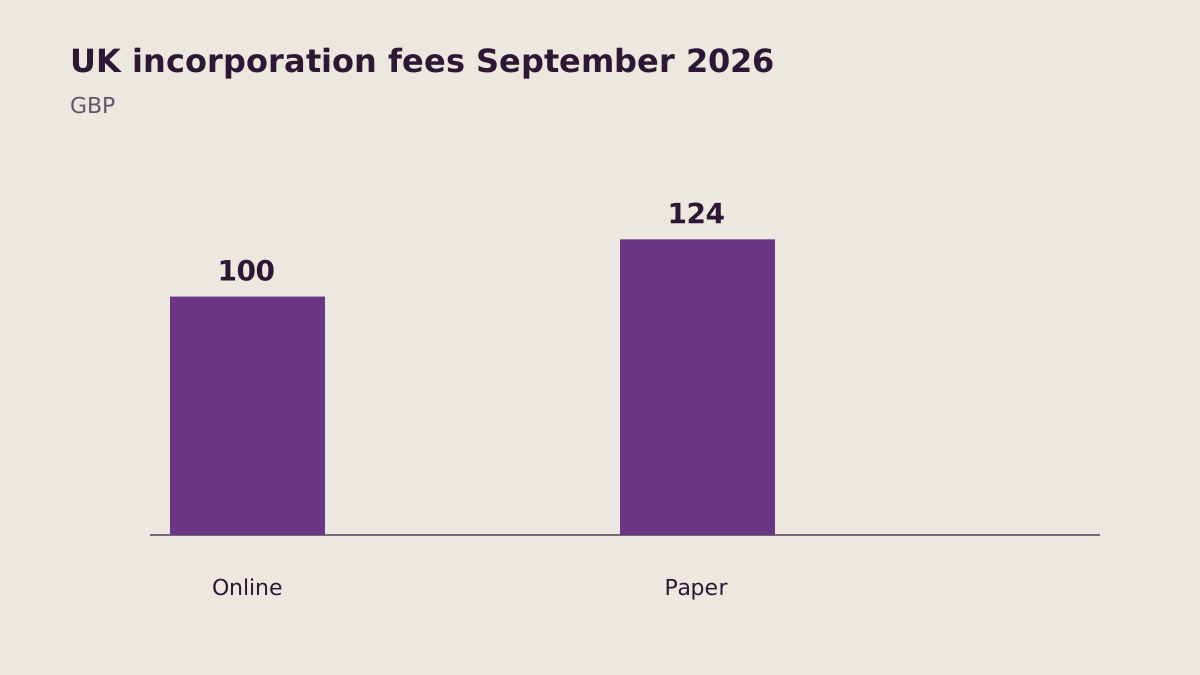
Comparable charges
- Incorporation: £100 online, £124 on paper.
- Confirmation statement: £50 and £110.
A public corporate register requires separate decisions about personal information. British guidance permits applications to remove home addresses from published documents, including addresses formerly used as registered offices. An active company must first change its office address. Since July 2025, procedures have also covered certain signatures, occupation details and days of birth. These mechanisms concern information visible in public documents. They do not eliminate the business, its records or address requirements. Protecting private information and maintaining a legally significant register remain separate tasks, even when both are managed through the same institutional system.
Future reporting has its own timetable
In June 2026, the British registrar announced annual-accounts filing reforms for April 2028 rather than the previously indicated April 2027. The arrangements require commercial software and a structured electronic format. Small companies and micro-entities must file profit-and-loss accounts while retaining an option to withhold them from public publication. Government access remains. Web services for other filing categories will continue. The announcement separates preparation time, transmission method and public visibility. Changing one element does not mean closing every digital channel used by a company or making every submitted account available to the public.
Sharing records across European jurisdictions
In December 2024, the Council of the EU adopted a directive expanding digital tools in company law. It provides for information exchange through interconnected business registers, multilingual company documents and digital powers of attorney. The once-only principle is intended for establishing subsidiaries and branches in another member state. The announcement specifies different periods: thirty months for necessary national measures and forty-two months until application after entry into force. This is a programme for subsequent implementation. Adoption alone does not establish that every planned instrument is already universally available across the participating jurisdictions.
The European digital-identity system received a separate legal framework in March 2024. The Council described a wallet linking national digital identity with verified attributes, such as qualifications or other documents. Users should share only necessary information and control disclosure. Common technical standards and mandatory certification are envisaged. This layer primarily concerns identity and credential verification rather than a single corporate mail address. The announced wallet-availability timetable must be distinguished from the actual readiness of an individual service in a particular country when a company intends to use it commercially.
In November 2025, the European Commission presented a digital package containing a separate business-wallet proposal. The wallets would give companies a single digital identity and simplify administrative work across EU member states. The Commission estimated potential annual business savings of €150 billion from the wallets. That is an announced possible benefit rather than a measured result of an operating system. The corporate proposal should be distinguished from the previously adopted framework for citizens’ identification. Together, they indicate several directions of digitalisation, without allowing the European savings estimate to be automatically transferred to businesses in another jurisdiction.
One portal, several corporate actions
In Singapore, the Accounting and Corporate Regulatory Authority describes Bizfile as a single portal for registration, filings and business information. Its new version launched on 9 December 2024, with the description updated in January 2026. Listed operations include establishing entities, managing information, annual declarations and purchasing business data. Guides, videos and chatbot support are available. The portal brings several administrative activities into one interface. That does not make incorporation, recurring reporting and counterparty research the same procedure: each action concerns a different stage or purpose in a business’s relationship with the register.
Singapore’s corporate-service-provider regulation took effect in June 2025. The authority’s May announcement listed provider registration and obligations concerning money laundering and financing prohibited activities. Nominee directors require fit-and-proper assessments through registered providers. Services include company formation, provision of registered office addresses and filing on another person’s behalf. This example describes the intermediary infrastructure surrounding an electronic register. Delegating an operation to a provider is regulated separately from having an online service. Requirements imposed on the intermediary do not replace the obligations or legal status of the organisation receiving its services.
A separate Singapore change from June 2025 concerns registers of controllers, nominee directors and nominee shareholders. New companies must supply the relevant information at formation. Existing entities had a transition deadline at the end of December 2025. Controllers must confirm information accuracy annually through signed and dated statements. The announcement also described extending the deadline for updating information in the private controller register to seven calendar days. These measures concern the content and maintenance of corporate records. They are independent of the convenience of signing into a portal or receiving electronic mail.
Contact details remain subject to review
An October announcement from Singapore’s authority schedules its next set of changes for 20 October 2026. Annual returns will require confirmation of current particulars concerning directors, secretaries, auditors and relevant members. Fixed minimum public-access hours for offices are to be removed, while prescribed record-inspection access following reasonable notice remains. Changes of registered office address must still be reported within fourteen days. This stage was still forthcoming on the date of the principal Russian report. Greater flexibility in using premises is combined with continuing obligations concerning address information and corporate records.
In Estonia, the official electronic business register combines legal-entity information, applications, documents and annual reports. For electronic formation, everyone involved in the application must be able to sign using the specified Estonian identity tools. The description lists the identity card, mobile identification and the relevant application. Applications are processed by the registration department of Tartu County Court, while the Centre of Registers and Information Systems develops and operates the portal. Separating operator and registrar clarifies the procedure: technical access enables submission, while handling the registry entry remains the function of the authorised institution.
Delegation and a notification’s origin
A December 2025 newsletter from the Australian Securities and Investments Commission reminded intermediaries that authority for a company differs from authority for a business name. Appointment as a company’s registered agent is separate; authority to lodge documents for a business name uses a different access arrangement. Permission to act in one capacity does not automatically authorise the other. In Australia, the digital interface therefore also accompanies distinctions in representation. Registered agents were reminded to report contact-detail changes within fourteen days, including postal, physical and email addresses as well as telephone numbers.
An Australian regulator notice in May 2026 addressed unsolicited intermediary offers to renew business names or assist with company annual reviews. Such messages can resemble compulsory invoices or agency correspondence. The regulator explained that an independent provider must identify itself clearly and separate its remuneration from the official fee. Companies can perform the task directly or through their agent. This does not claim that every intermediary is fraudulent. The example highlights reliable sender identification and understandable pricing: receiving an electronic message does not establish that its proposed service or payment is compulsory.





Leave a comment