The audit’s measured gap
The European Court of Auditors’ January 2026 review found the 2030 network target at risk across eight flagship projects. Estimated costs had risen 82 percent against original estimates and 24 percent since the previous audit, measured at 2019 prices. Its average delay of seventeen years concerned five projects. These measures describe the audit’s selected projects and comparison periods.
Three deadlines in the network regulation
- The EU Council adopted the revised trans-European transport network regulation on 13 June 2024. It set three horizons: the core network by 2030, the extended core by 2040 and the comprehensive network by 2050. The extended core category brought an additional deadline for network development, including cross-border connections. Core network corridors and rail freight corridors were merged into European Transport Corridors, integrating railways, roads and waterways. The legislative sequence began with a Commission proposal in 2021, followed by an amended proposal in 2022 and a provisional agreement in December 2023.
Embankments and crossings in Estonia
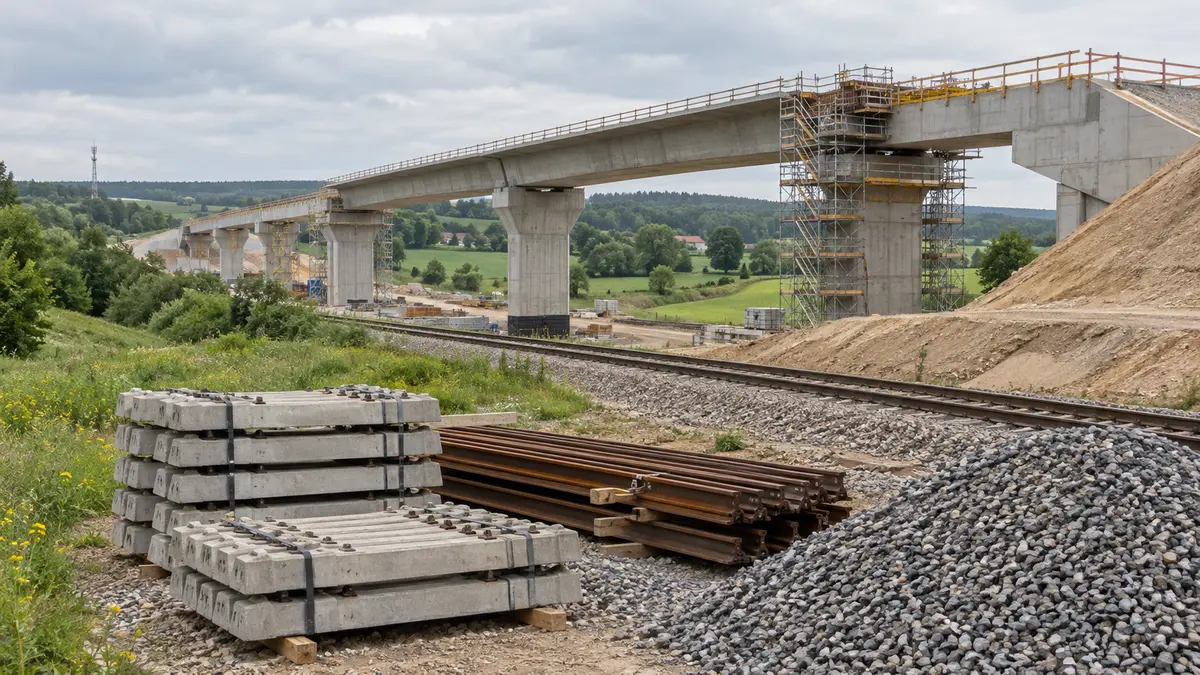
On 7 March 2025, Rail Baltic Estonia signed a design and construction contract with TREV-2 Grupp for the 14-kilometre Kärpla–Selja section. Worth €67.6 million excluding VAT, it covered the Ahekõnnu and Nõlva viaducts, bridges across the Velise and Nurtu rivers, the Kärpla ecoduct, Kootja green bridge and Lihuveski animal tunnel. Financing combined the Connecting Europe Facility with Estonia’s state budget. The schedule extended through the end of 2028, with at least eight kilometres of mainline embankment expected to be finished by 2027.
Alliance procurement reaches selection
Six days later, the Estonian implementing company announced the selection of two international consortia for separate mainline packages. The first covered railway superstructure between Ülemiste and Pärnu and substructure between Tootsi and Pärnu, with an estimated cost of €394 million. The second covered full design and construction between Pärnu and Ikla, estimated at €332 million. Selection preceded the contracts: the announcement specified company background checks, a ten-day period for challenging the decisions and a further fourteen-day waiting period before preparations for signing could proceed.
Signed contracts and terminal plans
By his interview on 23 May, Rail Baltic Estonia chief executive Anvar Salomets confirmed that the mainline contracts had been signed and South Pärnumaa’s spatial planning was complete. He described the alliance arrangement as design and construction under a jointly agreed plan and budget. The company intended Ülemiste terminal to serve existing regional trains before completion of the mainline, while a construction tender for Pärnu’s passenger terminal was planned later in 2025.
Latvia authorises southern works
In Latvia, Eiropas Dzelzceļa līnijas and contractor ERB Rail signed the construction-start document on 11 July 2025. It covered the first four of eleven permits for the southern route from Misa toward the Lithuanian border, including ordnance inspections, embankments, access roads, an overpass and the Iecava River bridge. Preparatory work on the sixteen-hectare Iecava maintenance site was complete; its embankment was under construction and access roads had been built. Board member Jānis Naglis reported funding for the first 45 kilometres and a €153.3 million European Commission allocation.
Foundations beneath the Neris crossing
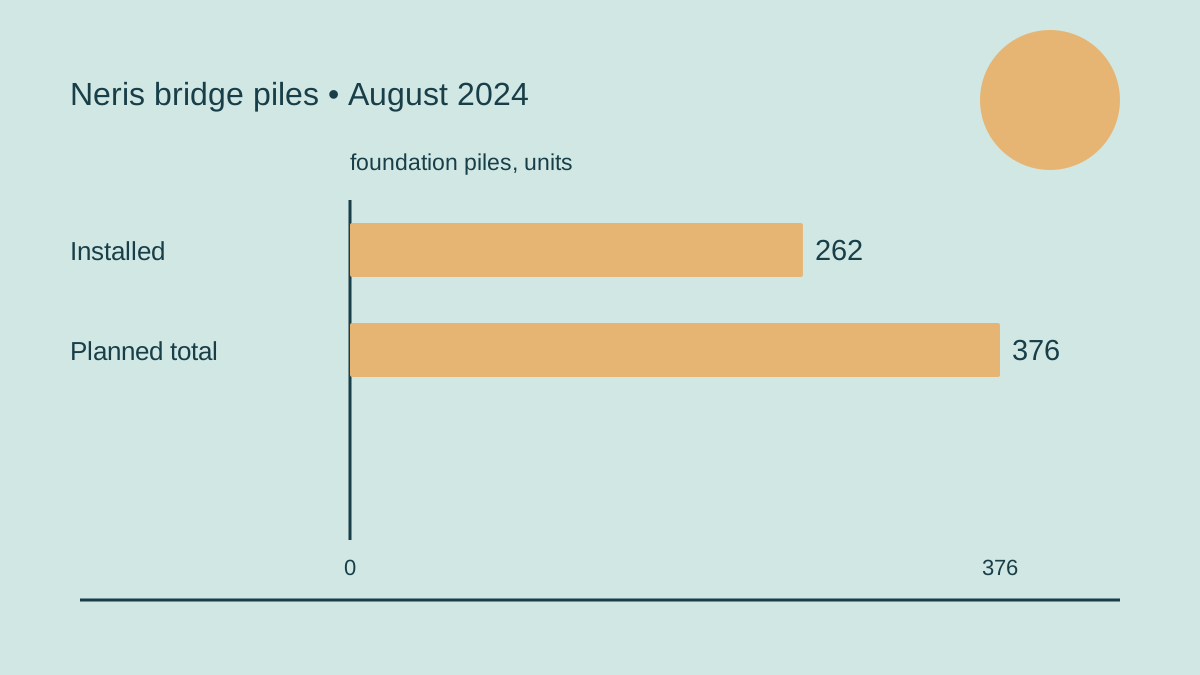
The Neris crossing in Lithuania illustrates the preparatory work beneath a large railway structure. In August 2024, the project reported that Rizzani de Eccher had delivered sheet piling for a temporary protective perimeter around the bridge foundations. The 1.51-kilometre bridge was designed to rise forty metres, using moving scaffolding, balanced construction and formwork. At that stage, 262 of the planned 376 piles had been installed, using 7,600 cubic metres of concrete. The perimeter would permit installation of the pile heads before its subsequent removal.
Earthworks include roads and utilities
A July 2025 contract placed a further 12.1 kilometres of embankment between Šėta and Ramygala with HISK, for €83.36 million excluding VAT. Its scope included two wildlife bridges, a railway bridge, two viaducts and 27 culverts and wildlife crossings. HISK would also repair regional roads, reconstruct drainage and a gas pipeline crossing, relocate electricity distribution infrastructure and install noise barriers. The railway crossed three regional roads. Completion was scheduled for the final quarter of 2027, with funding from the European Union and Lithuania’s national budget.
Track laying follows embankment contracts
In August, LTG Infra signed three contracts worth approximately €235 million. Leonhard Weiss partners received ten kilometres of track laying between Šveicarija and Žeimiai, valued at €13.9 million excluding VAT. Work on 8.8 kilometres was scheduled for year-end 2025, with remaining tasks extending into early 2027; stone, sleepers and rails had already been procured. Two embankment contracts toward Šveicarija covered 8.5 kilometres for HISK and 10.4 kilometres for Fegda and Tilsta, at €97.8 million and €123.5 million respectively, excluding VAT. Both carried early-2028 completion schedules.
Designing the connection toward Poland
The route toward Poland remained a separate design assignment. On 11 August 2025, RB Rail, LTG Infra and DB Engineering & Consulting signed a €38.31 million agreement for design and supervision along the 96-kilometre border–Kaunas section ending at Jiesia. The proposed electrified double-track railway would pass through Marijampolė and connect with the existing Rail Baltica line retained for freight. LTG chief executive Egidijus Lazauskas said priority segments were identified for early design, while construction procurement would be announced in advance to prepare the next stage.
Power supply across three countries
The electrification contract covered a different layer of the railway. Electronically signed on 31 July 2025 and marked by a September ceremony in Vilnius, the €1.77 billion agreement excluding VAT went to COBELEC Rail Baltica, formed by Cobra and Elecnor. Its first phase carried a €949 million budget and a 2030 completion schedule. The full scope comprised 870 kilometres of railway and 2,403 kilometres of tracks. The planned power system combined static frequency converters with a 2×25-kilovolt, 50-hertz arrangement supplied by ten traction substations.
Signalling procurement enters negotiations
Signalling was still in procurement when RB Rail announced a month of negotiations with four qualified bidding groups on 3 April 2025. They included Hitachi-related companies, Indra with AŽD Praha, SKGN Baltics and Alstom–Cobra–Fima. Procurement chair Aiga Benfelde described an architecture drawing on ERTMS and EULYNX, alongside traffic management, power supply, cable infrastructure and cybersecurity requirements. Negotiations would refine technical and financial proposals against the project requirements and budget. The announcement anticipated signing with a selected supplier by the end of 2025.
Designing freight access to Muuga
A freight branch required its own design contract. In June 2025, AllSpark received the approximately sixteen-kilometre Soodevahe–Muuga assignment for nearly €2.9 million excluding VAT. Besides the new 1,435-millimetre railway, the design covered changes to existing 1,520-millimetre tracks, intersecting roads and utility networks, with service roads, noise barriers, culverts and retaining walls. A control centre and depot were included at the freight terminal. The contract’s final design deadline was September 2027; earlier design packages were intended to enable construction that year, with works expected through 2030.
Drill-and-blast excavation at Hochstegen
The Brenner project recorded a breakthrough on 8 May 2025 in the east main tunnel of the H53 Pfons–Brenner lot. The southward excavation used drilling and blasting in the difficult Hochstegen geology, around 1,200 metres beneath Padauner Kogel near Steinach am Brenner. BBT’s following-day report put total tunnel excavation at 196 kilometres, or 85% of the system.
Concrete lining produced beside the portal
At Ahrental, the last precast lining segment left the production line on 19 July 2025. Since February 2023, the dedicated factory had made approximately 59,000 segments, averaging around ninety a day. The H41 consortium chose local production because the site lacked an external railway connection. Moulding, reinforcement, casting and curing took place in sequence; special vehicles and construction trains then carried the segments underground. Implenia project manager Marco Reith said part of the factory hall would subsequently be used to make reinforcement cages.
Ida completes the western drive
A separate August breakthrough completed Ida’s southward drive in the western main tube of the H41 Sill Gorge–Pfons lot. After approximately 26 months, the machine reached the Iris auxiliary excavation near Navis, adjoining H53. It had bored 8.4 kilometres from Ahrental since June 2023. The machine was approximately 160 metres long and weighed 2,420 tonnes, with a cutterhead about 10.4 metres across. Its route crossed the Viggar valley and Walzn fault zones and the roughly 35-metre Werner zone, which it traversed early in 2025.
The eastern drive follows in October
Lilia reached the eastern main tunnel’s breakthrough point near Navis on 6 October 2025, at approximately 12:40. Its excavation had covered 8.1 kilometres from Ahrental since May 2023, passing through complex geological zones before reaching the Iris connection toward the adjacent Pfons–Brenner lot. BBT reported that this completed both mechanised and conventional main-tunnel excavation in H41. At that date, only Wilma and Olga remained active among the nine tunnel boring machines originally used across the project, both working in the neighbouring H53 lot.
An exploratory connection across the border
September’s cross-border event concerned the exploratory tunnel beneath the Brenner Pass. On 18 September 2025, a chisel excavator connected the Austrian H53 and Italian H61 sections around 1,400 metres below the border. This tunnel supported geological investigation and construction logistics, with drainage and maintenance functions envisaged for railway operation. BBT then reported 204 kilometres excavated within its approximately 230-kilometre tunnel system: 100 kilometres of main tubes, 57 of exploratory tunnel and 47 of other tunnels. The border connection was in the exploratory passage, which was not intended for trains.
Viviana begins its Maurienne assignment
The Lyon–Turin project marked a new mechanised excavation stage on 1 April 2025, when French transport minister Philippe Tabarot and his Italian counterpart Matteo Salvini attended Viviana’s launch ceremony. The first of seven TELT tunnel boring machines was assigned nine kilometres between Saint-Martin-La-Porte and La Praz. Built and assembled by Herrenknecht, it measured 180 metres long, with a 10.4-metre diameter and a 2,300-tonne weight. Its cutterhead carried 61 cutters and its installed power was 8,100 kilowatts. The operator forecast an advance of 300–450 metres a month.
Casting the immersed tunnel
Fehmarnbelt uses factory-made concrete elements for an eighteen-kilometre immersed link between Rødbyhavn in Denmark and Puttgarden in Germany. In July 2023, a 140-person Femern Link Contractors team completed the first casting, a segment approximately 24 metres long. The production plan comprised 89 tunnel elements, including 79 standard units measuring 217 metres long, 42 metres wide and nine metres high. Each standard element was assembled from nine cast segments. The first pour therefore began the segment-production sequence inside the purpose-built factory at Rødbyhavn.
Completed elements move into the basin
By February 2025, the first two completed tunnel elements had moved from the factory’s dry dock into its basins. The operation followed weeks of testing involving dock flooding and closure of the watertight factory gate. Seven standard elements and two special elements had been cast; the special units included basements for technical equipment. Preparation for the first immersion still lay ahead. The contractor planned to attach a special pontoon at each end of an element and add ballast concrete before lowering it into the tunnel trench. The elements would remain in the basins until the contractor was ready for final work.
The portal and its railway ramp
On the Danish shore, September 2025 work was approaching completion on the 160-metre cut-and-cover portal. Crews were covering the land-based tunnel sections with soil after construction that had begun in 2022. The railway approach remained under development: 300 metres of an 800-metre ramp were complete, and an operations building was being constructed for personnel and monitoring systems. Before the first underwater elements could be connected to the portal, the immersion vessels Ivy 1 and Ivy 2 needed final tests and permits, which Sund & Bælt expected later that year.
Marquion’s tender combines engineering and supply rules
The Marquion lock tender opened on 25 July 2025, with bids due in September and an award expected in the second half of 2026. The design specified a 25.71-metre fall and a chamber 197 metres long and 12.5 metres wide. Thin walls would be supported by treated local silts. Tender evaluation favoured rail or waterborne delivery of materials and required bidders to explain their concrete-and-steel carbon strategy. Water-saving basins and pumping were part of the lock design, whose filling and emptying target was ten to thirteen minutes.
Quays and excavation contracts
December contract awards addressed construction logistics as well as locks. Spie Batignolles Nord received rehabilitation of existing Canal du Nord quays, while a Charier-led group received the new Catigny quay. These formed part of a nine-quay programme for river delivery of construction materials. Preparations were scheduled for three months, followed by seven months of works beginning in the first half of 2026. A Guintoli-led consortium separately received upper excavation works for Oisy-le-Verger lock, designed with a 25-metre fall and a 195-by-12.5-metre chamber; its planned works duration was nine months after preparation.
Diaphragm walls at Montmacq
Actual diaphragm-wall construction began at Montmacq–Cambronne-lès-Ribécourt in early December 2025. The operator described twenty-metre trenches excavated with a mechanical grab and stabilised with water and bentonite clay. Reinforcement cages were inserted before concrete displaced the supporting slurry to form the walls. Construction would proceed from the lock chamber to its upstream and downstream heads, then to the pumping station. The structure’s design specified a 6.41-metre fall and a chamber 195 metres long by 12.5 metres wide. This was the first structural phase of the lock’s watertight enclosure.
A base for assembling the Basque railway
A Spanish official notice dated 16 October 2025 advertised an ADIF Alta Velocidad tender for the Gipuzkoa track assembly and storage base on the Basque Y railway. Its estimated value was €19,066,297.38 and the specified duration seventeen months. Price carried 51 percent of the evaluation, with judgment-based quality criteria accounting for 49 percent. Bids were due on 24 November and opening was scheduled for 17 December. The notice allowed possible Connecting Europe Facility cofinancing; it did not report an awarded contract or a secured grant.
Passenger service on a renewed E59 section
Poland’s railway manager reported on 9 December 2024 that two renewed tracks, overhead equipment and signalling were ready along 190 kilometres between Poznań and Szczecin. The timetable beginning on 15 December offered the fastest journeys in under two hours at speeds up to 160 kilometres per hour; a later December report confirmed the service change. New platforms served thirty localities, with tactile surfaces and station underpasses improving access. Work at Stargard remained unfinished, with completion then forecast for the second half of 2025. The operating section had a narrower scope than the whole E59 project.
Romania’s A1 combines excavation and an open section
Webuild’s first-half 2025 report recorded a second construction permit for A1 Lot 3 and the start of work at the Poiana tunnel and ten viaducts following approved designs. The lot’s planned scope covered 37.4 kilometres, forty-nine bridges and viaducts and a 1.7-kilometre tunnel. On Lot 5, approximately fifteen kilometres between Băiculești and Curtea de Argeș opened during the first half of the year. Auxiliary roads, hydraulic works, landscaping and two operating centres remained under construction. The report thus distinguished an opened section from ongoing works within the contractor’s separate lots.



Leave a comment