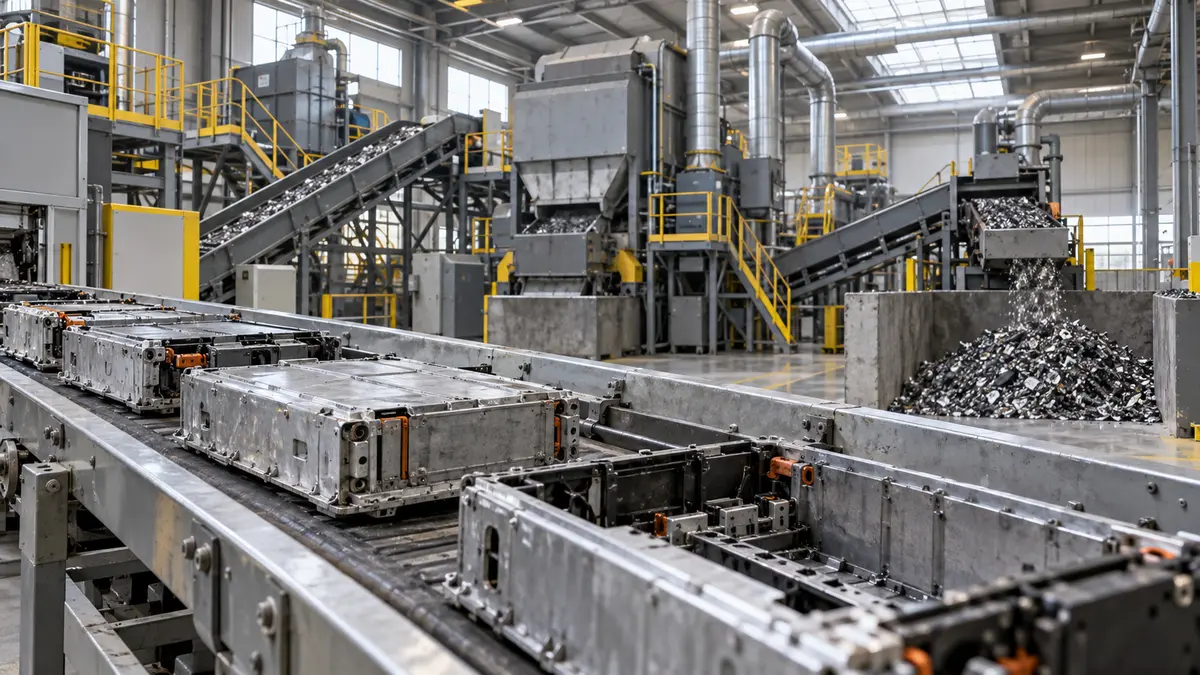
An integrated route at Kuppenheim
Mercedes-Benz’s October 2024 opening in Kuppenheim, Germany, connected mechanical battery treatment with hydrometallurgical recovery. Euronews reported that the company expected recovery above 96 percent and material for more than 50,000 new battery modules annually. These were expected performance and output figures. The plant’s process encompassed shredding modules, separating materials and processing and drying active battery components.
Recovery and recycled content have separate targets
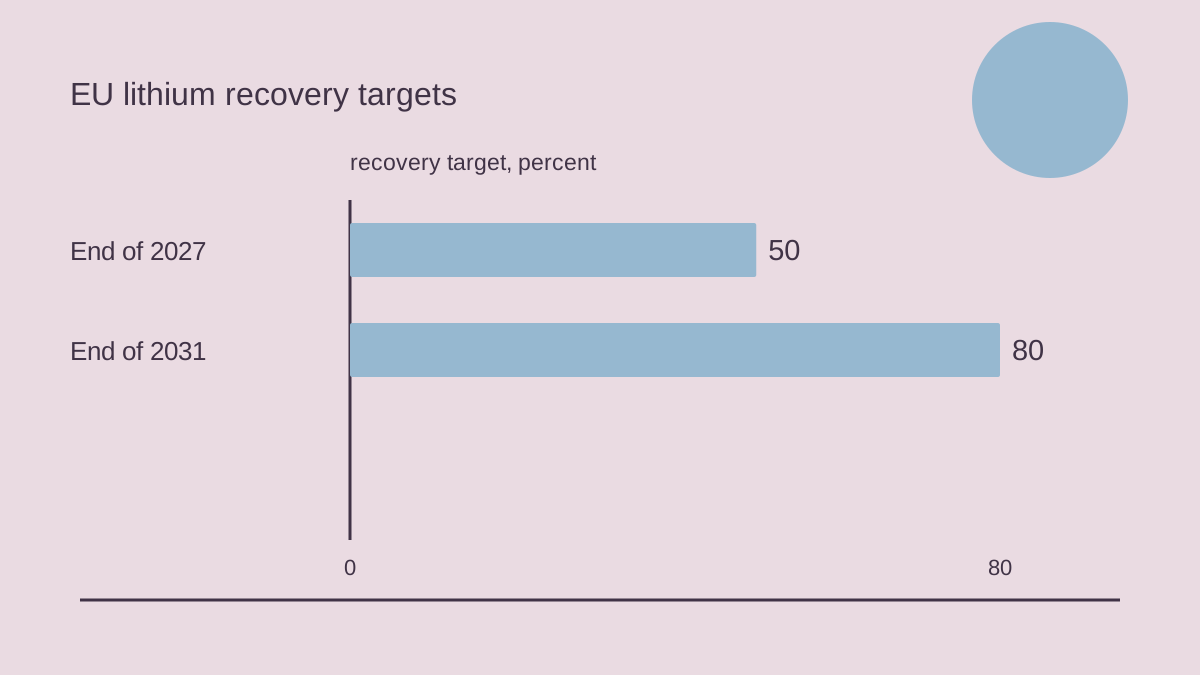
- The EU Council adopted the batteries and waste batteries regulation on 10 July 2023, covering the lifecycle from production to reuse and recycling. Its scope included vehicle, industrial, portable and light-transport batteries. Lithium recovery targets were 50 percent by the end of 2027 and 80 percent by the end of 2031. Future minimum recycled-content levels for industrial and vehicle batteries were set at 16 percent for cobalt and six percent each for lithium and nickel, alongside documentation requirements. Collection obligations and extended producer responsibility formed another part of the framework.
Capacity figures measure different process stages
Fraunhofer ISI’s August 2024 review separated pretreatment sites from refining hubs. The former collect, discharge, dismantle and process batteries into black mass; the latter recover metals from that intermediate material. Its expected 300,000 tonnes of European pretreatment capacity by year-end included announced facilities not yet commissioned. The institute cautioned that reported capacities describe maximum site capability, rather than actual throughput. Integrated plants appear in both stage totals, making simple addition inappropriate. Its June survey therefore described infrastructure announcements alongside existing sites, with different recycling depths.
Construction funding and the original operating plan
Hydro announced construction at Fredrikstad, Norway, in January 2021. Hydro and Northvolt had invested NOK 120 million through Hydrovolt, which had also received NOK 43.5 million from Enova in November 2020. The original plan specified more than 8,000 tonnes of battery modules annually and a late-2021 operating start. Adjacent company Batteriretur would supply batteries and operate the plant. Renewable power, automated crushing and sorting, aluminium reuse by Hydro and black-mass supply to Northvolt or other buyers were parts of the proposed arrangement.
Commercial operation uses a pack-based capacity measure
Hydrovolt reported the start of commercial recycling in Fredrikstad on 15 May 2022. The operating plant had a stated capacity of approximately 12,000 tonnes of battery packs annually, equivalent to around 25,000 vehicle batteries. Its reported material recovery exceeded ninety percent, covering plastics, copper, aluminium and black mass. A dust-collection system captured material otherwise lost during mechanical treatment. The capacity concerned complete packs, whereas the earlier construction plan measured modules. Further processing of the black mass into battery-grade material still required a hydrometallurgical stage.
Harjavalta produces recovered metal sulphates
Fortum announced commercial operation of its Harjavalta hydrometallurgical facility in Finland on 27 April 2023. It was already producing nickel and cobalt sulphates that the company said met customer specifications. Fortum reported recovery of 95 percent of valuable and critical metals from black mass. That denominator differed from its separate claim that mechanical and hydrometallurgical processes together could recycle eighty percent of a battery. The company also processed metal-industry side streams at Tornio to produce a nickel intermediate, adding another source of feedstock to its recycling activities.
An offtake agreement connects Norway and Finland
The two Nordic operators signed a black-mass delivery agreement announced on 27 February 2024. Hydrovolt’s Fredrikstad plant would mechanically process vehicle batteries, with the resulting powder shipped to Fortum’s Harjavalta facility for metal recovery. The companies described it as their first commercial black-mass offtake agreement. The powder contained active battery materials including lithium, nickel, manganese, cobalt and graphite. Chemical treatment was needed to turn those components into materials suitable for new batteries. The agreement connected the existing mechanical and refining stages through a defined commercial delivery relationship.
Financing supports the next expansion stage
In May 2024, Hydrovolt secured NOK 63 million in investment financing through DNB and Export Finance Norway, Eksfin. DNB facilitated the financing, while Eksfin provided a guarantee to the bank. Hydrovolt intended to develop its Fredrikstad operations and prepare further European expansion. The company had 65 employees and was considering facilities in other European markets to obtain batteries reaching the end of their useful lives. Chief financial officer Erik Magelssen linked the financing to scaling capacity and expertise, drawing on the company’s existing industrial experience.
Hordain starts with collection and dismantling
Hydrovolt’s July 2024 final investment decision concerned Hordain in northern France. The company chose a region that had attracted four major battery factory investments, citing industrial skills, automotive experience and location. Its first step would be a collection point able to discharge and dismantle vehicle and industrial batteries. The selected site had approximately 3,000 square metres configured for recycling operations. Startup was estimated for 2025, subject to final permits.
Kirchardt receives batteries and production scrap
Fortum received an environmental permit from the Heilbronn district authority and started operations at Kirchardt in southern Germany in March 2023. The hub could receive end-of-life batteries and battery production scrap, with stated pretreatment capability above 3,000 tonnes annually. Its central-European customers would connect to the company’s Finnish chemical recovery facility through that entry point. Operations director Frank Stumpf described services covering pretreatment, black-mass production and metal recovery. The German site was operating and accepting deliveries; its role was an upstream part of the wider recycling route.
Artern remains a feasibility and development proposal
In July 2023, Fortum was examining a secondary-materials production facility at Artern in Thuringia. It had begun discussing a black-mass development plan with local authorities, following initial contact in April 2022. The mayor welcomed an estimated seventy potential jobs. Fortum’s broader 2030 ambition was to handle more than 200,000 tonnes of battery waste, with two additional hydrometallurgical facilities and roughly seven mechanical units in Europe.
Acquiring an existing mechanical separation site
Redwood Materials acquired Redux Recycling in September 2023, obtaining a Bremerhaven facility equipped for 10,000 tonnes of annual processing. Approximately seventy technical staff joined Redwood’s European team, including chemical engineers, metallurgists and materials scientists. The site handled vehicle and electric-bicycle batteries, stationary storage and consumer products such as laptops and power tools. Its mechanical separation expertise produced high-purity metal concentrate. Redwood described its hydrometallurgical technology as complementary to Redux’s pretreatment capabilities. The transaction established a German operating presence near the port, with capacity across several battery formats and chemistries.
A Polish joint venture and separate expansion plans
Ascend Elements and Elemental Strategic Metals formed the equally owned AE Elemental venture in April 2024. Its newly constructed Zawiercie facility in Poland had a stated capacity of 12,000 tonnes annually, approximately 28,000 vehicle batteries. Disassembly, discharge and shredding would produce black mass for new battery materials. The partners separately planned investment in lithium extraction, with construction expected in autumn 2024 and operation in 2026. A proposed German facility would handle 25,000 tonnes annually.
Cathode production opens alongside recycling construction
BASF’s June 2023 Schwarzheide event combined inauguration of a cathode active materials plant with unveiling of a black-mass recycling project. The company described the cathode facility as fully automated, supplying materials tailored to European cell manufacturers and vehicle producers, with its output already sold for subsequent years. The two projects were expected to create approximately 180 jobs. Black-mass construction had begun, but production was forecast for 2024. Federal and Brandenburg support formed part of the European battery IPCEI programme. The ceremony thus brought together an inaugurated production facility and recycling capacity under development.
The prototype develops operating procedures
In April 2024, BASF started its prototype metal refinery at Schwarzheide. It processed end-of-life lithium-ion batteries and manufacturing scrap to develop operating procedures and optimise recovery technology. The targeted metals included lithium, nickel, cobalt, manganese and copper. The prototype complemented the site’s cathode production, while the black-mass plant was still scheduled to begin operations later in 2024. BASF intended to scale the refining technology into a commercial European facility over subsequent years.
Halmstad supplies a refining partnership
BASF and Stena Recycling signed a black-mass purchase agreement announced in January 2024. Stena’s role covered collection, assessment, dismantling and discharge of batteries and production scrap, followed by mechanical treatment at Halmstad in Sweden. BASF would process the resulting black mass through its Schwarzheide prototype and recover metals for new cathode materials. The partners also intended to improve black-mass production processes and transfer the model to a planned commercial refinery. Their agreement defined complementary collection and processing responsibilities across two countries, with the larger refining installation still a future project.
Seed funding develops a university-derived process
Cylib raised an €8 million seed extension in February 2023, bringing the total seed round to €11.6 million. World Fund led, with 10x Founders, existing investors VSquared Ventures and Speedinvest, and business angels participating. The RWTH Aachen University spin-off had a patent-pending recycling process and customers among vehicle manufacturers, battery producers and materials processors. Its water-based lithium and graphite recovery was intended to reduce additive and acid use. Co-founder Paul Sabarny described the development work as refining recovered-material quality for subsequent use in battery production.
Aachen demonstrates the pilot process
Cylib commissioned its Aachen Rothe Erde pilot line in September 2023, reporting immediate capability to recycle around 500 kilograms of batteries daily. The company had moved into the facility in January and built the infrastructure to begin operation within nine months. The pilot implemented its integrated recovery process, including water-based lithium and graphite recovery alongside other battery metals. Industrial-line planning was already underway. Sabarny said discussions with Aachen and other potential locations were progressing, with a site choice intended later that year. The operating pilot and proposed industrial line had different scales.
Equity funding backs industrialisation and hiring
A €55 million equity round followed in May 2024, co-led by World Fund and Porsche Ventures. Bosch Ventures, DeepTech & Climate Fonds, NRW.Venture, existing investors and business angels also participated. Cylib intended to scale at an already secured German brownfield industrial facility and recruit additional specialists. Its team exceeded sixty people. The company said it had completed recycling projects for automotive manufacturers, suppliers and refineries.
Dormagen moves from funding to construction
September 2024 brought groundbreaking at Currenta’s Chempark Dormagen site. Cylib’s planned industrial facility occupied approximately 22,000 square metres and was designed for around 30,000 tonnes of end-of-life batteries annually, with an initial expectation of 170 jobs. The chemical park provided existing supply chains, chemical infrastructure and supporting services. Its location between Düsseldorf and Cologne connected the project to rail, road, air and waterborne logistics. Cylib described customers in automotive, battery manufacturing and chemical industries.
Bessines connects two industrial pilots
Orano commissioned two industrial pilots at its Bessines extractive-metallurgy innovation centre in November 2023. The pretreatment pilot began early that month after receiving a regional environmental permit covering used modules and manufacturing scrap. Its process had previously been designed and tested at laboratory scale with CEA Liten. The resulting active-material powder entered an existing hydrometallurgical pilot for purification. Together, the installations could handle the equivalent of two to three vehicle batteries daily. Orano used them to produce customer samples, test technologies and gather feedback for subsequent commercial plant design.
Dealer collection feeds the UK recycling route
Volkswagen Group UK expanded its Ecobat recycling relationship through a February 2024 agreement. Their cooperation had begun with lead-acid batteries in 2014 and extended to high-voltage batteries in 2019. The new arrangement covered collection from dealers, distributors and end-of-life recycling centres using vehicles compliant with dangerous-goods transport rules. Batteries would enter Ecobat’s new UK lithium-ion recycling centre. Its Darlaston diagnostics and disassembly operation had already processed and upgraded thousands of batteries. The agreement linked automotive distribution, battery assessment and recycling services within the company’s collection and treatment network.
Teesside’s study separates feedstock and product capacity
Altilium completed a six-month feasibility study for Teesside in February 2023 with Automotive Transformation Fund support. Hatch designed a plant for 50,000 tonnes of black-mass input annually. Its proposed two-facility model comprised chemical production of 95,000 tonnes of battery precursors and 30,000 tonnes of cathode active materials. The design accommodated several battery chemistries and optional primary nickel-cobalt mixed hydroxide feed to address supply or quality imbalances. Costs remained confidential, while around 250 skilled jobs were projected.
Nissan’s consortium develops material qualification
A March 2024 Nissan-led collaborative project had a £30 million budget and £15 million grant, with Altilium and Connected Energy among its participants. Work at Nissan Technical Centre Europe in Cranfield would develop battery reuse, recycling and energy-balancing technology. Altilium’s role included processing spent Nissan Leaf batteries and manufacturing scrap into high-nickel cathode active material for testing in future batteries. The grant concerned the consortium, rather than an announced allocation solely to Altilium.
Recovered graphite undergoes anode-material testing
Altilium and Talga’s March 2024 agreement addressed graphite recovery for new battery anodes. Graphite from Altilium’s Tavistock technology centre and planned Plymouth facility would supply the collaboration. Talga would apply chemical purification methods and test coin cells and single-layer pouch cells. The partners reported that initial recycled-graphite tests matched primary graphite in purity and physicochemical characteristics. Their work aimed to optimise recovery into a battery-grade product, extending attention beyond cathode metals. The agreement described a development and testing route, rather than a completed commercial supply of anodes from recycled graphite.
Plymouth completes the first infrastructure phase
Altilium’s April 2024 update reported completion of the first phase at its Plymouth ACT 2 plant and innovation centre. Finished work included an electrical upgrade, an initial vehicle-battery recycling test bed and equipment procurement. The 18,000-square-foot facility was intended to combine recycling, cathode material production and research across the battery supply chain, with staffing scaling to seventy people. Improvements developed there would inform future plants, including efforts to raise lithium recovery and reduce capital and operating costs.
October collection precedes the next processing milestone
By October 2024, Altilium reported receiving retired batteries from multiple automotive manufacturers, alongside partners Synetiq and Connected Energy. Dismantling and shredding would supply black mass for chemical conversion into high-nickel cathode active materials at its Devon facilities. The mini-commercial plant was nearing completion, with prospective capacity of one vehicle battery daily for material qualification. A separate project with JLR would demonstrate new-cell production at the UK Battery Industrialisation Centre. Collection was already occurring; the described processing expansion and cell demonstration remained next steps, connecting recovered batteries to testing for future manufacturing use.


Leave a comment