
The International Monetary Fund recommended gradual, cautious rate cuts in its consultation assessment reported by Interfax on May 27, 2024. It praised prudent monetary policy while warning of downside risks from a reversal of migrant and financial inflows and weaker reform momentum. The Fund also called for exchange-rate flexibility and reserve accumulation. Its assessment placed monetary normalisation alongside continuing exposure to external shocks.
Pandemic cuts and uneven demand
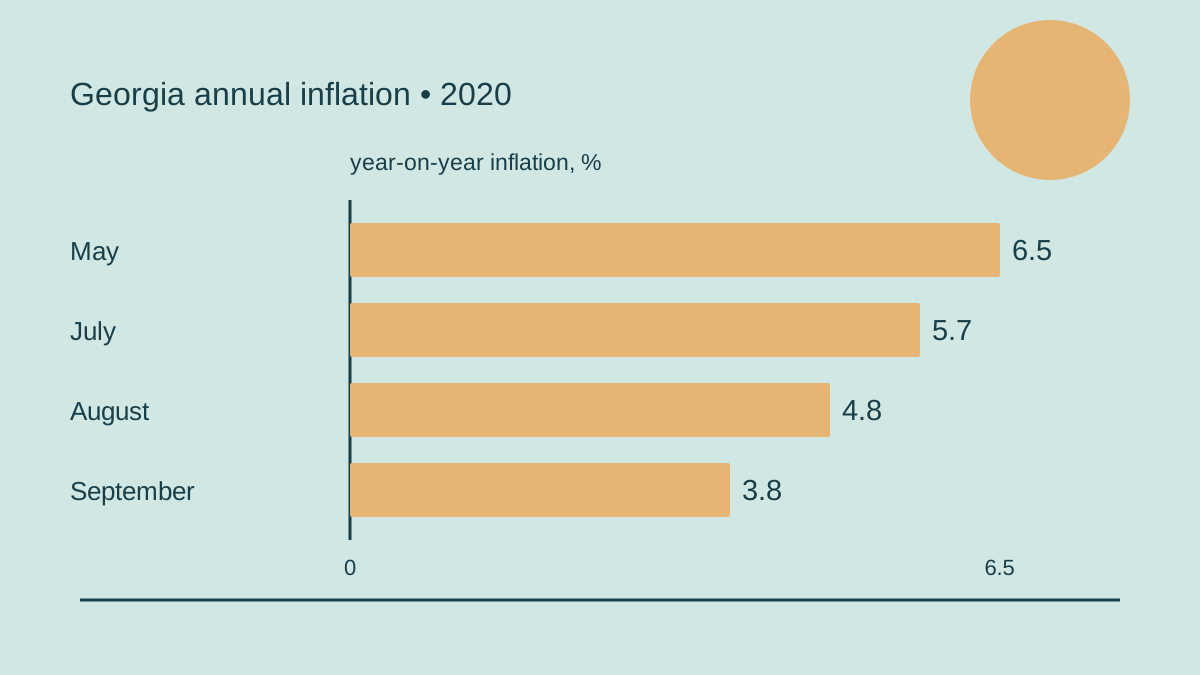
On June 24, 2020, the National Bank of Georgia cut its refinancing rate by a quarter of a percentage point to 8.25%. May inflation was 6.5%. The bank expected temporary supply-cost increases to fade, while weaker domestic and external demand would have a longer effect on prices. It nevertheless described policy as tight after the cut. Preliminary April economic activity had fallen 16.6% from a year earlier. Card transactions rose 21% in May from April, but remained below their year-earlier level. The bank treated these mixed indicators as a reason for uncertainty about the scale of the demand decline.
The next cut, on August 5, took the rate to 8%. The bank reported July annual inflation of 5.7% and a monthly price decline of 0.5%. Its revised forecast anticipated a 5% contraction in the economy during 2020, reflecting a larger expected fall in global activity and external demand than at the pandemic’s outset. Preliminary June economic activity had declined 7.7% year on year. Domestic demand showed signs of recovery compared with April and May, supported by fiscal stimulus, lending and remittances. Even so, prolonged inflation above target kept expectations among the reasons for a slow exit from tight policy.
On September 16, the bank held the rate at 8% as August annual inflation fell to 4.8%. Its forecast still envisaged inflation below target in the first half of 2021, largely because external demand was weak. The committee balanced that forecast against volatile currency markets, prolonged above-target inflation and supply risks. It said the partial mortgage-interest subsidy supported demand with an effect similar to monetary easing. Preliminary international-traveller revenues fell 96% year on year in August, while exports declined 7% and imports 19%. These external indicators accompanied a recovery in domestic demand linked to fiscal support, credit and remittances.
The October 28 decision again left the rate at 8%. September annual inflation had eased to 3.8%, and the bank expected weak demand to keep weighing on prices. It also warned that renewed coronavirus activity and a longer pandemic could slow the following year’s global recovery. Preliminary September goods exports rose 8.6% year on year, their first positive annual change since January. International-traveller revenues, however, were down 95%, and imports fell 9%. The bank expected domestic demand to drive growth in 2021, while making further monetary normalisation dependent on inflation expectations and the evolution of economic activity.
By December 9, the bank was stressing the limits on further easing. It held the rate at 8%, citing higher production costs under new restrictions, uncertainty about the pandemic and high dollarisation. It did not rule out a future rate increase. The same statement described an agreement with the European Central Bank for a €100 million euro repo line, available to support financial-system liquidity if needed. The facility was to run until June 30, 2021, with operational support from the German Bundesbank.
Temporary price relief and renewed tightening
On February 3, 2021, the rate remained 8%, despite January inflation of 2.8%. The bank attributed the recent slowdown in inflation to a temporary government subsidy of utility charges. Its forecast put average inflation around 4% that year, with commodity prices, production costs and currency depreciation creating upward pressure. High dollarisation strengthened the transmission of exchange-rate movements to prices. The end of the partial mortgage-interest subsidy, meanwhile, had an effect the bank likened to monetary tightening. Its growth forecast was also around 4% for 2021, led by domestic demand, while external demand was expected to recover only marginally.
The March 17 meeting raised the rate by half a percentage point to 8.5%. February annual inflation was 3.6%, still affected by the utility subsidy. The bank expected the subsidy’s ending in March to lift measured inflation and its later base effect to push up annual readings in December and early 2022. It forecast average inflation of 4–4.5% in 2021. Rising oil and food prices, higher production costs and persistent currency depreciation were among its reasons for tightening. At that meeting, however, the committee said it saw no apparent need for additional tightening over the rest of the year.
On April 28, the bank increased the rate by a full percentage point to 9.5%. March annual inflation had reached 7.2%, and the updated forecast put the year’s average near 6.5%. The bank linked the upward shift partly to the ending of the utility subsidy, while also citing international commodity prices and pandemic-related production costs. Its baseline growth forecast remained about 4%. The decision also announced changes, starting in July, to foreign-currency reserve requirements according to each bank’s deposit dollarisation. The bank expected those changes to encourage competition for lari deposits and gradually increase demand for the domestic currency.
An external assessment of the policy framework
An August 7 republication by the bank carried Fitch Ratings’ assessment of the policy framework. Fitch affirmed the sovereign’s foreign-currency rating at BB and changed its outlook from negative to stable. The agency cited an improved macroeconomic baseline and confidence in policies supporting stability and public-finance sustainability. It recorded three rate increases that year, taking the rate to 10%, alongside July inflation of 11.9%. Fitch nevertheless highlighted vulnerability to external shocks in a small, highly dollarised economy. Its positive assessment of the monetary framework accompanied concerns about high net external debt and a comparatively low external liquidity ratio.
On December 8, the rate rose another half-point to 10.5%. November inflation was 12.5%; the bank estimated that temporary external factors contributed about nine percentage points. Imported inflation reached 18%, even though the exchange rate had appreciated from a year earlier. The bank also identified stronger domestic demand, supported by fiscal stimulus, pent-up spending and faster lending. It said the widening interest-rate gap between lari and foreign-currency loans had encouraged foreign-currency borrowing, creating exchange-rate risks. A future rate reduction, under the conditions described at that meeting, required significantly lower inflation and inflation expectations.
High rates alongside credit measures
By May 11, 2022, the rate stood at 11%, and the committee kept it there. The statement reported inflation of 12.8%, with international price increases and supply disruptions affecting the domestic market. The bank’s revised growth forecast was about 4.5% for 2022, subject to unusually high uncertainty. Strong consumer and foreign-currency lending remained a concern despite monetary tightening. The bank said remuneration on dollar reserve requirements would remain zero as external rates increased. It also retained the option of further measures, including raising the upper bound of foreign-currency reserve requirements, then 25%, if needed to slow foreign-currency loan growth.
The June 22 hold at 11% brought a specific housing-market pressure into the inflation assessment. The bank said an increase in long-term visitors had rapidly raised local rents, adding 0.6 percentage points to headline inflation and 1.1 points to core inflation. Foreign inflows and stronger external demand had also supported the exchange rate, helping imported inflation retreat. Its forecast still placed inflation above target throughout the year. Consumer and foreign-currency loan growth remained strong, and the bank expected recent macroprudential measures to work gradually. It kept additional reserve-requirement or other macroprudential measures available if lending continued growing at that pace.
On August 3, the committee again held the rate at 11%. July inflation was 11.5%. Preliminary economic growth in the first half of 2022 was 10.5%, while the bank forecast 9% growth for the full year. The bank linked strong activity to record remittances, recovering tourism and active lending. It argued that high consumption was preventing inflation from falling faster. Its forecast envisaged a slower disinflation path than previously, with inflation approaching target from the second half of 2023 if other conditions remained unchanged.
The September 14 statement retained the 11% rate but described grounds for cautious optimism. August inflation had slowed to 10.9%. International oil prices and shipping costs were declining; the international food-price index had fallen 9% in July and 1.9% in August from the preceding month. The bank expected those changes and a stronger effective lari exchange rate to reduce domestic inflation gradually. Demand remained strong, however, with preliminary average real GDP growth of 10.3% in the first seven months. The committee also fixed remuneration on euro reserve requirements at zero, matching its treatment of dollar reserves alongside other credit measures.
The October 26 hold accompanied an upward revision of the growth outlook. Average real GDP growth in the first eight months was 10.3%, and the bank raised its full-year forecast to 10%. It expected average activity to exceed its potential level, increasing demand-related inflation risks. September inflation was 11.5%. A stronger currency partly offset demand pressure, while falling commodity and shipping costs offered further relief. The bank also reported that credit growth had begun slowing after tight policy and macroprudential measures. Alongside a shrinking fiscal deficit, it expected these developments to ease demand pressure, while retaining a tight stance until clear disinflation emerged.
On December 15, parliament supported the main directions of monetary and foreign-exchange policy for 2023–25. Governor Koba Gvenetadze presented a framework covering the inflation target, policy instruments and potential risks. He described the refinancing rate as the main instrument of inflation targeting, with decisions based on the macroeconomic environment, financial markets, inflation forecasts and risks to expectations. An above-target forecast could require a higher rate or a continued tight stance; a below-target forecast could allow easing. He also explained that the bank had combined refinancing-rate increases with additional tools to slow lending amid successive supply and inflation shocks.
The December 21 meeting left the rate at 11%. November inflation had eased to 10.4%, but the bank still judged economic activity above potential. Preliminary growth averaged 10% in the first ten months of 2022, with October at 8.3%. Credit growth was decelerating, and the committee expected recently introduced macroprudential measures to reinforce that trend. It also pointed to an announced increase in the countercyclical capital buffer as another restraint on lending. Together with a shrinking fiscal deficit, these measures were expected to reduce demand-driven inflation. The bank’s forecast placed a gradual return toward the inflation target in the second half of 2023.
Disinflation and the first cautious cuts
On March 29, 2023, the rate remained 11%, although February headline inflation had fallen to 8.1% and core inflation to 6.6%. Lower international oil prices, cheaper shipping and a stronger lari were reducing imported inflation. The bank also reported slower credit growth following macroprudential measures and tighter global financial conditions. Labour costs remained a risk: the statement cited fourth-quarter 2022 annual wage growth of 21.2%, against productivity growth of 6.8%. Domestic goods and services prices were still rising 13.8%. The committee wanted evidence of a declining domestic-inflation trend before beginning a gradual exit from its tight stance.
On May 10, the bank cut the rate by half a percentage point to 10.5%. April headline inflation had fallen to 2.7%, below the 3% target, while core inflation was 4.7%. The bank said international price pressures had been neutralised as commodity prices and shipping costs declined and the currency strengthened. Domestic inflation was falling more slowly. Its growth forecast was around 5%, close to potential, with moderated lending and fiscal consolidation helping contain demand pressure. The committee saw no clear wage-price spiral but still identified higher unit labour costs and geopolitical uncertainty as reasons to reduce the rate only slowly.
A separate IMF staff statement on May 11 described agreement on policies for the second review of the Stand-By Arrangement. Board consideration was still required; completion would make SDR30 million, about $40 million, available, with the authorities treating the programme as precautionary. Staff projected growth a little above 5% in 2023 and inflation below target during that year, returning close to target in 2024. They attributed the recent disinflation to lower commodity prices, currency appreciation and restrictive policies, among other factors. Strong domestic demand and a tight labour market nevertheless warranted cautious cuts until core inflation fell durably, in their assessment.
The June 21 meeting paused at 10.5% after the May cut. May headline inflation was 1.5% and core inflation 3.9%, but domestic inflation remained 9.1%. The bank said imported-goods prices were falling as external shocks faded, while domestic price growth was retreating more slowly. Unit labour costs had declined slightly from the preceding quarter but remained high because wages were growing faster than productivity. Average annual economic growth in the first four months was 7.7%, raising the possibility of stronger demand pressure than expected. Those risks led the committee to hold rather than repeat the previous meeting’s half-point reduction.
On September 13, the bank cut a quarter-point to 10%. Lower commodity and shipping prices, currency appreciation, tight policy and subdued expectations were all contributing to disinflation, according to the committee. Economic growth was approaching its long-term potential, offering early signs that demand pressure was easing. Foreign-currency credit, however, had accelerated, and the bank warned that continued growth could add pressure to the inflation outlook. It therefore retained a cautious pace of normalisation despite the low headline reading, with further moderate cuts conditional on inflation trends and forecasts.
- August headline inflation was 0.9%, core inflation 2.5% and domestic inflation 6.1%.
On December 15, parliament supported the monetary and foreign-exchange policy directions for 2024–26. Acting Governor Natia Turnava reported November headline inflation of 0.1% and core inflation of 1.8%. She presented a forecast of average inflation at 3.6% in 2024, with a temporary overshoot partly reflecting base effects, before medium-term stabilisation around 3%. She described policy as still tight and put the estimated neutral rate at 7%, to be approached gradually as risks eased. With low inflation and the medium-term estimate near target, she also explained the decision to restore a four-year maximum maturity for consumer loans.
Normalisation continues in 2024
The January 31, 2024 decision cut the rate by half a percentage point to 9%. December headline inflation was 0.4% and core inflation 1.9%. Lower-than-expected inflation and reduced electricity prices led the bank to lower its inflation forecast for the year. It expected inflation below 3% at the start of 2024 and near target over the medium term. The bank’s latest estimate put 2023 growth at 7%, while its projection envisaged activity normalising toward potential growth of 5% in 2024. Shipping uncertainty and the possibility of faster lending remained reasons to maintain a gradual approach rather than accelerate normalisation.
On March 13, the committee made a larger cut of three-quarters of a percentage point, taking the rate to 8.25%. February headline inflation was 0.3% and core inflation 2.4%. The bank judged inflation risks less severe, although tensions in the Red Sea continued to threaten shipping costs. Those costs had fallen somewhat in February after increases in December and January. Preliminary January economic growth was 5.8%, which the bank interpreted as movement toward potential and reduced demand-driven price pressure. It nevertheless retained the option of holding a tight stance longer or tightening again if expectations or external risks worsened.
The May 22 decision lowered the rate another quarter-point to 8%. April headline inflation was 1.5%, with core inflation at 2.3%. The bank attributed the slight rise in headline inflation to higher global oil prices amid geopolitical tensions. It also noted a small increase in measures of inflation expectations and stronger demand partly driven by credit. Its baseline nevertheless envisaged activity stabilising around potential, with real growth of 5.6%; in that scenario, demand-side inflation risks would not materialise. The committee said further normalisation would remain gradual and cautious, preserving the option of a longer tight stance or renewed tightening if expectations risks intensified.






Leave a comment