
Reuters reported on June 8, 2026 that Hungary’s deputy governor Zoltan Kurali saw lower inflation and risk premia potentially reducing the required rate. He urged caution over energy prices and long-term yields, requiring positive real rates. He backed May’s hold despite a cut proposal, avoiding cycle predictions. June 23 would depend on data and forecasts. A summer review of the 3% target would assess a lower target closer to euro-area levels, possibly phased; analysis was expected by autumn alongside the government’s 2030 euro-criteria goal.
The earlier descent from double-digit rates
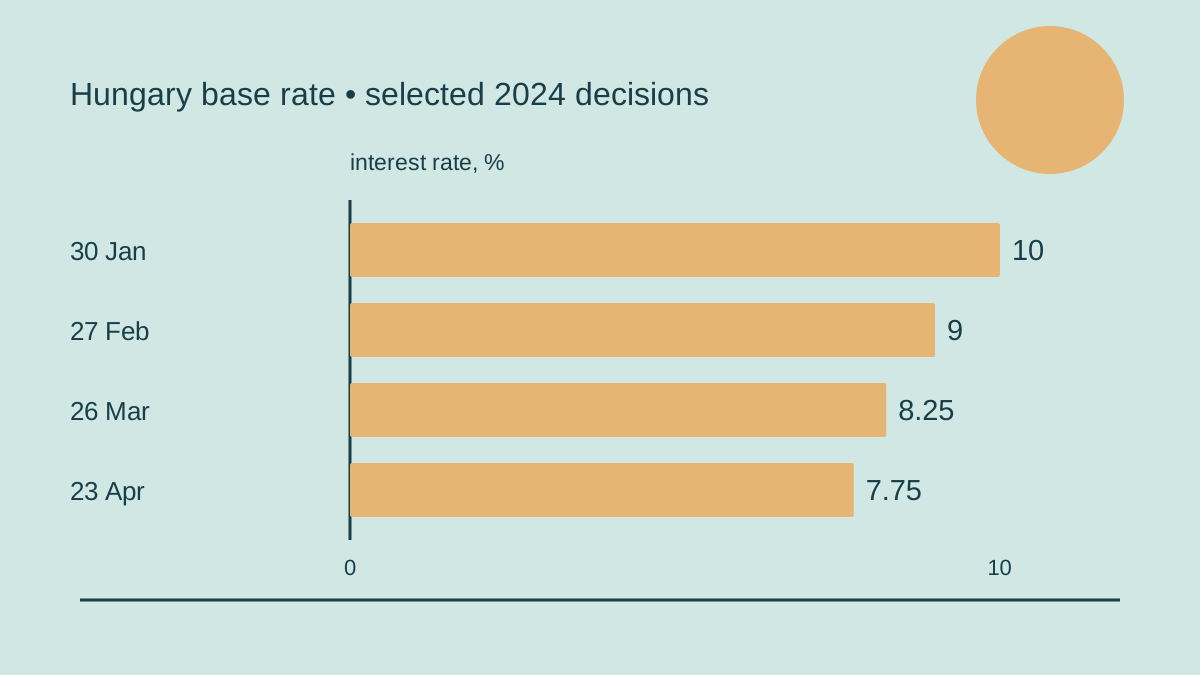
On January 30, 2024, the Monetary Council of the Magyar Nemzeti Bank cut its base rate by 75 basis points to 10%. December’s annual inflation had slowed to 5.5%, although core inflation was still 7.6%. The bank attributed disinflation to tight monetary policy, weaker domestic demand and lower external costs. It projected economic growth of 2.5–3.5% in 2024, with recovering real wages supporting consumption. Alongside the rate decision, it announced that the longer-term deposit facility would cease from January 31, while foreign-exchange swap instruments would remain available to support market stability.
The February 27 decision accelerated the reduction to 100 basis points, leaving the base rate at 9%. January headline inflation was 3.8% and core inflation 6.1%. The bank reported that output had contracted by 0.8% in 2023, while household consumption and investment remained weak. External balances had improved: the current account recorded a surplus equivalent to 0.2% of GDP in 2023, after a deficit above 8% in 2022, according to preliminary data. Policymakers continued to emphasise market stability and positive real interest rates while assessing the scope for further reductions at subsequent meetings.
On March 26, the reduction slowed to 75 basis points and the base rate reached 8.25%. February headline and core inflation were 3.7% and 5.1%. The bank identified increasing financial-market risk aversion as reasons for proceeding more carefully. Its new forecast put 2024 growth at 2–3%, with a slower recovery than previously expected. Consumption was expected to strengthen as purchasing power recovered, whereas weak European demand constrained exports. The Council said that decisions on subsequent cuts would depend on incoming data and financial-market developments.
The April 23 meeting brought a 50-basis-point reduction to 7.75%. March inflation had eased to 3.6%, with core inflation at 4.4%. Nevertheless, the bank expected core inflation to remain around 4.5–5% during the rest of 2024. It described monetary easing as entering a new phase from April, with a slower pace warranted by changing risks. Policymakers highlighted international financial-market volatility and the importance of preserving currency-market stability. A careful assessment of the inflation outlook, rather than a fixed sequence of reductions, remained the stated basis for future decisions.
On May 21, another 50-basis-point cut took the rate to 7.25%. April headline inflation was 3.7%, while core inflation fell to 4.1%. Output in the first quarter had grown by 1.1% from a year earlier and 0.8% from the previous quarter. The bank expected stronger domestic demand to support growth, while weak European activity restrained exports. Household inflation expectations were broadly unchanged from March. In explaining its cautious approach, the Council combined the improving inflation data with unchanged price expectations and uncertainty surrounding the international financial environment.
The June 18 cut was smaller again: 25 basis points, taking the base rate to 7%. Both headline and core inflation had been 4% in May. The bank’s forecast put annual inflation at 3–4.5% in 2024 and economic growth at 2–3%. First-quarter household consumption had increased, while investment declined. Policymakers expected the recovery in real wages to support spending, but continued to stress that price stability required disciplined monetary conditions. The Council also retained instruments intended to reinforce financial-market stability around the end of the quarter.
A further 25-basis-point reduction on July 23 lowered the rate to 6.75%. June headline inflation was 3.7%, but core inflation had edged up to 4.1%. The bank continued to identify high service-price increases as an inflation risk. Household expectations had declined but remained high. Growth was again projected at 2–3% for 2024. The Council said that cautious policy remained necessary, even as lower inflation permitted another adjustment, and assessed the effects of government measures and the international interest-rate environment on domestic conditions.
The August 27 meeting left the rate unchanged at 6.75%. July inflation had increased to 4.1%, with core inflation at 4.7%. Second-quarter GDP fell by 0.2% from the previous quarter but remained 1.5% above its year-earlier level. The bank expected household consumption to support growth, while noting weak investment. July unemployment was 4.2%. It also reported a first-half current-account surplus of nearly €3.7 billion. The Council’s assessment paired that stronger external position with ongoing domestic price pressures and uncertainty over the pace of economic recovery.
On September 24, the Council reduced the rate by 25 basis points to 6.5%. August headline inflation had fallen to 3.4%, with core inflation at 4.6%. The bank lowered its 2024 growth forecast to 1–1.8%. Household consumption in the second quarter had increased by 4.2%, but weaker investment constrained activity. Its annual inflation forecast was 3.5–3.9% for 2024 and 2.7–3.6% for 2025. Policymakers stressed that financial-market stability and a disciplined approach remained necessary as they considered further decisions in a changing international environment.
A pause despite inflation reaching the target
October 22 brought a hold at 6.5%, even though September headline inflation had reached 3%. Core inflation was 4.8%. Household inflation expectations had risen, while geopolitical developments and commodity prices presented additional risks. The bank noted that the external interest-rate environment could become less favourable than previously expected. Its policy statement emphasised the need for financial-market stability and described a pause in reductions as appropriate. The Council retained a cautious, data-dependent approach to the base rate, with domestic inflation expectations and international developments both part of its assessment.
On November 19, the base rate again remained at 6.5%. October headline inflation was 3.2% and core inflation 4.5%. The bank noted lower monthly prices for telephone and internet services, while cautioning that currency movements and excise-tax changes could raise inflation ahead. Preliminary figures showed GDP shrinking by 0.8% from a year earlier in the third quarter. Policymakers expected consumption to recover with real wages, but regarded the investment and export outlook as uncertain. Their statement continued to place price and financial-market stability at the centre of the policy response.
The December 17 statement maintained the 6.5% rate and reported November inflation of 3.7%, with core inflation at 4.4%. The bank forecast 2024 growth of 0.3–0.7% and a recovery to 2.6–3.6% in 2025. Its projection then envisaged a sustainable return to the inflation target in early 2026. For 2025, annual inflation was expected at 3.3–4.1%. Consumption was projected to benefit from higher real incomes, while export prospects depended on improving external demand. The Council continued to require tight monetary conditions despite the forecast recovery.
Inflation expectations kept the 2025 rate unchanged
The January 28, 2025 meeting held the base rate at 6.5%. December inflation had risen to 4.6%, and core inflation to 4.7%; the annual average for 2024 was 3.7%. The bank identified upward inflation risks and rising household expectations as reasons for caution. It also reported that the implied rate on its foreign-exchange swap instrument had been raised to 6% from December 20. That operational adjustment accompanied an unchanged base rate. The Council continued to emphasise positive real rates and stable currency markets when setting domestic monetary conditions.
On February 25, the Council again kept the rate at 6.5%, as January headline inflation reached 5.5% and core inflation 5.8%. The bank described household inflation expectations as high and identified broad repricing at the start of the year. Fourth-quarter 2024 GDP had risen by 0.4% year on year and 0.5% quarter on quarter, ending the technical recession. The bank expected consumption to drive growth as real wages rose, with delayed corporate investments potentially resuming if demand improved. Its assessment called for patience and tight monetary conditions to secure a lasting return to the target.
The April 29 hold at 6.5% followed March headline inflation of 4.7% and core inflation of 5.7%. The bank noted that restrictions on food-price margins and voluntary price commitments in telecommunications and banking were expected to restrain inflation. Household expectations nevertheless remained high. Its assessment also distinguished the immediate effect of falling commodity prices from medium-term risks associated with tariffs and disrupted trade. Policymakers argued that preserving financial-market stability and tight monetary conditions would support the anchoring of inflation expectations, while decisions continued to depend on the evolving outlook.
The May 27 meeting retained the 6.5% base rate. April inflation had eased to 4.2%, with core inflation at 5%. Household and business expectations declined but remained elevated. The bank linked subdued food repricing partly to margin restrictions introduced in mid-March. First-quarter GDP had stagnated compared with a year earlier. Lending remained uneven: household borrowing expanded, while corporate demand was subdued. The bank described the financial system’s capital and liquidity position as strong, but continued to consider persistent services inflation and uncertainty over international trade in its monetary-policy assessment.
At the June 24 meeting, the Council maintained the 6.5% rate while cutting its 2025 growth forecast to 0.8%. May headline inflation was 4.4%, with core inflation at 4.8%. The bank projected growth of 2.8% in 2026 and 3.2% in 2027. The target was expected in early 2027. It assessed the main risks as higher inflation and weaker growth, highlighting strong repricing outside price controls and uncertainty in the external economy. Its annual inflation forecasts were:
- 2025: annual inflation of 4.7%.
- 2026: annual inflation of 3.7%.
- 2027: annual inflation of 3%.
Reserve requirements and the monetary stance
The July 22 meeting left the base rate at 6.5%, after June headline inflation of 4.6% and core inflation of 4.4%. Separately, the bank announced that the reserve requirement would fall from 10% to 8% on August 1. The non-interest-bearing portion remained 2.5% of the reserve base. It described the change as a technical response to declining excess liquidity, neutral for monetary transmission and leaving the restrictive stance unchanged. The statement also identified a possible risk of housing-market overvaluation from existing and newly announced subsidised loan programmes, while maintaining the need for careful interest-rate decisions.
On August 26, the rate stayed at 6.5%. July headline inflation had declined to 4.3% and core inflation to 4%. The bank reported year-on-year second-quarter GDP growth of only 0.1%, with household consumption and investment continuing to diverge. It described household lending as expanding, while company credit demand remained restrained. Newly announced loan programmes were expected to affect an already active housing market. Policymakers also assessed government measures that could increase the budget deficit from 2026, maintaining that inflation and financial-market stability required a patient, restrictive monetary stance.
The September 23 decision again held the rate at 6.5%. August inflation was 4.3%, while core inflation had declined to 3.9%. The bank revised expected 2025 growth to 0.6% and projected 2.8% for 2026 and 3.2% for 2027. Its new annual inflation forecasts were 4.6% for 2025, 3.8% for 2026 and 3% for 2027. It expected household loan stocks to expand by 17–20% in 2025 and 18–22% in 2026, compared with only 2% corporate-loan growth in each year. All these credit figures were forecasts.
At the October 21 meeting, the base rate remained 6.5%. September headline inflation was 4.3%, and core inflation 3.9%. The bank reported slower retail-sales growth and further weakness in industrial production, while construction output had fallen significantly. It observed that the stronger forint was increasingly reducing import and manufacturing producer prices. However, businesses outside the price-restriction measures continued to reprice strongly, and household inflation expectations were still high. The Council regarded currency-market stability as important for lowering those expectations and retained its careful approach to interest-rate policy.
November 18 brought another hold at 6.5%. Third-quarter GDP was 0.6% above its year-earlier level but unchanged from the previous quarter. October inflation remained 4.3%, while core inflation rose to 4.2%. The bank expected extended and widened margin restrictions to bring inflation into the tolerance band by year-end, followed by a temporary further decline in early 2026. It also reported the government’s announced deficit targets of 5% of GDP for both 2025 and 2026. Higher public spending was expected to stimulate demand and complicate debt reduction.
The December 16 meeting maintained the rate at 6.5%. November inflation had slowed to 3.8%, with core inflation at 4.1%. The bank’s new projection put annual inflation at 4.4% in 2025, 3.2% in 2026 and 3.3% in 2027. A sustainable return to the 3% target was expected in the second half of 2027. Growth forecasts were 0.5%, 2.4% and 3.1% for the same three years. The Council assessed inflation risks as balanced, while continuing to require positive real interest rates and financial-market stability.
Lower 2026 inflation meets renewed external risks
The January 27, 2026 meeting held the rate at 6.5%. December headline inflation had fallen to 3.3%, and core inflation to 3.8%; average inflation in 2025 was 4.4%. The bank attributed the decline chiefly to fuel and processed food, while noting above-average repricing in market services and tradable goods. It expected inflation temporarily below the 3% target early in 2026, before rising towards the upper tolerance limit. The Council retained its second-half 2027 timetable for sustainable target attainment and said that subsequent decisions would be cautious and meeting-specific.
On February 24, the bank cut the base rate by 25 basis points to 6.25%. January headline inflation had declined to 2.1%, and core inflation to 2.7%. The bank reported 2025 GDP growth of 0.4%, with retail sales rising and industrial production remaining subdued. It linked disinflation to restrained repricing, an improved external cost environment and the stronger currency. Nevertheless, it maintained that tight monetary conditions and positive real rates remained warranted. The Council said that it would decide cautiously at each meeting, continually reassessing macroeconomic data and financial-market developments.
The March 24 meeting held the rate at 6.25%. February inflation was 1.4%, with core inflation at 2.1%, but the bank warned that the energy-price shock worsened the outlook. Its forecasts put 2026 growth at 1.7% and annual inflation at 3.8%, followed by 3.7% inflation in 2027. It still expected sustainable target attainment in the second half of 2027. The statement also recalled a March 10 decision to meet major foreign-exchange liquidity needs associated with energy imports, intended to preserve the balance of currency-market supply and demand.
On April 28, the Council again left the base rate at 6.25%. March headline inflation was 1.8%, while core inflation declined to 1.9%. The bank reported lower risk premia on domestic assets following the parliamentary election, partly reflecting expectations about EU funds and euro adoption, alongside a stronger forint. It stressed that the improvement needed to persist. Higher energy prices were expected to raise inflation during the year, although currency appreciation would moderate that effect. The Council continued to link monetary decisions to inflation risks and the stability of domestic financial markets.
The May 26 statement maintained the base rate at 6.25%. April headline inflation was 2.1% and core inflation 2.2%, while first-quarter GDP had increased by 1.7% from a year earlier. The bank said the stronger forint, fuel-price restrictions and margin limits were restraining inflation, even as energy costs presented upward risks. Household inflation expectations had declined; company expectations had increased but remained subdued. It again emphasised that lower domestic risk premia needed to persist, and retained a cautious, data-driven policy aimed at achieving the target sustainably through positive real rates.






Leave a comment