Finance and national programmes
Cabinet approval
On September 24, 2025, India’s Cabinet approved 69,725 crore rupees: shipbuilding assistance, 24,736 crore until March 31, 2036, including 4,001 crore shipbreaking credits; maritime financing, 25,000 crore, comprising 20,000 crore investment with 49 percent government participation and 5,000 crore interest incentives; development, 19,989 crore for clusters, insurance and a technical centre under the Indian Maritime University. A National Shipbuilding Mission would oversee implementation. Government targets were annual capacity of 4.5 million gross tonnage, three million jobs and investment of 4.5 lakh crore rupees.
The earlier budget proposals
The February 1, 2025 budget proposals addressed the inputs used by shipbuilders as well as the yards themselves. Finance Minister Nirmala Sitharaman proposed continuing the basic customs duty exemption on raw materials, components, consumables and parts used to manufacture ships for another ten years. She proposed the same treatment for shipbreaking. Large ships above a specified size were also proposed for inclusion in the harmonized infrastructure master list. The proposed shipbuilding clusters would combine additional infrastructure, skills and technology to widen vessel categories and capacity.
Support for maritime startups
A March 27, 2025 government account placed shipbuilding, repair and recycling among the priorities of Sagarmala 2.0, alongside port modernization. It described 40,000 crore rupees of budgetary support and an ambition to mobilize investment of 12 lakh crore rupees over the following decade. The associated Sagarmala Startup Innovation Initiative had launched on March 19. Its support covered green shipping and shipbuilding technology, as well as smart ports and maritime logistics. Funding, mentorship and industry partnerships were the announced channels for assisting participating startups.
A phased green-tug programme
Operating procedures for the Green Tug Transition Programme launched on August 16, 2024, specified a phased replacement of conventional diesel harbour tugs. Its first phase, running from October 1, 2024 through December 31, 2027, covered Jawaharlal Nehru, Deendayal, Paradip and V. O. Chidambaranar port authorities. Each was to procure or hire at least two green tugs. Battery-electric propulsion was specified for the initial phase, with investment expected to reach approximately 1,000 crore rupees. The government’s longer-term programme envisaged transitioning the harbour tug fleet at India’s major ports to green alternatives by 2040.
Port operators place orders
Adani Ports and Special Economic Zone announced an order for eight harbour tugs from Cochin Shipyard on December 27, 2024. The company estimated the contract at 450 crore rupees, with deliveries expected between December 2026 and May 2028. Its earlier procurement had already produced two azimuthing stern-drive tugs with 62-tonne bollard pull. Adani said those vessels had been delivered and deployed at Paradeep and New Mangalore ports. Three additional tugs were under construction, bringing the company’s combined orders to thirteen vessels across the announced programme.
Yards and fabrication
Kochi infrastructure opens
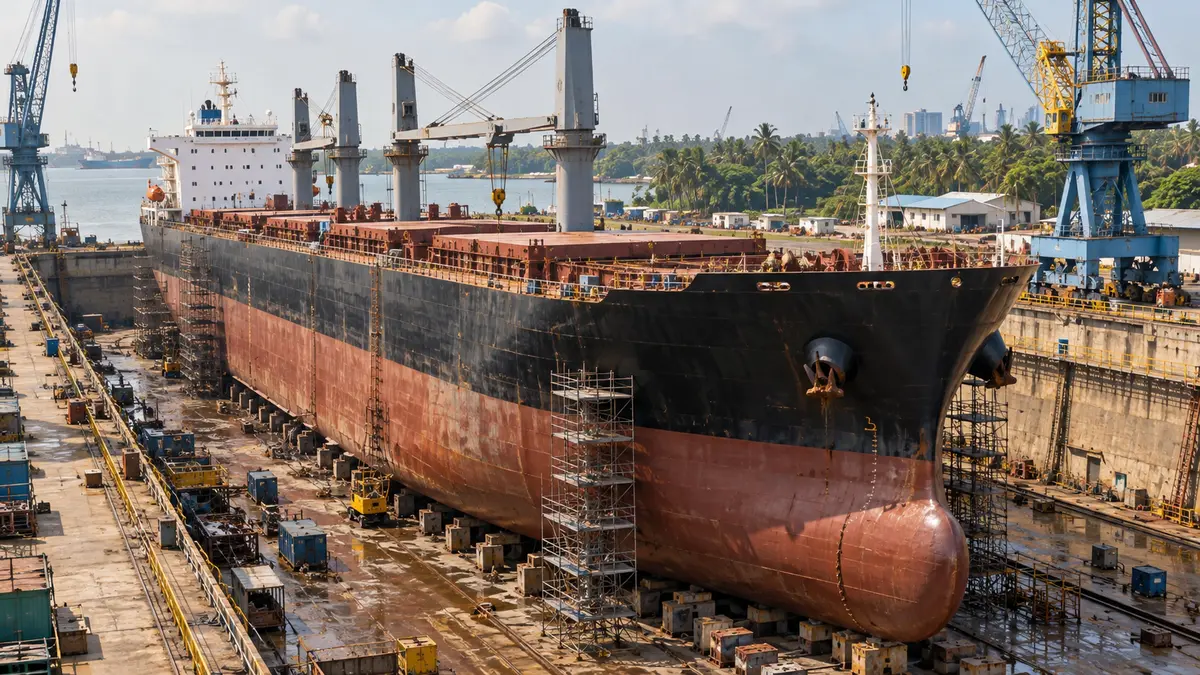
Kochi had already gained major infrastructure on January 17, 2024, when Prime Minister Narendra Modi inaugurated Cochin Shipyard’s new dry dock and International Ship Repair Facility. The 310-metre dry dock represented investment of 1,799 crore rupees and was designed to handle large commercial vessels, including Suezmax tankers, Capesize ships and LNG carriers. The repair facility cost 970 crore rupees and occupied 42 acres leased from Cochin Port Authority at Willingdon Island. The government described added repair capacity of nearly eighty vessels or more annually.
Fabrication and a proposed new yard
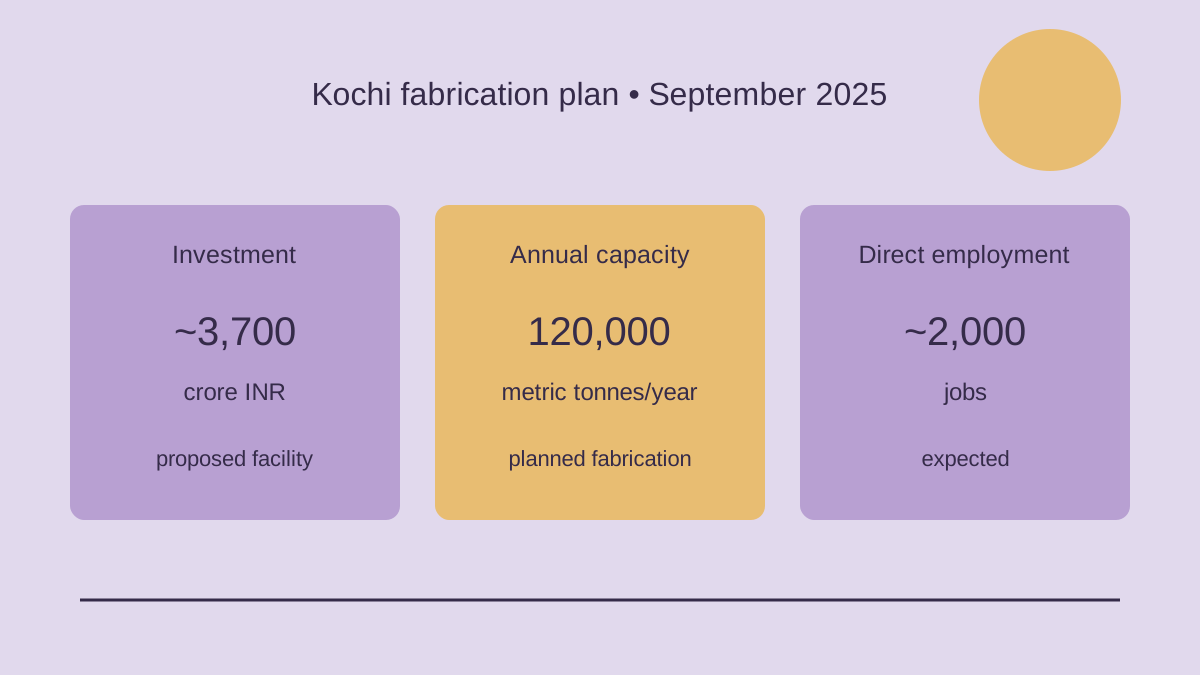
The collaboration with HD Korea Shipbuilding & Offshore Engineering presented in September 2025 included a proposed block-fabrication facility at Kochi. The government described an approximately 80-acre site, annual capacity of 120,000 metric tonnes and investment of about 3,700 crore rupees. Around 2,000 direct jobs were expected. Cochin Shipyard also signed an agreement with Guidance, Tamil Nadu’s investment agency. It was considering a 15,000-crore-rupee greenfield shipyard with a Korean partner, with first-phase forecasts of 4,000 direct and 6,000 indirect jobs. A repair facility was another possibility.
Pipavav expansion and training
Swan Defence and Heavy Industries announced a separate agreement with the Gujarat Maritime Board on September 20, 2025. Its proposed 4,250-crore-rupee programme comprised 3,500 crore for yard expansion, 200 crore for a maritime training centre and 550 crore for a 200-acre ancillary cluster. The yard work covered slipways, jetties, cranes, block fabrication and dredging. The centre was intended to train more than 1,000 young people annually, using classrooms, laboratories, simulators and design software. Swan described its existing Pipavav dry dock as 662 metres long and 65 metres wide.
A supplier opens local support
Kongsberg Maritime’s May 24, 2024 announcement recorded an opening rather than a shipyard construction proposal. Its Kochi facility was located in the Maritime Park beside Cochin Shipyard’s International Ship Repair Facility. The local team would support newbuilding projects and customers in the region, with service engineers covering propulsion, handling and navigation equipment. Assembly and overhaul of Kamewa waterjets remained future expansion plans. The group reported around 500 employees across its activities in India, including 150 working for its maritime business in Mumbai.
Five institutional partnerships
GRSE signed five memorandums at the September 20, 2025 maritime programme in Bhavnagar. The partners were Deendayal Port Authority at Kandla, Syama Prasad Mookerjee Port Authority at Kolkata, Indian Port Rail & Ropeway Corporation, Shipping Corporation of India and Modest Infrastructure. Chairman P. R. Hari described the agreements as an effort to bring shipyards, ports, operators and infrastructure partners together. His stated aim was to develop sustainable, green and globally competitive solutions.
Repair and construction work
Container-ship repair cooperation
Maersk and Cochin Shipyard announced their repair cooperation agreement on February 17, 2025. The initial scope covered container ships of up to 7,000 TEU for afloat repairs and up to 4,000 TEU for drydocking. The partners identified technical expertise sharing, maintenance opportunities and joint training as areas of cooperation. Skills development would include yard employees and Maersk seafarers. Maersk fleet executive Leonardo Sonzio said the first repair was planned for 2025 and described a prospective long-term relationship. The announcement also included exploration of newbuilding activities.
Evaluating repair clusters
Drydocks World, part of DP World, announced its agreement with Cochin Shipyard on April 11, 2025. The companies would jointly evaluate repair clusters at Kochi in Kerala and Vadinar in Gujarat. Cooperation could also involve major ports and potential offshore fabrication projects, alongside marine engineering and related infrastructure. The agreement was signed at a Dubai–India business event in Mumbai. DP World chairman Sultan Ahmed bin Sulayem said the partnership would accelerate repair and fabrication development. Cochin Shipyard chairman Madhu S. Nair described it as the beginning of strategic collaboration.
Licensed dredger construction
The Dredging Corporation of India project had an earlier technology agreement. On December 5, 2022, IHC Dredging announced a design, engineering, hardware and support package for Cochin Shipyard to build a licensed Beagle 12 trailing suction hopper dredger. Its planned hopper volume was 12,000 cubic metres. IHC director Ronald van Son said support would come from the company’s Mumbai office and workshop, where some equipment was also manufactured. The intended customer use was maintenance dredging and improving access to ports and waterways.
Work underway in August
During Cochin Shipyard’s August 19, 2025 earnings call, management reported fourteen vessels at different repair stages in the international repair facility and three vessels being built in the new dry dock. The group’s 75-vessel construction order book included 25 in design and engineering, 37 in fabrication and assembly, and thirteen launched vessels nearing completion. Chairman Madhu S. Nair cautioned that vessel counts varied with size and complexity. He also reported delivery-timeline challenges for the Dredging Corporation of India dredger, which remained under construction, with launching expected within about a month.
Export vessel orders
A cargo-vessel series expands
On July 2, 2024, designer Conoship International reported Wilson’s contract for eight CIP6300 cargo vessels at Cochin Shipyard. They supplemented six CIP3800 vessels announced in June 2023, with the combined fourteen-vessel programme scheduled for delivery from the first half of 2025 through 2028. Conoship described diesel-electric propulsion, a large-diameter propeller and optimized hull lines. The design offered optional installation of three VentoFoil units and the possibility of changing fuel type later. A single high-volume hold was intended to accommodate different heavy and light cargoes.
Wilson receives the first ship
Wilson announced delivery of WILSON ECO I on April 23, 2025, identifying it as the first vessel in its new ECO series built at Udupi Cochin Shipyard. Wilson said it was prepared for a wind-assisted system and reported an Energy Efficiency Design Index 30 percent below the IMO requirement for 2025. The company presented that comparison as estimated greenhouse-gas emissions per transported cargo unit.
Multipurpose cargo for an export customer
Garden Reach Shipbuilders & Engineers signed its initial commercial-vessel agreement with Germany’s Carsten Rehder on June 22, 2024. The order comprised four 7,500-DWT multipurpose vessels, with options for another four. Each vessel was designed to be 120 metres long and 17 metres wide, with maximum draft of 6.75 metres. A single cargo hold would carry bulk, general and project cargo, while containers could be placed on hatch covers. The deck arrangement was specifically designed to accommodate multiple large wind-turbine blades, according to the shipyard’s announcement.
A later hybrid contract
GRSE’s September 20, 2025 release reported a further contract signed in Hamburg the previous day. Carsten Rehder ordered four battery-assisted hybrid multipurpose vessels for 62.44 million US dollars, with provision for two additional ships. The yard described enhanced fuel efficiency and flexible cargo handling as features of the new design. This contract followed the earlier conventional multipurpose-vessel series. GRSE reported that subsequent agreements had expanded that series to eight ships and that steel cutting for the CORAL series had begun on April 17, 2025.
Offshore design cooperation
GRSE’s June 5, 2025 account of Nor-Shipping also described cooperation beyond its cargo-vessel customers. It had signed a memorandum with Aries Marine, a Dubai-based engineering and design firm, to explore offshore platforms and vessels. The partners would identify and develop orders for platforms designed by Aries and built by GRSE, with an intended worldwide market reach. GRSE also reported agreements with an unnamed global engine manufacturer on June 4. These announcements concerned design, order development and supplier relationships; the company described them as collaborations intended to enhance its capabilities.
Passenger and research vessels
Thirteen ferries for the Hooghly
West Bengal’s Transport Department contracted thirteen hybrid ferries from GRSE on November 19, 2024, for operation by its transport infrastructure corporation on the Hooghly.
- Six twin-deck ferries would carry 200 passengers each, with air-conditioned main decks, approximately 30-metre lengths and maximum speeds of 12 knots.
- Seven single-deck boats would carry 100 passengers each, be about 25 metres long and reach 9 knots.
Both groups combined battery and diesel-generator power and required five crew members. Estimated group costs were 126.41 and 99.77 crore rupees respectively, excluding goods and services tax.
Dheu reaches the transport department
The electric ferry Dheu reached a later stage: GRSE’s January 11, 2025 announcement recorded its handover to West Bengal’s Transport Department at Babughat, Kolkata, on January 9. The 24-metre aluminium catamaran was designed for 150 passengers in air-conditioned accommodation. Its liquid-cooled energy storage system held 246 kWh, and solar panels supplemented the batteries. Twin propellers supported manoeuvring, with a stated top speed of 10 knots. GRSE said the ferry complied with Indian Register of Shipping passenger-safety rules and had undergone harbour and afloat trials.
An ocean-science construction contract
GRSE signed a construction contract with the National Centre for Polar and Ocean Research on July 16, 2024. The planned ocean research vessel was 89.5 metres long and 18.8 metres wide, with gross tonnage of 5,900. Its scientific equipment would support operations at depths of up to 6,000 metres. The specified missions included multibeam and seismic surveys, water profiling and sampling, seabed coring, moorings and data buoys. The vessel would also deploy and recover autonomous and remotely operated underwater vehicles and provide onboard analysis and technician training.
Two coastal research ships
The Geological Survey of India signed a separate contract with GRSE for two coastal research vessels on June 11, 2025. Each would be 64 metres long and 12 metres wide, with approximately 450 tonnes deadweight, fifteen-day endurance and accommodation for 35 people. The planned speed was 10 knots. Diesel generators would drive electric thrusters, while Dynamic Positioning–1 equipment would maintain position in Sea State 3. Operations were intended for depths of 5–1,000 metres within India’s exclusive economic zone, supporting geological mapping, mineral exploration and environmental monitoring.
Exploring a polar-vessel design
Kongsberg Maritime’s June 5, 2025 announcement described an exploratory design agreement with GRSE for an indigenous polar research vessel. The agreement was associated with Nor-Shipping in Oslo, Norway. Kongsberg proposed integrating propulsion, automation and mission-critical systems for extreme polar environments and heavy ice. The intended scientific roles included climate research, oceanography and polar logistics. Country manager Annette Holte said the company would work with GRSE on innovative, locally driven design solutions. The company also cited its experience delivering complex polar research vessels for Norway and the United Kingdom.
Technology and skills
A shipyard innovation challenge
GRSE’s Accelerated Innovation Nurturing Scheme was launched in Kolkata on July 10, 2024, by minister Sanjay Seth. The GAINS programme invited small and medium enterprises and startups to develop solutions to present and emerging shipyard problems, including ship design and construction. GRSE chairman P. R. Hari described technology adoption as a priority and said he expected the programme to contribute to it. The scheme sought solutions the yard could incorporate into its work, linking participating startups to specific shipbuilding challenges.
An autonomous vessel under development
The Indian Register of Shipping’s December 2024 newsletter linked its account of SWAYAT, an indigenous autonomous-vessel pilot under construction at Cochin Shipyard. The organizations had an umbrella technology agreement and a separate cooperation agreement covering development and certification. KPIT and other domestic component manufacturers were technology partners. Verification would follow the register’s autonomous and remotely operated vessel guidelines, with cybersecurity addressed under its maritime cyber-safety guidelines. The project also covered certification of a navigation and communication suite, supported by academic and research collaboration on design and simulation.
Training for underwater maintenance
A completed training programme provided another workforce example. On November 18, 2024, IIT Guwahati reported that its Technology Innovation Hub and the Indian Register of Shipping had conducted underwater-welding and deep-diving training at Neel Diving Academy in Kochi. Trainers delivered theoretical and practical sessions, followed by underwater welding exercises and technical evaluations. The quality and safety of participants’ work samples were assessed before certification. IIT director Devendra Jalihal described the combination of academic training and practical expertise as addressing a maritime and energy-sector skills gap.


Leave a comment