
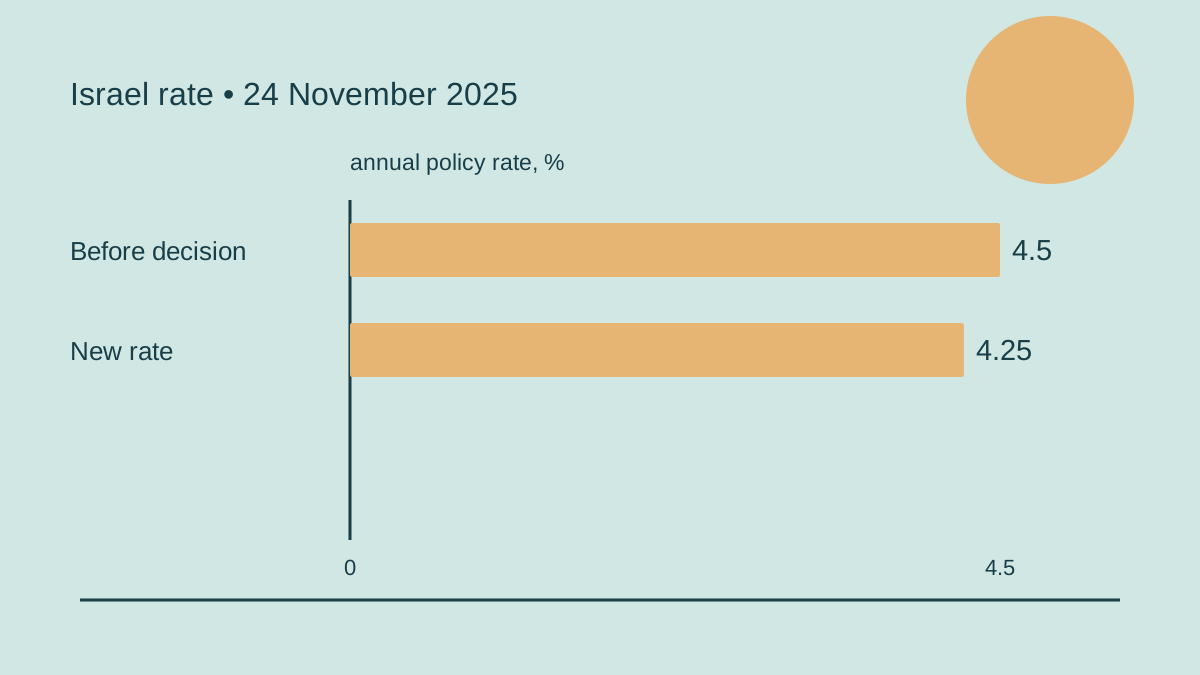
On 24 November 2025, Israel’s central bank reduced its policy rate by a quarter of a percentage point to 4.25%. Reuters reported that it was the first reduction since January 2024. October’s annual inflation of 2.5% supported the decision, while the bank continued to flag supply and demand risks.
Recovery and inflation in 2022
The starting point was very different. On 3 January 2022, the committee maintained a rate of 0.1%, while the latest available annual inflation figure, for November, was 2.4%. Prices had fallen by 0.1% during that month. The bank described an economy adapting to the pandemic, but identified the Omicron wave as a fresh risk to activity. It also reported functioning bond and credit markets. Its assessment combined ongoing recovery with uncertainty about the next disruption, rather than presenting economic normalization as a completed process.
By the 21 February meeting, the committee still held the rate at 0.1%, but January’s annual inflation had reached 3.1%. The statement signaled that conditions would allow a gradual increase in the interest rate. The economic backdrop included an initial estimate of 8.1% GDP growth for 2021 and annual home-price growth of 11.3%. Broad unemployment was 5.6% in January. These were the figures available at that decision, when the bank was preparing to move from an exceptionally low rate toward gradual monetary tightening.
On 11 April, the committee raised the rate to 0.35%. February’s annual inflation was 3.5%, while annual home-price growth had reached 13%. New mortgage borrowing in February totaled 11.2 billion shekels. The statement also described a robust labor market. These observations placed rising consumer prices alongside strong housing finance and employment when the bank began increasing rates. They were contemporary indicators of the conditions surrounding the decision; the April projections for later economic growth remained forecasts, rather than measurements of what subsequently happened.
The next increase, on 23 May, took the rate to 0.75%, with annual inflation at 4% in April. The bank continued to report shortages of workers despite a first-quarter GDP contraction of 1.6% at an annualized rate. That decline followed an annualized expansion of 15.6% in the preceding quarter. Housing prices had risen by 16.3% over a year. April mortgage borrowing was 10.5 billion shekels, with seasonal factors affecting the monthly figure. The committee therefore faced contrasting output and labor-market signals, alongside continuing price pressures.
The July decision changed both the policy rate and the operating corridor. On 4 July, the rate rose to 1.25%, while the corridor widened from 0.1 percentage point on either side of the rate to 0.5 percentage point. May’s annual inflation stood at 4.1%. The shekel had depreciated by 5.1% against the dollar since the previous decision. The research department forecast GDP growth of 5% in 2022 and 3.5% in 2023. Those estimates described its July outlook, alongside the actual changes to the monetary framework.
On 22 August, the committee raised the rate to 2%. July’s annual inflation had reached 5.2%, while annual home-price growth was 17.8%. New mortgages in July totaled 10 billion shekels. In contrast with the earlier depreciation, the shekel had strengthened by 6.9% against the dollar between policy decisions. The release thus recorded a stronger currency alongside still-elevated inflation and housing prices. The committee continued tightening in that setting; the exchange-rate movement alone did not establish that the broader inflation problem had been resolved.
The rate reached 2.75% on 3 October. August’s annual inflation had eased to 4.6%, and prices had fallen by 0.3% during that month. However, inflation in tradable components was 5.1%, compared with 4.4% in nontradables. The shekel had depreciated by 8% against the dollar since the preceding decision. The committee expected monetary tightening, easing supply pressures and commodity developments to help moderate inflation. That was the bank’s assessment of forces acting on prices, rather than proof that any single factor had caused the observed decline.
By 21 November, the rate was increased to 3.25%, as October’s annual inflation stood at 5.1%. New mortgage borrowing in October amounted to 6.1 billion shekels. The bank reported a slight decline in outstanding bank credit as interest rates rose. Small and medium businesses were reporting greater difficulty obtaining finance, although that difficulty remained low by historical comparison. Unemployment among people aged 15 and over was 4.1%. The release therefore added evidence about borrowing conditions to the inflation and employment picture at the end of the tightening year.
The peak rate and market stabilization
The first decision of 2023 took the rate to 3.75% on 2 January. November’s annual inflation was 5.3%, while annual housing-price growth stood at 20.3%. The bank reported slower credit growth to small and medium businesses and rising borrowing costs. However, reported financing constraints remained low, and it did not identify a significant increase in credit risk. Its forecasts of 2.8% growth in 2023 and 3.5% in 2024 were forward-looking estimates. The release distinguished a slowdown in credit expansion from a severe deterioration in access to finance.
On 20 February, the rate rose to 4.25%, with January’s annual inflation at 5.4%. The initial national accounts estimate put 2022 GDP growth at 6.5%. Fourth-quarter growth was 5.8% at an annualized rate, partly reflecting temporary vehicle purchases. New mortgages in January totaled 6.4 billion shekels. The shekel had depreciated by 1% against the dollar since the previous rate decision; a larger 5% decline referred to the last month. Those different comparison windows matter when reading the bank’s account of exchange-rate pressures alongside domestic activity.
The committee increased the rate to 4.5% on 3 April. February’s annual inflation had moderated to 5.2%, but the bank judged that moderation slower than anticipated. Nontradable inflation stood at 5.5%, against 4.8% for tradables. Annual housing-price growth was 14.6%, while February mortgage borrowing totaled 5.7 billion shekels. The research department presented conditional scenarios concerning legislative and institutional changes to the judicial system. Those scenarios were assessments of possible economic paths, rather than observed outcomes. The rate decision came while inflation remained broad despite its modest decline.
The rate reached 4.75% on 22 May. April’s annual inflation was 5%, and the monthly price increase was 0.8%, with around half of that rise linked to accommodation and vacations. First-quarter GDP expanded by 2.5% at an annualized rate. Credit developments differed by business size: lending to small and micro businesses declined, while credit to large businesses increased. Medium businesses reported greater financing difficulty, although it remained low. The statement therefore showed uneven borrowing conditions alongside a further rate increase and persistent inflation, rather than a uniform credit contraction.
On 10 July, the committee held the rate at 4.75%, while keeping open the possibility of another increase if inflation failed to moderate as expected. May’s annual inflation was 4.6%, with nontradables at 5.4% and tradables at 3.4%. The bank described strong activity, but private consumption and credit-card spending were below their precrisis trends. Financing difficulty eased for medium businesses, while credit-risk indicators increased slightly for small and micro firms. May mortgage borrowing totaled 6.5 billion shekels. The pause thus accompanied continuing scrutiny of prices, demand and borrowing conditions.
The rate remained at 4.75% on 4 September. July’s annual inflation fell to 3.3%, partly because a particularly high July 2022 reading dropped out of the comparison. Nontradable inflation was still 5%, against 0.6% for tradables. Second-quarter GDP grew by 3% at an annualized rate, but the bank judged growth below potential. Bank and nonbank credit slowed across business segments, while reported financing difficulty remained low. Slight increases in credit-risk indicators for medium, small and micro businesses added a caution alongside the lower headline inflation figure.
Liquidity support during disruption
The 23 October decision maintained the rate at 4.75%, but the bank’s emphasis shifted toward market stabilization amid the war. September’s annual inflation was 3.8%. On 9 October, the bank had announced foreign-exchange sales of up to $30 billion and swaps of up to $15 billion, alongside repo liquidity support. These amounts were program ceilings, rather than completed transactions. Banks and credit-card companies also adopted repayment deferrals. The statement showed how liquidity and cash-flow measures could be used while the policy rate remained unchanged during heightened uncertainty.
On 27 November, the rate stayed at 4.75%, with October’s annual inflation at 3.7%. The bank reported actual foreign-exchange sales of $8.2 billion in October under the previously announced program. Small and micro business credit was slowing, alongside targeted credit support and expanded repayment deferrals. Broad unemployment, including workers temporarily absent for economic reasons, had risen to 9.6% in October from 3.6% in September. That measure excluded other absences, including reserve duty. The release therefore documented disruption to work and credit alongside the continuing interest-rate hold.
The 2024 cut and supply-limited recovery
The committee reduced the rate by 0.25 percentage point to 4.5% on 1 January 2024. November’s annual inflation was 3.3%, and prices had fallen by 0.3% during the month. The bank also saw slowing inflation in quarterly and half-year measures, while identifying war, exchange-rate and fiscal risks. Credit to businesses and households continued to slow, and repayment deferrals were extended. November mortgage borrowing totaled 5.5 billion shekels. The reduction accompanied improving inflation dynamics, but the statement retained conditions concerning market stability, activity and fiscal policy for subsequent decisions.
On 26 February, the rate remained at 4.5%, even though January’s annual inflation had fallen within the target range to 2.6%. The bank reported a 5.2% fourth-quarter GDP contraction relative to the preceding quarter, seasonally adjusted; this was a quarterly change, not an annualized rate. Demand constraints were easing, but supply constraints showed no marked improvement, with labor shortages particularly significant in construction. Credit to households and small and micro businesses continued to decline, although reported financing difficulty had returned to its prewar level. The recovery remained uneven.
The 8 April decision again held the rate at 4.5%. February’s annual inflation was 2.5%, while one-year inflation expectations were near the upper bound of the target range. The bank described a recovery driven mainly by demand, with persistent equipment and hiring constraints in several industries. Broad unemployment declined to 4.4% in February from 4.8% in January. March mortgage borrowing totaled 6.2 billion shekels. Meanwhile, the shekel depreciated by 2.7% against the dollar between decisions. Lower measured inflation therefore coexisted with expectations and supply conditions requiring continued attention.
The rate stayed at 4.5% on 27 May as April’s annual inflation increased to 2.8%. Prices rose by 0.8% during April, with foreign travel contributing 0.4 percentage point to that monthly change. The bank considered it unclear whether the travel-related increase was temporary. First-quarter GDP grew by 3.35% quarter on quarter, equivalent to 14.1% annualized, but remained 2.8% below its third-quarter 2023 level. Construction employment was about 20% below its prewar level. The strong rebound in output therefore did not mean that productive capacity and activity had fully recovered.
On 8 July, the committee maintained 4.5%, with May’s annual inflation at 2.8%. The bank reported that the moderation of nontradable inflation had halted and that the economic recovery slowed in the second quarter. Hiring and supply constraints persisted. Business credit had expanded since the beginning of the year, led by large firms, while some credit-risk indicators rose, particularly in construction, without reaching historically high levels. May mortgage borrowing totaled 7.8 billion shekels. Its conditional growth forecasts of 1.5% for 2024 and 4.2% for 2025 reflected an assumed longer period of intense war.
Inflation rises again
The rate remained 4.5% on 28 August, with July’s annual inflation rising to 3.2%. Nontradable inflation was 3.4% over a year, compared with 2.6% for tradables. Second-quarter GDP grew by 0.3% quarter on quarter, or 1.2% annualized, leaving output about 3% below its trend and business output about 5% below. The bank interpreted weak activity alongside rising inflation as consistent with supply limitations and fiscal expansion. June credit to large businesses increased, while credit to the rest of the business sector contracted slightly. July mortgages totaled 9.1 billion shekels.
On 9 October, the committee kept the rate at 4.5%. August’s annual inflation had reached 3.6%, with a monthly increase of 0.9%, and price pressures broadened across tradable and nontradable components. The shekel depreciated by 2.8% against the dollar between decisions. Business and consumer credit outstanding continued to grow, but more slowly than before the war. August mortgage borrowing totaled 8.4 billion shekels. The research department lowered its conditional growth forecasts to 0.5% for 2024 and 3.8% for 2025, assuming intense fighting would continue into early 2025.
The last decision of 2024, on 25 November, again maintained 4.5%. October’s annual inflation was 3.5%, with nontradables at 3.9% and tradables at 3%. Third-quarter GDP grew by 3.8% annualized, but remained 3.6% below its long-term trend. Business output’s gap was 4.6%. The bank described supply constraints as dominant in construction and services, while weak demand remained important for hotels. Outstanding business credit expanded through bank loans and tradable bonds. October mortgages totaled 6.9 billion shekels, as the risk premium declined but remained elevated relative to prewar conditions.
The prolonged hold in 2025
On 6 January 2025, the rate remained at 4.5%. November’s annual inflation was 3.4%, while the bank expected VAT increases, supply constraints and excess demand to raise inflation during the first half of the year before moderation in the second half. That was its outlook at the time. Business credit continued expanding, led by large firms in construction and real estate. November mortgage borrowing totaled 8 billion shekels. The shekel appreciated by 0.5% against the dollar between decisions, while the bank’s assessment still emphasized the incomplete recovery of supply.
The 24 February decision maintained 4.5%, as January’s annual inflation increased to 3.8%, partly because of tax changes. Nontradable inflation was 4.1%, compared with 3.4% for tradables. The bank described increased domestic spending being met through imports against supply constraints. Mortgage borrowing had reached 13.8 billion shekels in December, partly ahead of tax increases, before returning to 7.3 billion in January. Business credit grew mainly in construction, real estate and financial services. These figures show why the unusually large December mortgage volume requires its timing explanation when assessing borrowing demand.
On 7 April, the committee again held 4.5%, with February’s annual inflation at 3.4%. The bank identified geopolitical developments, supply constraints, worsening global terms of trade and currency volatility as inflation risks. Between the previous decision and 4 April, the shekel depreciated by 4.3% against the dollar. Business credit continued expanding through bank loans and tradable bonds, while business and household credit risk remained low. February mortgage borrowing totaled 7.4 billion shekels. The statement combined moderate recovery with increased uncertainty, rather than treating the lower inflation figure as sufficient grounds for a rate reduction.
The committee held the rate at 4.5% on 26 May, after April’s annual inflation increased to 3.6%. The monthly rise of 1.1% was partly affected by foreign-flight prices. Nontradable inflation was 4.2%, compared with 2.5% for tradables. Forecasters delayed their expected return to the target range after the April reading. Business and household credit continued expanding at stable lending rates. Although payment arrears increased among small and medium firms, the bank considered business credit risk moderate. April mortgages totaled 8 billion shekels, alongside a still-incomplete recovery of output.
On 7 July, the rate stayed at 4.5%, with May’s annual inflation down to 3.1%. Nontradable inflation remained 3.9%, against 1.5% for tradables. The shekel appreciated by 7.3% against the dollar between decisions. The bank reported a sharp decline in credit-card spending during the June military operation against Iran, followed by rapid recovery when it ended. May mortgages totaled 9.3 billion shekels, and mortgage arrears remained low. Business and household credit expanded, while serious reported business credit constraints were low. The decision still retained geopolitical uncertainty among its policy considerations.
The rate remained at 4.5% on 20 August. July’s annual inflation was 3.1%, with nontradables at 3.7% and tradables at 2.2%. Second-quarter GDP contracted by 3.5% at an annualized rate, leaving output about 5.4% below its long-term trend. The bank emphasized the concentrated impact of the operation against Iran and reported a rapid activity recovery in July. June credit to small and medium businesses expanded faster, while serious financing constraints remained low. July mortgages totaled 10.7 billion shekels, with arrears stable at low levels despite the recent disruption.
On 29 September, the committee maintained 4.5% despite August’s annual inflation falling within the target range to 2.9%. Nontradable inflation was still 3.6%, compared with 1.7% for tradables. The bank warned about demand increasing against supply constraints, alongside geopolitical, fiscal and trade risks. August’s job vacancy rate was 4.5%, while broad unemployment among people aged 25–64 was 3.1%. July lending to small and medium firms grew, and business credit over 90 days in arrears remained low. August mortgages totaled 9.1 billion shekels. The hold preceded November’s eventual reduction.
- Worker shortages persisted despite a quarterly output decline.
- Foreign-exchange sales and targeted credit support accompanied an unchanged rate.
- Inflation entered the target range while the committee retained its rate.






Leave a comment