Malaysia's economy grew 5.3% in the third quarter of 2024, following 5.9% in the preceding quarter. Bernama reported the figures on 15 November, citing central-bank Governor Abdul Rasheed Ghaffour. Growth for the first three quarters reached 5.2%. The governor attributed the expansion to stronger investment activity and improving exports, while household spending benefited from labour-market conditions and policy support.
Investment and production across the economy
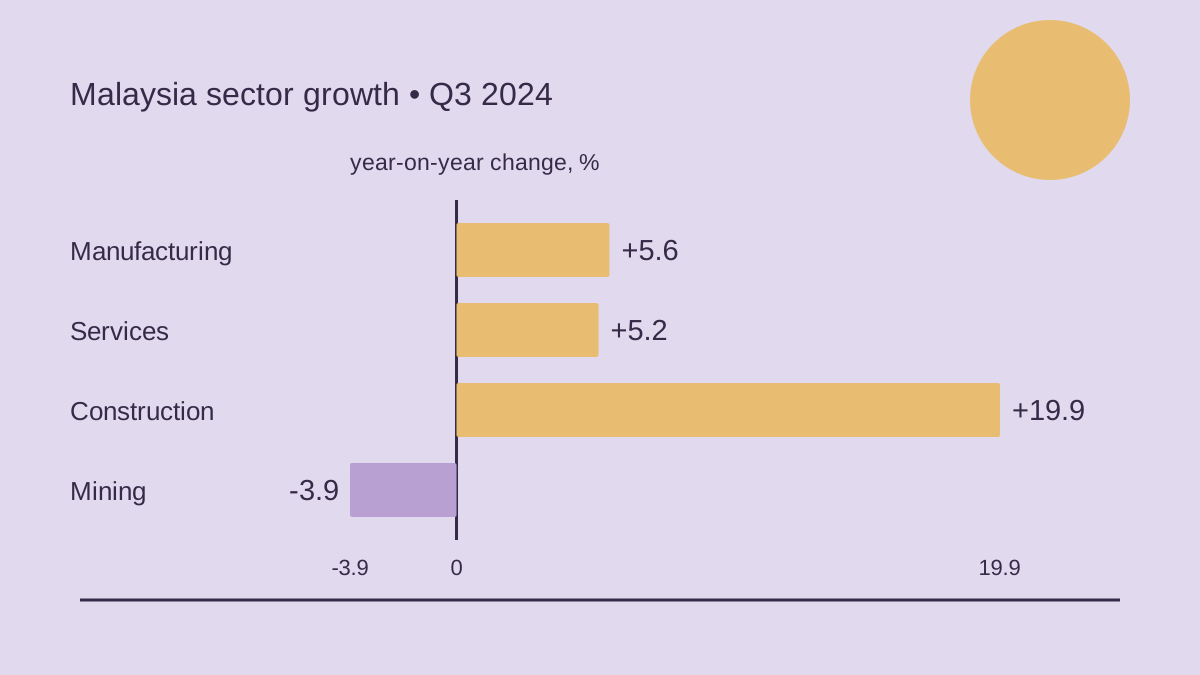
The Department of Statistics reported seasonally adjusted quarterly growth of 1.8%. Manufacturing expanded by 5.6% from a year earlier, services by 5.2% and construction by 19.9%. Mining and quarrying contracted by 3.9%. Gross fixed capital formation rose 15.3%, with structures increasing 18.6% and machinery and equipment 12.3%. Private investment accounted for 80% of fixed capital formation.
Abdul Rasheed said investment spending on structures and machinery was strong. He linked export improvement to recovering external demand and the global technology upcycle. Export-oriented manufacturing clusters improved, while maintenance work in mining partly offset growth.
Inflation and credit
Bank Negara Malaysia reported headline and core inflation of 1.9% for the quarter, unchanged from the preceding quarter. Food and beverage inflation moderated to 1.6% from 1.9%. The share of consumer-price-index items recording monthly increases fell to 38.9%, from 49.4%.
Credit to the private non-financial sector grew 4.8%, compared with 5.5% in the second quarter. The bank attributed the moderation to slower growth in outstanding business loans and corporate bonds. Household loan growth remained steady, supported by housing and car loans, with robust applications and sustained approval rates.
Policy setting and the governor's outlook
The monetary-policy committee had maintained the overnight policy rate at 3% on 6 November. In that earlier statement, it described the policy stance as supportive of the economy and consistent with its assessment of inflation and growth. It said it would monitor developments informing domestic growth and inflation in 2025.
- Abdul Rasheed identified weaker external demand and commodity production as downside risks.
- He also cited geopolitical tensions and protectionist measures.
- Greater technology spillovers, faster investment projects and stronger tourism were possible upside factors in his outlook.





Leave a comment