
The final 2025 decision
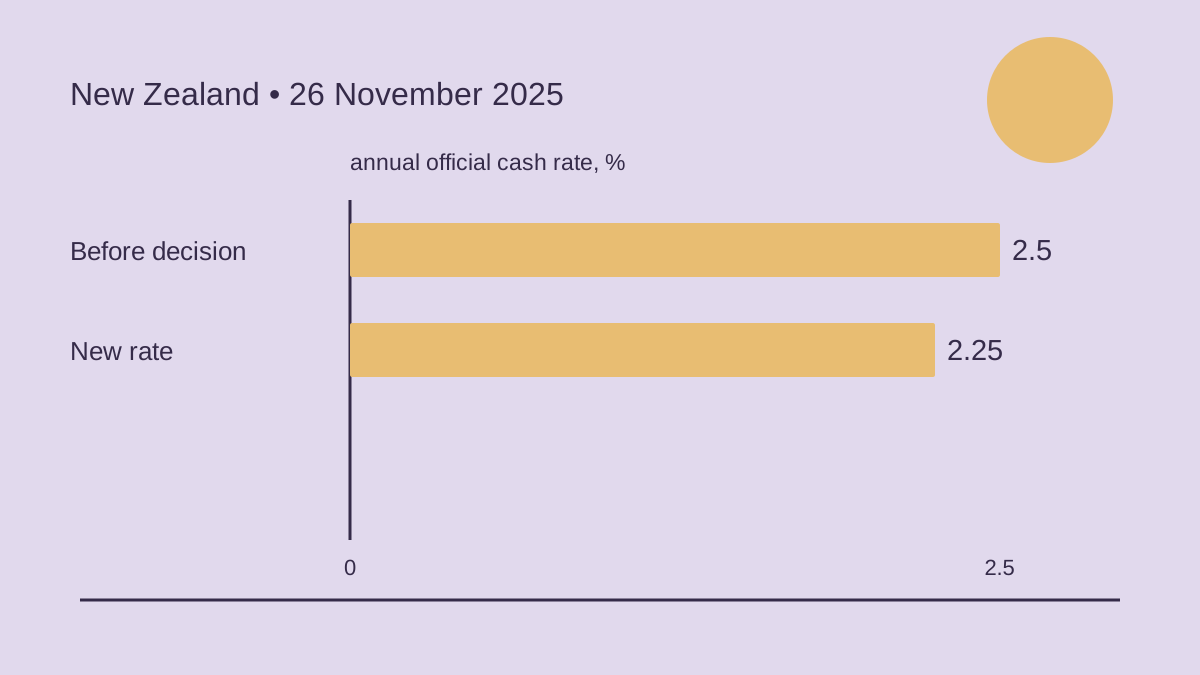
Reuters reported the Reserve Bank of New Zealand's final 2025 decision: a 25-point cut to 2.25%, approved five votes to one. The local meeting was on 26 November. Annual inflation was 3%, with approximately 2% forecast by mid-2026. Further moves depended on the outlook.
- Easing since August 2024 totalled 325 basis points.
- Future policy remained conditional.
2022
23 February 2022
The February decision raised the official cash rate by 25 basis points to 1%. The Committee described employment as above its sustainable maximum and output as exceeding current capacity, while expecting near-term disruption from Omicron. It considered both a 25-point and a 50-point increase before reaching consensus on the smaller move. Alongside the rate decision, it agreed not to reinvest maturing bonds from its large-scale asset purchases. Sales to New Zealand Debt Management were planned at five billion New Zealand dollars per fiscal year from July, subject to policy objectives and market conditions.
13 April 2022
April brought a larger increase: 50 basis points, taking the rate to 1.5%. The Committee wanted to reach a more neutral stance earlier and reduce the risk of rising inflation expectations. Core inflation measures were at or above 3%, while imported energy and commodity prices were lifting headline inflation. It forecast an inflation peak around 7% in the first half of 2022. Rising mortgage rates were already reducing mortgage demand and house prices, according to the record, but labour shortages and broader domestic capacity pressures persisted despite that change in financial conditions.
25 May 2022
In May, the Committee added another 50 basis points, bringing the rate to 2%. It assessed domestic demand as strong relative to the capacity to supply goods and services, with employment above its maximum sustainable level. Labour shortages and interruptions to materials deliveries were constraining construction, and firms were passing higher costs into prices. Higher mortgage rates and falling house prices were expected to moderate household spending and residential investment. The Committee's stated objective was to restore inflation to its 1–3% target range; that return remained a policy aim rather than an achieved result.
13 July 2022
The July review increased the rate by 50 basis points to 2.5%. Core inflation was around 4%, and the Committee considered both demand restraint and inflation expectations in deciding to continue tightening. Labour shortages were being reinforced by illness-related absences and a net outflow of workers. The decline in March-quarter GDP was assessed as partly reflecting temporary disruption, with tourism recovering after borders reopened. A lower exchange rate was increasing imported price pressure. The Committee judged household balance sheets resilient overall, while recognising that rising mortgage costs and lower house prices were beginning to restrain spending.
17 August 2022
August's 50-point increase took the rate to 3%. The Committee said wage growth remained below consumer price inflation and noted that house prices had been declining since November 2021. Forward orders in construction were weakening, although existing work and resource shortages still supported cost pressure. At that date, inflation was forecast to return within the target range by mid-2024. The bank also confirmed that access to its Funding for Lending Programme would close in December. That programme offered eligible banks funding linked to the official rate; its maximum allocation was equivalent to 6% of eligible lending.
5 October 2022
October's decision raised the rate from 3% to 3.5%, after consideration of both 50-point and 75-point moves. June-quarter GDP had rebounded with returning tourism and relaxed pandemic restrictions, but spending on durable goods continued to fall. The Committee identified delayed mortgage resets as an important channel: average household debt-servicing costs would rise as fixed-rate contracts expired. It also noted that strong bank funding positions had delayed the transmission of higher wholesale rates to retail rates. Negative net migration continued to constrain labour supply, and firms still identified costs and scarce workers as their principal concerns.
23 November 2022
November accelerated tightening with a 75-point increase to 4.25%. The Committee considered increments of 50, 75 and 100 basis points, citing inflation and domestic spending that had proved stronger than expected. Its projection included a temporary GDP contraction of around 1% from 2023, with timing and depth uncertain. Members noted that accumulated household savings were unevenly distributed, leaving many borrowers exposed to higher debt-servicing costs. Bond sales under the asset-purchase programme had begun in July. The Committee said the government bond market continued to function normally at the existing pace of sales.
2023
22 February 2023
February raised the rate by 50 basis points to 4.75%. Annual consumer inflation was 7.2% in the December 2022 quarter, with core pressures still high despite early signs of moderation. The Committee considered a 75-point increase but chose 50 points as demand began to ease. Cyclone Gabrielle created immediate disruption and price increases, while reconstruction could add demand later. Members decided to look through direct short-term price effects and assess medium-term consequences. They also observed that deposit rates had lagged mortgage and wholesale rates, widening banks' lending-deposit margins.
5 April 2023
April's 50-point increase brought the rate to 5.25%. December-quarter activity had been weaker than forecast, yet the Committee still assessed demand as exceeding supply. International banking stress had lowered wholesale rates, creating a risk that retail lending conditions would become less restrictive. Members considered 25-point and 50-point increases, choosing the latter to maintain the necessary pressure on lending rates. They described domestic banks as well capitalised and liquid, with no material conflict between reducing inflation and financial stability. Reconstruction after severe weather was expected to add more inflation pressure than previously assumed.
24 May 2023
May raised the rate by 25 basis points to 5.5%, with five members favouring the increase and two preferring no change. Inflation had eased to 6.7% in the March quarter, while the published December-quarter GDP figure showed a 0.6% contraction. The Committee expected policy to remain restrictive and considered lower construction orders an increasingly important constraint on activity. Net immigration was easing labour shortages but also increasing demand. Its projections assumed weather-related rebuilding would add approximately 1.5% to GDP over several years, with the scale and timing still uncertain.
12 July 2023
July held the rate at 5.5% by consensus. The Committee saw spending and employment growth slowing broadly as required, while migration was helping to ease labour shortages. House prices were assessed as near sustainable estimates after earlier declines. The average rate on outstanding mortgages had risen from approximately 3% in early 2022 to about 5%, and was forecast to approach 6% by early 2024. That refinancing process meant earlier policy increases were still reaching borrowers. Residential construction weakened, and members expected restrictive rates to remain necessary while inflation returned to target.
16 August 2023
August again retained 5.5% by consensus. Annual inflation was 6% in the June quarter, and the Committee expected weaker spending per person as mortgage costs increased. Export volumes had been resilient, although lower international prices were reducing the income outlook. The estimated long-run neutral nominal rate used in the projections rose by 25 basis points to 2.25%; this was a forecasting assumption, not a change in the actual policy rate. Members continued to expect average outstanding mortgage rates to approach 6% in early 2024 as existing contracts repriced.
4 October 2023
October kept the rate at 5.5%. June-quarter GDP had exceeded expectations, partly because population growth and household spending were stronger than anticipated. More recent business surveys nevertheless showed easing capacity pressures. The Committee noted weak credit demand apart from firms' working-capital needs, and less difficulty recruiting workers. Government spending was forecast to decline as a share of potential GDP, but by less than previously expected, with greater infrastructure investment. Rising oil prices posed a near-term inflation risk, while weaker global demand could reduce export earnings and non-oil import prices.
29 November 2023
November's consensus hold at 5.5% accompanied a distinction between aggregate and per-person spending: population growth supported total consumption while consumption per head declined. Migration was adding workers but also increasing housing rents. The Committee raised its estimated long-run neutral nominal rate to 2.5%, without changing the policy rate. Average outstanding mortgage costs were projected to rise from 5.4% to 6.4% by mid-2024. For mortgaged households, debt servicing was forecast to increase from 15% to 19% of disposable income. Further tightening remained possible if inflation pressures exceeded expectations.
2024
28 February 2024
February retained the rate at 5.5%. Annual inflation had fallen to 4.7% in the December 2023 quarter, while the then-published September-quarter GDP estimate showed a 0.3% decline. The Committee lowered its estimate of potential output as productivity proved weaker. Strong immigration increased both demand, including rents, and labour supply. Members expected inflation to enter the target band by the September 2024 quarter and approach its midpoint later in 2025. They intended to look through the first-round effects of higher shipping costs, while monitoring any broader price and expectation effects.
10 April 2024
April again held 5.5% by consensus. December-quarter GDP was near the bank's projection, but business activity and investment intentions remained weak. The Committee noted that renegotiating shipping contracts could delay the effect of higher freight costs on import prices by three to six months. Deposit competition was keeping bank funding expensive even as some wholesale rates eased. Services prices, council charges and insurance costs were among domestic inflation risks. Members considered the existing restrictive stance necessary to continue reducing capacity pressure and bring inflation sustainably back within the target range.
22 May 2024
May held the rate at 5.5%, though members discussed increasing it. Annual March-quarter inflation was 4%, while non-tradables inflation of 5.8% exceeded the bank's 5.3% projection. Lower productivity reduced estimated potential output, and the assumed neutral nominal rate rose to 2.75%, separate from the actual policy setting. The average mortgage rate was approaching its projected peak near 6.5%. Inflation was expected to enter the target band in the December quarter. The government's forthcoming tax reductions had not yet been incorporated into that forecast, leaving a fiscal-policy uncertainty.
10 July 2024
July maintained 5.5% by consensus, but the assessment increasingly emphasised spare capacity. High-frequency spending and credit indicators were weak, employment was flat and net immigration was declining. The Committee noted that non-performing loans and business insolvencies had risen from low levels. It expected inflation to return to the target range during the second half of 2024. Members said the degree of monetary restraint would be moderated over time in line with the expected decline in inflation pressure. That guidance remained conditional on subsequent developments rather than specifying a date for a cut.
14 August 2024
August began easing with a consensus reduction of 25 basis points to 5.25%. Business inflation expectations had moved close to 2%, and activity indicators suggested a broad-based contraction. The Committee assessed the output gap as more negative than previously assumed, with employment, hours and wage growth weakening. It noted that borrowers were increasingly choosing shorter mortgage repricing periods, which could transmit future rate reductions more quickly. The rate remained restrictive, and the pace of further easing was to depend on confidence that inflation pressure continued to decline and expectations remained anchored.
9 October 2024
October accelerated the reduction to 50 basis points, bringing the rate to 4.75%. The Committee considered a 25-point alternative before reaching consensus on the larger cut. It assessed inflation as within the 1–3% target band in the September quarter and described spending, investment and filled jobs as weak. Higher dairy export prices were supporting some businesses. Shorter mortgage repricing periods were expected to help lower rates reach household cash flows. The Committee still regarded 4.75% as restrictive, while judging that a faster reduction was consistent with maintaining low and stable inflation.
27 November 2024
November cut another 50 basis points to 4.25% by consensus. Inflation was near the target midpoint, while activity remained below potential. The Committee expected economic growth to recover from the December quarter but labour conditions to stay weak until around mid-2025. The average rate on outstanding mortgages had peaked at 6.4%; its forecast anticipated approximately 5.8% over the following twelve months. Members warned that financial stress could lag an economic recovery as borrowers' circumstances adjusted. A further reduction in early 2025 was presented as conditional on the economy developing broadly as projected.
2025
19 February 2025
February delivered a consensus 50-point cut to 3.75%. Revised GDP data showed both a higher historical output level and a larger mid-2024 contraction, leaving slightly more spare capacity than previously estimated. Business inflation expectations were near target, while household expectations were more variable. Higher export prices and the lower exchange rate were supporting primary-sector incomes. The Committee's central projection did not incorporate possible new global trade barriers, whose timing and effects were uncertain. Employment recovery was forecast for the second half of 2025, alongside the gradual transmission of earlier rate cuts.
9 April 2025
April reduced the rate by 25 basis points to 3.5% by consensus. Higher export prices and a lower currency were supporting primary-sector income, but household spending and residential investment remained weak. The Committee said earlier rate cuts had not yet taken full effect. New tariff announcements created downside risks to global growth, while their inflation effects were ambiguous: trade diversion and lower oil prices could reduce pressure, whereas supply-chain disruption could raise costs. Members therefore maintained a medium-term focus and assessed the balance of domestic and international risks rather than assuming a single tariff outcome.
28 May 2025
May cut the rate by 25 basis points to 3.25%, with five votes for easing and one for holding. March-quarter annual inflation was 2.5%; the forecast showed 2.7% in September before a return toward 2% in 2026. Approximately half the mortgage stock was due to reprice during the June and September quarters, supporting transmission of earlier cuts. The Committee noted higher inflation expectations alongside declining core inflation. Budget assumptions included additional investment incentives through depreciation allowances and offsetting expenditure effects. Different tariff scenarios could raise or lower domestic inflation and activity.
9 July 2025
July paused at 3.25% by consensus after considering another 25-point reduction. GDP in the December and March quarters had been stronger than expected, but April and May indicators subsequently weakened. The Committee expected about half of outstanding mortgages to reprice during the September and December quarters. Inflation was projected near 3% in the June and September quarters before easing toward 2% in early 2026. With uncertainty high and near-term inflation risks still present, members preferred to wait for the August forecasts and additional information before deciding whether further easing was warranted.
20 August 2025
August cut 25 basis points to 3%, with four members supporting that move and two favouring a 50-point reduction. June-quarter inflation was 2.7%, and the September forecast was 3%. Indicators suggested a second-quarter contraction followed by some improvement in July. Labour hours had weakened and households had drawn down savings. Higher agricultural incomes were partly being used to repay debt rather than immediately increase investment. The Committee said tariffs had not yet materially affected domestic prices. It expected spare capacity and lower wage pressure to bring inflation back toward the midpoint.
8 October 2025
October accelerated easing with a consensus 50-point cut to 2.5%, rather than the 25-point alternative discussed. June-quarter GDP had contracted more than expected, although the Committee attributed part of that weakness to a seasonal balancing item and constraints in energy and meat production. Its estimate of spare capacity changed only marginally. September inflation was still forecast at 3%, while timely activity indicators pointed to modest recovery. Construction recovery was expected around mid-2026. Members also noted that weak productivity constrained potential output, limiting how much growth could occur without renewed inflation pressure.






Leave a comment