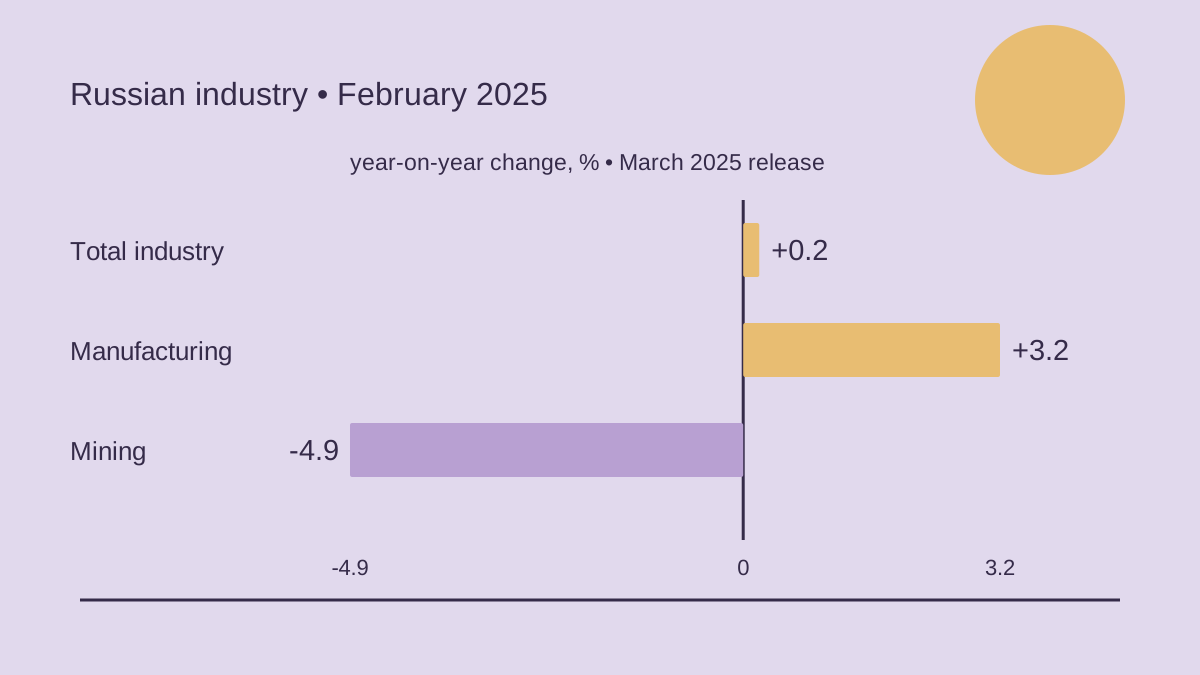
Industrial production in Russia rose just 0.2% year on year in February 2025; January–February growth was 1.2%. Interfax reported on 26 March, citing Rosstat, connected much of the slowdown to comparison with leap-year February 2024. The result missed economists’ 1.1% forecast. Manufacturing still expanded, while mining contracted: the headline concealed opposing movements within industry.
- Manufacturing: +3.2% year on year.
- Mining: −4.9% year on year.
- Adjusted output: +0.4% month on month.
The slowdown began in January
The weakening had begun before February. Interfax’s 26 February report put January 2025 industrial growth at 2.2%, against an early-February consensus of 5.4%. Its seasonally and calendar-adjusted estimate showed a 3.2% monthly fall. Manufacturing increased 7%, but mining declined 2.1% and energy supply fell 6.4% year on year. Other transport equipment rose 36.9%, fabricated metals 33.1% and pharmaceuticals 22.8%; motor vehicles, trailers and semi-trailers fell 5.5%. These were January readings: the adjusted January estimate was subsequently revised in the February release.
The leap-year comparison
The comparison month had been unusually strong. Reporting on 27 March 2024, Interfax recorded February 2024 growth of 8.5%, exceeding a 5.6% consensus; the agency attributed part of that acceleration to the extra leap-year day. Manufacturing rose 13.5%, mining 2.1% and energy supply 6.4%. The adjusted monthly increase was 1.5% in that release, a different measure from annual growth. Fabricated metals expanded 51.5%, electronics and optical products 47.2%, and motor vehicles 37.9%. Thus the February comparison combined calendar differences with substantial sector-specific increases in the earlier period.
How the recovery changed the base
To understand the changing base, the earlier releases need their own dates. On 22 February 2023, Interfax reported January industrial production down 2.4% year on year, less than the 3% fall economists expected. Manufacturing declined 2.3% and mining 3.1%; adjusted monthly output fell 0.6%. Motor vehicles, trailers and semi-trailers were down 54.6%, wood processing 22.1% and machinery outside other classifications 22%. Yet other transport equipment rose 27.4%, and food output increased 4.4%. Even the initial contraction contained expanding branches rather than a uniform decline across every industrial activity.
RBC’s 29 March 2023 examination of February output showed the same separation. Overall production fell 1.7% year on year, mining 3.2% and manufacturing 1.2%. Within manufacturing, fabricated metals grew 38.8%, electronics and optical products 19.3%, and other transport equipment 10.3%. RBC noted that these classifications include both defence-related and civilian products. Economist Vladimir Salnikov said the precise contribution of defence and import substitution could not be measured without activity-level weights. The category increases therefore documented concentration, while the source itself limited how confidently their individual causes could be quantified.
RBC reported on 26 April 2023 that March industrial output grew 1.2% year on year, although the first quarter still contracted 0.9%. Manufacturing increased 6.3%, with fabricated metals up 30.3% and electronics and optical products up 22.5%. Mining fell 3.6%. That report also recorded the removal of oil-production statistics from the monthly publication. Analyst Sofya Donets said the omission complicated economic analysis and forecasting. This was a dated disclosure episode, alongside the first-quarter results; it cannot establish the availability of every later statistic or supply a missing oil-output value.
By 31 May 2023, the April release showed growth of 5.2% year on year and 0.6% over January–April. Interfax explicitly linked the acceleration to the weak April 2022 base, when output had fallen 2.7%. Adjusted monthly production increased 1.7%, so the report also contained growth beyond the annual comparison. Manufacturing rose 8% and mining 3.1%, while energy supply fell 1.4%. Fabricated metals increased 30%, electrical equipment 29.3% and motor vehicles 27.3%. Meanwhile, machinery outside other classifications declined 17.4%, illustrating that the recovery did not remove differences among industrial branches.
Finmarket’s 28 June 2023 report put May industrial growth at 7.1% year on year and January–May growth at 1.8%. The adjusted monthly increase was 0.7%, despite an unadjusted monthly decline of 0.3%. Manufacturing grew 12.8% annually and mining 1.9%. Passenger-car output was eleven times the exceptionally weak May 2022 level, reaching 42,200 vehicles; nevertheless, January–May passenger-car production remained 42% below the corresponding 2022 period. The monthly rebound and the accumulated shortfall coexisted in the same release, making it necessary to retain both the comparison period and the product definition.
On 26 July 2023, Finmarket reported June industrial growth of 6.5% year on year and a 2.6% first-half increase. Adjusted production was unchanged from May, even though the annual figure remained strongly positive. Manufacturing rose 13.1%, but mining fell 1.7%. Electronics and optical products increased 71.6%, fabricated metals 45.8% and electrical equipment 32.1%. Passenger-car production was 3.1 times its June 2022 level, while first-half car output remained down 29.9%. The release showed that annual recovery, monthly momentum and cumulative production could tell different stories without any contradiction in the reported comparisons.
The 27 September 2023 release put August growth at 5.4% year on year and the eight-month increase at 3%. Its adjusted monthly estimate, however, fell 0.3%. Manufacturing grew 10.3%, mining declined 1.2% and energy supply increased 2.1%. Electronics and optical products rose 54.2%, furniture 42.8% and motor vehicles 41.8%. Tobacco output fell 14.5%, paper 3.7% and beverages 1.6%. Interfax also recorded an upward revision of the earlier 2022 annual estimate. The publication thus combined continuing recovery, weaker immediate momentum and statistical revisions, rather than presenting an uninterrupted acceleration across every measure.
Finmarket’s 25 October 2023 account showed September output up 5.6% year on year and January–September up 3.3%. Manufacturing rose 10.9%, while mining declined 0.7% and energy supply 3%. Motor vehicles expanded 56.3%, fabricated metals 47.5% and other transport equipment 45.8%. At the same time, tobacco production fell 18%, paper 3.6% and beverages 1.8%. Passenger-car production over nine months was now 2.7% above its corresponding 2022 total. These figures documented recovery in that product’s accumulated output, alongside persistent weakness elsewhere; they were September results released in October, not October production data.
Interfax’s 29 November 2023 report described October growth of 5.3% year on year, matching the economists’ consensus. January–October output was up 3.5%, but adjusted monthly production fell 0.4%. Manufacturing expanded 9.5%, while mining declined 0.1%. Furniture rose 45.7%, motor vehicles 41% and fabricated metals 34.5%; tobacco fell 28.2%. The agency also stated that the 2022 annual estimate had changed from a 0.6% contraction to 0.6% growth. That revision concerned the preceding year, demonstrating why contemporary release figures must be labeled by publication date rather than treated as permanently fixed historical observations.
On 27 December 2023, the November report showed annual industrial growth slowing to 4.3%, with an eleven-month increase of 3.6%. Adjusted monthly output rose 0.2%, after the preceding month’s decline. Manufacturing increased 8.1%, while mining fell 0.4% and energy supply 0.5%. Motor vehicles grew 53.1%, electronics and optical products 38.9% and pharmaceuticals 28.8%; machinery repair and installation declined 7.6%. Over January–November, electronics, other transport equipment and fabricated metals remained leading growth categories. The source distinguished these cumulative results from November’s individual gains, preserving a broader view than the single headline rate alone provided.
The first annual assessment, published on 31 January 2024, put 2023 industrial growth at 3.5%. December’s increase was 2.7% year on year, below a 4.4% consensus, while adjusted monthly output was unchanged. Full-year manufacturing rose 7.5% and mining declined 1.3%. Electronics and peripheral products grew 32.8%, fabricated metals 27.8% and other transport equipment 25.5%. The report revised earlier monthly data and raised the 2022 estimate to 0.7% growth. Its 3.5% figure was therefore an initial dated annual assessment, subsequently replaced by later revisions; it is useful here as evidence of how the recovery was originally reported.
Growth after the leap-year surge
The next year opened with stronger reported annual growth. On 28 February 2024, Interfax put January output up 4.6%, above economists’ 4% consensus. Manufacturing rose 7.5%, mining 0.8% and energy supply 4.6%. Electronics and optical products grew 54.6%, motor vehicles 50.2% and furniture 34.1%, while coke and petroleum products fell 4%. That release initially estimated adjusted monthly growth of 0.7%; later reports revised the January reading. The figures describe the information available in February 2024 and a broad set of expanding branches, rather than a final unrevised starting point for all subsequent comparisons.
The 24 April 2024 release showed March growth of 4% year on year and first-quarter growth of 5.6%. Interfax said the slower annual rate after February was expected, because the leap-day effect had boosted the preceding comparison. Adjusted monthly production still rose 0.1%. Manufacturing increased 6%, mining 0.4% and energy supply 4.1%. Other transport equipment grew 32.9%, fabricated metals 33.4% and electronics and optical products 31.9%; metallurgy fell 5.7%. The same document thus paired a lower headline annual rate with a slightly positive adjusted monthly reading and sizable growth in several manufacturing categories.
April 2024 growth, released on 29 May, slowed slightly to 3.9% year on year, while January–April growth was 5.2%. The actual result exceeded a 3.3% consensus, but adjusted monthly output declined 0.2%. Manufacturing accelerated to 8.3%; mining fell 1.7% and energy supply 0.8%. Electronics and optical products rose 44.3%, motor vehicles 36.7% and other transport equipment 35.1%. Coke and petroleum products declined 4.8%, and coal mining 2.2%. The release again required two distinctions: stronger manufacturing did not mean every major industrial sector expanded, and beating a forecast did not imply positive adjusted monthly momentum.
On 26 June 2024, May output was reported up 5.3% year on year, considerably above a 2.9% consensus. Adjusted monthly production increased 2% in that release, after a revised 0.1% April decline. Manufacturing grew 9.1%, but mining remained down 0.3%. Energy supply increased 4.2%, and water supply and waste-related activities rose 5.4%. January–May industrial growth was 5.2%, with manufacturing up 8.8% over the five months. Those cumulative figures and the revised previous-month estimate made the publication more informative than its May headline alone: it documented both the latest gain and changes to the preceding monthly comparison.
The next release brought another calendar example. On 24 July 2024, June growth was initially estimated at 1.9% year on year; Interfax noted nineteen working days against twenty-one a year earlier. The agency attributed part of the slowdown to that difference. Adjusted monthly output fell 1.5%, and first-half growth was initially 4.4%. Manufacturing rose 4.6%, while mining fell 3.1%. Machinery outside other classifications declined 18.6%, whereas fabricated metals increased 30.9%. The calendar explanation therefore accompanied an adjusted monthly contraction and substantial sector divergence; it did not replace either of those observations in the report.
Revisions and the second-half pattern
The 28 August 2024 publication revised that picture. June’s annual increase became 2.7%, replacing 1.9%; first-half growth became 5%, replacing 4.4%. Rosstat also raised the 2023 annual estimate to 4.1% from 3.5%. July itself grew 3.3% year on year, exceeding a 2.6% consensus, while adjusted monthly production fell 0.8%. Manufacturing increased 6.6% and mining declined 2.2%. These revisions changed historical comparisons without changing the identity of the months concerned. June’s original estimate and its August revision are separate publication vintages, so combining them without dates would conceal an important part of the statistical record.
On 25 September 2024, August industrial growth was reported at 2.7% year on year and January–August growth at 4.5%. Adjusted monthly output rose 0.8%. Manufacturing growth slowed to 4.7%, while mining increased 0.1%. The Industry and Trade Ministry linked the changing manufacturing trend to expensive borrowing and weaker investment activity, warning that a prolonged high policy rate could exhaust the investment upswing. This was an attributed ministry assessment, rather than a measured decomposition of output. The same report showed pharmaceuticals up 19.2%, other transport equipment up 32.7%, and machinery outside other classifications down 16.7%.
September 2024 figures, published on 23 October, showed annual growth of 3.2% and a nine-month increase of 4.4%. Adjusted monthly output was unchanged. Manufacturing grew 6.6%, mining contracted 1.8% and energy supply increased 1.7%. Other transport equipment rose 50.4%, electronics and optical products 31.5%, and fabricated metals 16.1%; leather products fell 13.8%, machinery outside other classifications 5.8% and metallurgy 4.9%. The headline acceleration relative to August therefore described the annual comparison. The unchanged adjusted monthly reading and the declining branches remained part of the same September industrial picture, rather than disappearing behind that annual improvement.
The 27 November 2024 release put October growth at 4.8% year on year, substantially above economists’ 3.1% consensus. Adjusted monthly production rose 0.5%, and January–October growth was 4.4%. Manufacturing increased 9.6%, while mining fell 2%. Electronics and optical products expanded 49.9%, other transport equipment 44% and fabricated metals 16%. Leather products declined 13.4% and metallurgy 3.9%. This was another manufacturing-led improvement with a mining offset, rather than simultaneous expansion in all major industrial sectors. The figures also show why a positive national result cannot be read as a description of every producer’s operating conditions.
On 25 December 2024, November output was initially reported up 3.7% year on year, close to a 3.8% consensus. The adjusted monthly increase was 0.7%, and January–November growth was 4.3%. Manufacturing rose 7.2%, mining fell 1.3% and energy supply grew 1.2%. Other transport equipment increased 44.2%, electronics and optical products 23.1%, and pharmaceuticals 16%; leather products declined 20.3%. The report also recorded economists expecting 2.5% industrial growth in 2025. That forecast belonged to the December survey and was an expectation for the coming year, not an observation of production already achieved in 2025.
The 5 February 2025 annual release subsequently put December growth at 8.2% year on year and full-year 2024 growth at 4.6%, revising November to 3.5%. Manufacturing rose 14% in December and 8.5% over the year; annual mining output declined 0.9%. The 2023 annual estimate was raised again, to 4.3%. Economist Vladimir Salnikov attributed the December surge partly to year-end completion of orders, including defence-related production, and cautioned against expecting those rates to persist. His explanation was explicitly attributed, while the release’s revisions demonstrate why the earlier monthly chronology here is a record of published assessments, not a reconstructed final series.
Prices and wider activity
Physical production was only one dimension of February’s industrial conditions. Interfax’s 19 March 2025 price report showed producer prices rising 0.9% from January, against economists’ 0.4% expectation. Mining prices increased 2.1%, manufacturing prices 0.5% and energy-supply prices 1.3%. The report also recorded full-year producer-price growth of 7.9% in 2024, after 19.2% in 2023. These are price changes, distinct from the volume index used for industrial output. The sector-level price increases therefore add information about selling-price movements but do not convert the February volume slowdown into a measure of revenue, profit or purchasing power.
The wider economy had also slowed in the preceding month. On 5 March 2025, Interfax reported the Economy Ministry’s January GDP estimate of 3% annual growth, following 4.5% in December. January freight activity rose 1.1%, retail turnover 5.4%, wholesale turnover 2.2% and construction work 7.4% year on year. The source recorded the central bank’s February forecast of 1–2% GDP growth for 2025. GDP covers a wider range of activity than industry, and that forecast was a prospective assessment. These January comparisons provide dated economic context without establishing February GDP or attributing the industrial result to any one of those activities.
A survey offered a February view of business activity. Interfax reported on 5 March that S&P Global’s services PMI fell to 50.5 from January’s 54.6, while the composite output index covering services and manufacturing fell to 50.4 from 54.7. Readings above 50 indicate expansion; both remained above that threshold. New-order growth in services was the weakest since July 2024, although employment creation accelerated and businesses still expected growth over twelve months. The survey therefore documented slower expansion alongside hiring and optimism. Its index points complement volume statistics but are neither percentage changes in industrial production nor forecasts already fulfilled.



Leave a comment