The September programme deadline
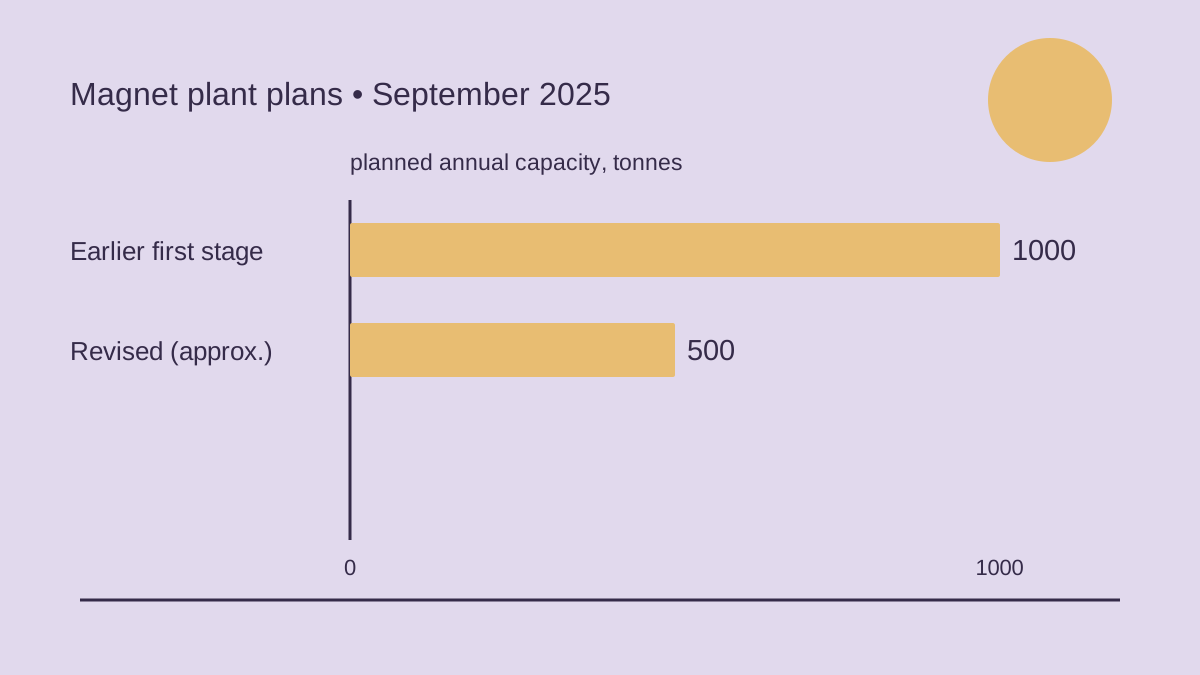
Interfax reported that on 5 September 2025, Vladimir Putin asked the government to approve a long-term rare-earth industry programme by November. At the Eastern Economic Forum, Rosatom MetalTech chief Andrey Andrianov reported that planned first-stage magnet capacity in Udmurtia had fallen from 1,000 to about 500 tonnes. He linked readiness to expand to 1,000 tonnes with customers confirming their demand.
A full-cycle national project
The earlier policy statement came on 24 February 2025, at a meeting devoted to rare and rare-earth metals. Putin said the newly launched New Materials and Chemistry national project should establish the entire industrial sequence: extraction, processing and finished technological products with high added value. He called for the volume of those products to increase severalfold over the project's duration. The president also asked that development instruments and mechanisms be directed toward that objective, describing new materials as a priority affecting industrial competitiveness, countries' development and citizens' quality of life.
Support instruments and separate metal targets
On 25 March, Industry and Trade Ministry official Konstantin Fedorov described approximately 60 billion roubles of support for the federal rare- and rare-earth-metals project. He listed research and development subsidies, preferential lending, special investment contracts and customs measures; a subsidy for product discounts was being developed. His presentation separated a 2030 target of 50,000 tonnes for large-volume rare metals and light rare-earth oxides from 80 tonnes for small-volume materials. He separately discussed reaching 3,000 tonnes of domestic rare-earth production, against the 50 tonnes he reported for 2024.
Separation enters the investment-contract list
A government order published on 21 July added rare-earth separation technologies to the list eligible for special investment contracts. One process separates collective concentrate into lanthanum, cerium, neodymium, praseodymium and a medium-heavy collective fraction; another separates that latter fraction. Under the SPIC 2.0 framework described in the report, participants are selected competitively and there is no minimum investment requirement. Contracts can run up to 15 years for investment up to 50 billion roubles, or 20 years above that amount. Investors undertake serial industrial production while government maintains the agreed implementation conditions, including taxation.
The July production and tax proposals
At a Federation Council economic-policy committee meeting on 1 July, Industry and Trade Minister Anton Alikhanov said the principal separation technologies had been developed. He expected major projects with interested investors to increase domestic rare-earth production sevenfold and reduce import dependence to a minimal level. Alikhanov also reported work with the Finance Ministry on tax preferences for the sector. He described such preferences as an effective instrument and expressed hope that the departments would complete their preparation soon.
Working beneath thin ore seams
A June 2023 account of Lovozersky GOK described underground mining along gently dipping ore bodies extending to a depth of 600 metres. Their thickness could be only tens of centimetres, leaving working faces 100–120 centimetres high. Annual water inflow was reported at 10–12 million cubic metres. The mine's active flanks stretched across roughly eight kilometres. General director Vladimir Fedyakov said repairs after the transfer to Rosatom had enabled nine wagons of concentrate to be shipped in June; the annual plan was 8,000 tonnes, with Solikamsk Magnesium Works as the buyer.
Chlorine connects the processing workshops
In March 2023, Solikamsk chief Ruslan Dimukhamedov explained the plant's linked chemical operations. Electrolysis of carnallite supplied by neighbouring Uralkali produces magnesium and chlorine. The chlorine is used to treat loparite concentrate at approximately 1,000°C, yielding chlorides subsequently converted into saleable tantalum and niobium oxides, titanium and rare-earth carbonates. Dimukhamedov said the aggressive process required the chlorinator to be dismantled to its foundation and rebuilt every three quarters. Because the workshops operate together, he favoured continuous equipment renewal and repairs over rebuilding that would interrupt the connected production sequence.
Equipment installed at the concentrator
- Rosatom's 4 June 2024 release reported the installation of a domestically manufactured drying drum at Lovozersky GOK, assembled by the plant's own workforce. Conveyor belts were replaced, drives repaired, new scales installed and drainage pumps mounted. The enterprise also purchased three screens for sorting ore by particle size.
- Repairs to concentration tables and spiral separators continued. Management expected completion to raise recovery to 80–81%. Fedyakov separately described planned scientific and laboratory work on fine concentrate fractions, which he expected could increase recovery to 85–87%; these percentages were prospective objectives.
Investment plans across linked facilities
At public hearings reported in February 2024, mining-division managers described approximately 500 million roubles allocated to replacing Lovozersky GOK equipment during 2023. The following year's supporting capital expenditure was planned at about 800 million roubles for the mine and 1.1 billion for Solikamsk. Four development projects were to be presented for investment approval in 2024: 7.5 billion roubles for rare-earth separation, 1.1 billion for metallic tantalum, 2.4 billion for additional generating capacity and 4.5 billion for mine modernisation.
Six cascades test the separation route
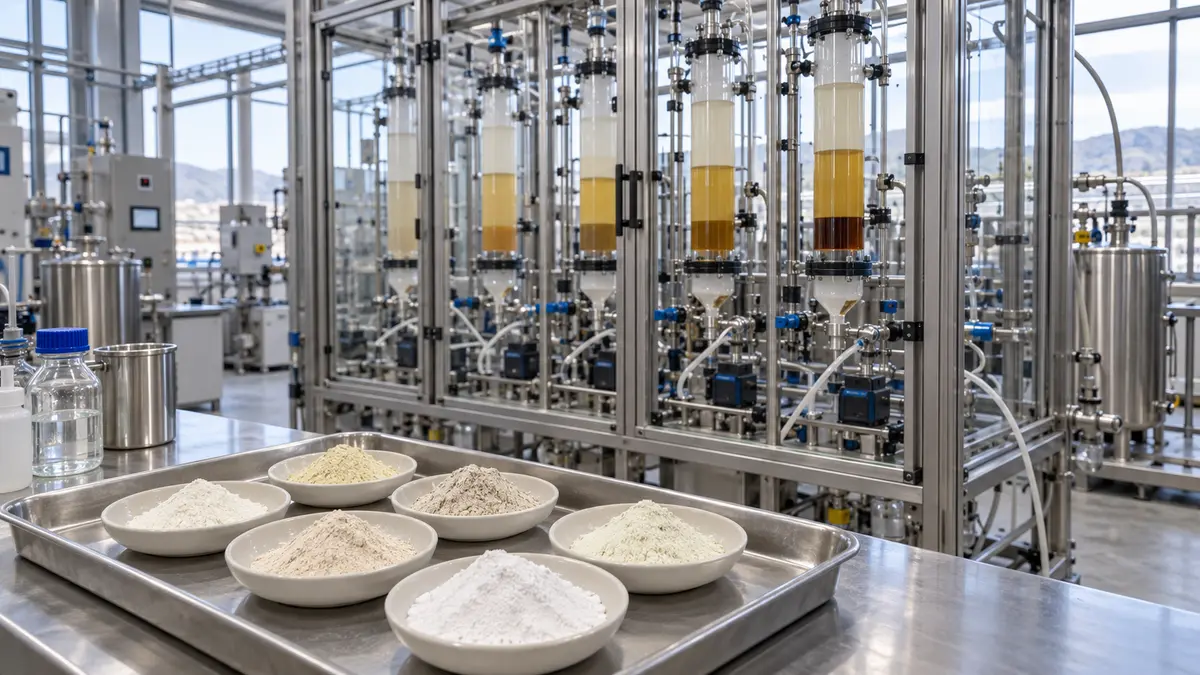
Rusredmet general director Andrey Nechaev described the separation pilot in a May 2024 interview. Carbonates were dissolved in nitric acid before extraction; he compared concentrations of useful components of 350–370 grams per litre in the nitrate route with 80–100 in the chloride route. Six extraction cascades had operated continuously for several thousand hours, allowing material flows to be balanced experimentally. Neodymium, praseodymium and other trial products had been sent to customers and met their parameters, he said. The work was then moving into technical decisions and design for an industrial installation.
A pilot plant and analytical laboratory
In its achievements release of 30 December 2024, Rosatom reported that mining-division investment and specialist expertise had supported the development of a domestic rare-earth extraction technology within eighteen months. The account described a pilot installation with capacity of up to 1.5 tonnes a year and an analytical laboratory. A separate entry in the same release recorded completed repairs to concentration tables, spiral separators, a ball mill and other equipment at Lovozersky GOK. Two new load-haul-dump machines had also arrived.
Surveys precede the industrial complex
By April 2025, Solikamsk had begun engineering investigations at the proposed separation site. Investment and development director Alexander Stepanov said the work would establish whether buildings could be constructed there, examining soils, geodetic characteristics, environmental effects and other factors. Two drilling rigs and additional machinery were operating. Process and equipment diagrams, preliminary layouts and a three-dimensional model of the main production building and auxiliary structures were ready. Engineering-network routes remained under discussion. The investigation results were to determine the specific positions of the principal production building and supporting facilities.
A research declaration with India
A declaration signed in Moscow by Giredmet and India's Council of Scientific and Industrial Research was reported in May 2025. The document covered academic, scientific and research cooperation between Russian and Indian specialists. Rosatom Science chemical-technology cluster director Andrey Goliney identified deep processing of rare- and rare-earth-bearing raw materials as a shared interest. He described technologies for obtaining high-purity metals, compounds, alloys and materials for electronics, chemicals and the nuclear industry. Goliney said the partners were interested in scaling technologies to pilot production and subsequently integrating them into both countries' industries.
Tomtor's infrastructure constraints
In a 2 July 2025 Federation Council appearance, Alikhanov described Tomtor in Yakutia as the richest of Russia's explored rare-earth deposits, while pointing to projects that were simpler to develop. He identified difficulties involving logistics, energy supply and personnel, and declined to promise an immediate solution. The deposit's owner had changed in May, when Rosneft acquired the project. Yakutia head Aysen Nikolayev had earlier said the regional authorities expected concrete development decisions during 2025. Alikhanov considered Tomtor a resource to be developed in due course, without setting an operating date.
Recovering geological knowledge
Norilsk Nickel head Vladimir Potanin discussed exploration uncertainty with journalists on 18 March 2025. He said many rare-earth deposits were small, difficult to mine and insufficiently studied. According to Potanin, some Soviet-era geological research results had been lost and would need to be restored; the company was considering and working on that task. Asked about foreign cooperation, he said technical support from various partners could be useful for complex projects. He nevertheless considered discussion premature because substantial work on the deposits remained.
Glazov's original factory agreement
TVEL, Rusatom MetalTech and Udmurtia's government signed their Glazov magnet-production agreement at the June 2023 St Petersburg International Economic Forum. Regional head Alexander Brechalov described a planned industrial park of 20 hectares, potentially expanding to 60, with infrastructure financed through programme 1704 and VEB.RF. He expected more than 200 jobs. The partners announced a full-cycle neodymium–iron–boron magnet operation using domestic mineral resources, targeting over 1,000 tonnes annually by 2028 and possible expansion to 3,000 after 2030. TVEL also recalled EleMash Magnet's first delivery to NovaWind for wind generators in 2020.
The maker's view of end uses
Following the signing of a special investment contract on 14 February 2024, Andrianov discussed intended customers in an interview with Rare Earth magazine. He described permanent magnets as a way of converting electrical energy into movement, whether rotation or displacement. His examples ranged from transport to drills, screwdrivers, lawnmowers, coffee grinders and mixers. Andrianov wanted domestically produced magnets incorporated into subsequent manufacturing stages and finished products. Asked about competing with China, he said efficiency was necessary throughout the chain, from extraction to final goods, and that an inefficient project would not proceed.
Demand estimates and a scientific memorandum
At the December 2023 strategic session hosted by MISIS University, Andrianov cited an estimated rise in domestic magnet demand from 1,045 tonnes in 2021 to 3,400 in 2030. He identified wind generation and electric transport as drivers. Rusatom MetalTech, MISIS, the Baikov Institute of Metallurgy and Materials Science and Science and Innovations signed a memorandum to organise an international conference for September 2024. Sergey Salikhov described specialist exchange and university training as objectives. Rosatom official Dmitry Ivanets emphasised control from raw materials through research and industrial manufacture.
Preparing shared research and education
MISIS reported further planning at Atomexpo in March 2024. Salikhov took part in Rusatom MetalTech's roundtable on permanent magnets, where the university and its Rosatom partners agreed a work plan for the September conference. He said the broader meeting was intended to bring the magnetic-materials community together and develop a long-term strategy connecting extraction with high-performance magnets. A business breakfast with corporation representatives also established common approaches to educational programmes for the nuclear sector. The university's delegation participated in discussions about the competencies needed by graduates of partner institutions.
A grant for rare-earth-free alloys
In April 2023, MISIS announced Russian Science Foundation support for Mikhail Gorshenkov's study of magnetic hardness in manganese–aluminium alloys with gallium, carbon and copper additions. Gorshenkov identified electromechanical machines without strict miniaturisation requirements as prospective applications, including motors for scooters, bicycles, motorcycles and cars. He said sufficiently high magnetic properties had not yet been achieved in bulk or thin-film manganese–aluminium materials, preventing industrial use. The project would investigate how additions affect thermodynamic stability and magnetic properties when alloys are produced through rapid quenching and mechanical alloying.
Copper additions and the manganese–aluminium phase
MISIS reported results from manganese–aluminium alloy research on 11 June 2025. The material's ferromagnetic tau phase can decompose at elevated temperatures, complicating heat treatment. Gallium helped stabilise that phase without impairing magnetic properties, while small copper additions lowered yield stress and improved workability. The researchers found their best result at 3% copper, producing up to 94% stable tau phase with a homogeneous structure. Higher copper content instead introduced chemical heterogeneity. The findings appeared in Journal of Alloys and Compounds under Russian Science Foundation project 23-13-00161; Gorshenkov described further technological optimisation as a direction.
Ferrite ceramics at lower sintering temperatures
A March 2025 study by MISIS and the Kurnakov Institute examined barium hexaferrite as another magnet material. Disc-shaped nanoplate powder achieved coercivity of 5.6 kilooersted, according to researcher Andrey Timofeev. Conventional sintering can enlarge particles and reduce coercivity. The team mixed the powder with low-melting bismuth or boron oxide additions and sintered the formed material at 900°C. Samples retained 5.3 kilooersted coercivity. Andrey Mironovich described the combination of controlled nanoplate synthesis and lower-temperature sintering as the approach; results appeared in Russian Journal of Inorganic Chemistry.
Carbonate flows and individual compounds
A study described by Interfax in February 2025 distinguished mixed carbonate supply from individual compounds. Analysts Alexandra Petrova and Sergey Bogdanov reported that Solikamsk's recent production contained 2,300–2,700 tonnes of rare-earth oxides within carbonates. Traditional onward processing took place at NPM Silmet in Estonia, while trade was being reoriented toward China. They also identified Skaygrad's smaller individual-compound capacity of 200–250 tonnes and its phosphogypsum-processing project, which could reach 4,000 tonnes of rare-earth production. The latter figure concerned prospective production from a fertiliser-manufacturing by-product, separate from established carbonate flows.
Demand and tariff proposals at Atomexpo
At Atomexpo's March 2024 rare-earth panel, Fedorov placed consumption at 2,200 tonnes and expected further growth. He proposed making domestic metallurgical raw materials a purchasing priority through lower export duties and higher import duties. Federation Council participant Konstantin Dolgov proposed customs regulation, government orders and an extraction-tax preference to support production and consumption. Alexander Sapegin of Rusatom MetalTech described the company's objective as uninterrupted supply of magnet products for wind energy, vehicles and mechanical engineering.
Procurement and operating-cost proposals
A Ministry of Industry and Trade strategic session reported in May 2024 gathered further proposals. Rosatom representatives suggested tax relief for strategic raw-material extraction and processing, preferential transport tariffs, reserve purchases where demand was absent, and subsidies supporting operating and investment break-even. Participants also proposed purchasing rules and localisation points favouring domestically sourced materials. Skaygrad co-founder Alexey Abramov called for a trading house to coordinate government orders and questioned penalties for changing suppliers on state-financed projects. The session's recommendations were to be consolidated and sent to the authorities for consideration.


Leave a comment