
Thailand’s central bank lowered its policy rate to 2.00% on February 26, 2025, with six committee members supporting the cut and one preferring a hold. Reuters reported a weaker growth outlook and trade-policy risks. The decision followed years of changing assessments of recovery, inflation and credit conditions.
Pandemic support and uneven credit access
On February 3, 2021, the monetary policy committee unanimously retained a 0.50% rate. Its statement described a recovery supported by government measures and improving exports, yet threatened by a renewed coronavirus outbreak. Less restrictive containment measures were expected to reduce the damage compared with the previous year. The committee also identified a distribution problem: abundant liquidity and low financing costs did not ensure access for vulnerable borrowers. Rising credit risks affected businesses recovering slowly and households hit by renewed restrictions, supporting calls for guarantees and debt restructuring. Vaccination, tourism and labor-market developments also shaped the recovery outlook.
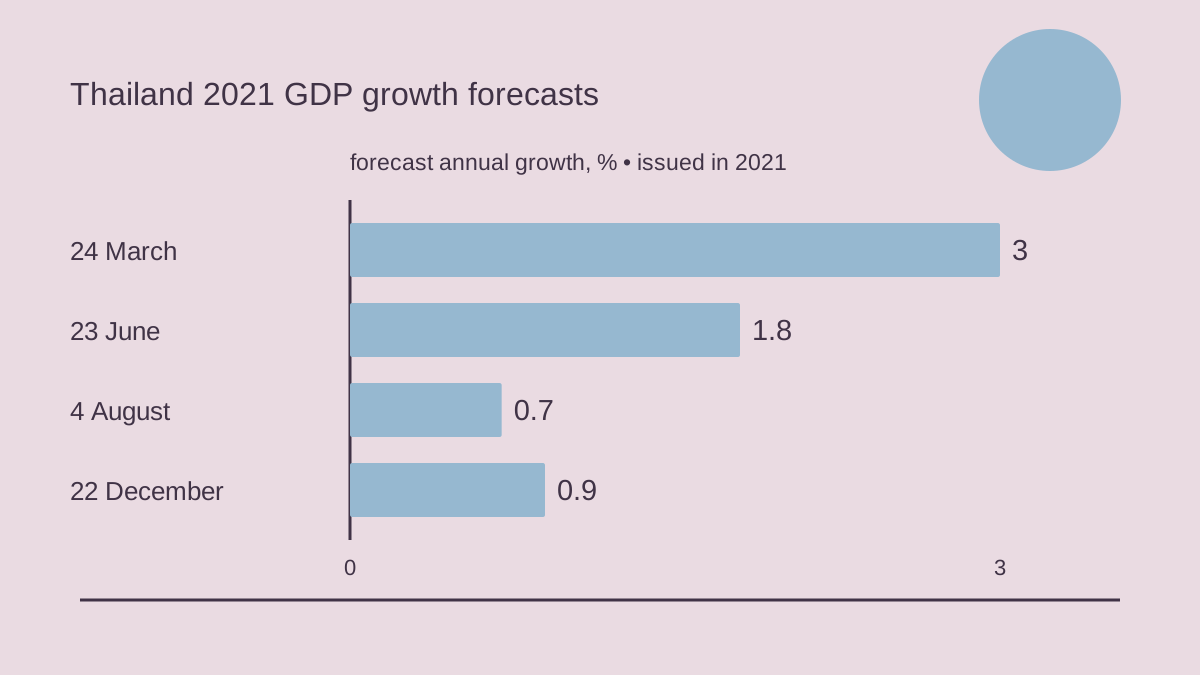
The March 24 statement again recorded a unanimous hold at 0.50%, alongside lower growth projections. The committee then expected GDP to expand by 3.0% in 2021 and 4.7% in 2022, reflecting weaker tourist arrivals and renewed pandemic disruption. Recovering merchandise exports and additional stimulus offered support, but vaccination, tourism and continued fiscal assistance remained important uncertainties. Financial conditions also reflected developments abroad: domestic long-term government yields rose with US Treasury yields, while the baht weakened in line with regional currencies. The bank still described uneven liquidity distribution.
By May 5, a third outbreak had weakened the outlook further, but the committee unanimously kept the rate unchanged. It considered timely vaccine procurement and distribution the immediate economic priority. For affected businesses and households, credit measures and faster debt restructuring were judged more targeted than reducing an already low policy rate. Exports benefited from expanding trading-partner economies, although the committee expected limited benefits for the overall labor market. Delayed reopening threatened tourism, while weaker household savings relative to income reduced the resources available to absorb expenses. Broader credit distribution was needed following the launch of special business loans.
The June 23 decision preserved the same rate by unanimous vote, with GDP forecasts reduced to 1.8% for 2021 and 3.9% for 2022. Lower tourist numbers and weaker domestic demand weighed on the projections. The committee highlighted slow recovery among service workers and the self-employed, while exports and greater public expenditure provided support. It expected a temporary inflation increase partly because oil prices had been unusually low a year earlier. Virus mutations remained a downside risk. The committee also preferred targeted loans and debt restructuring over another rate reduction. It emphasized faster assistance to affected borrowers.
The August 4 meeting exposed disagreement over how much additional monetary support was needed. Four members favored holding the rate at 0.50%, two wanted a quarter-point reduction, and one was absent. The committee projected growth of only 0.7% in 2021 and 3.7% in 2022, with consumption and tourism weaker than previously expected. Most members considered financial assistance more effective than another cut; the minority wanted a reduction to complement other measures. Improving exports remained supportive, although factory outbreaks and temporary raw-material shortages affected parts of manufacturing. Special business loans also helped improve access for smaller firms.
On September 29, the committee returned to a unanimous hold. Its growth projections stood at 0.7% for 2021 and 3.9% for 2022. Vaccination progress and earlier relaxation of restrictions were expected to rebuild confidence and consumption after a difficult third quarter. Tourism would recover slowly, while shortages of shipping containers and semiconductors continued to constrain exports. Weak domestic demand was keeping inflation subdued. The committee again favored accelerating liquidity distribution and debt restructuring, judging these financial measures more effective than a further reduction in an already low rate. Assistance would consider affected borrowers’ long-term ability to service their obligations.
The November 10 statement assessed that the economy had passed its third-quarter low and entered recovery as restrictions eased and borders reopened. The committee nevertheless unanimously retained the 0.50% rate because the recovery remained fragile. Energy prices were pushing inflation higher, but the bank still expected subdued demand pressure as incomes and purchasing power recovered slowly. Persistent energy increases and prolonged supply constraints were identified as risks. Financial support also extended beyond domestic lending: the committee supported helping smaller businesses hedge against exchange-rate volatility, alongside continued debt restructuring. Fiscal support was recommended to rebuild income and economic potential.
The final 2021 meeting, on December 22, left the rate unchanged by unanimous vote while identifying Omicron as a significant new uncertainty. The committee expected growth of 0.9% in 2021, followed by 3.4% in 2022 and 4.7% in 2023. Its corresponding headline-inflation forecasts were 1.2%, 1.7% and 1.4%. These were contemporary projections, conditional on recovery and pandemic developments. Employment and income remained below pre-pandemic levels, limiting cost pass-through in the bank’s assessment. Credit risks still obstructed liquidity reaching smaller businesses, sustaining its emphasis on targeted assistance.
The turn toward normalization
The February 9, 2022 hold at 0.50% was unanimous, but the inflation discussion was changing. The committee expected the Omicron variant to place limited pressure on the health system, allowing recovery to continue, while higher energy and raw-food prices could push inflation above target early in the year. It had not yet identified broad price increases, and recovering household incomes still limited demand pressure. The bank nevertheless warned that prolonged expensive inputs or wider supply constraints could increase cost pass-through, making energy prices, wages and domestic prices important monitoring points.
On March 30, the committee again held the rate unanimously, despite projecting annual inflation of 4.9% in 2022 and 1.7% in 2023. Sanctions against Russia were associated in its assessment with higher energy and commodity costs and weaker external demand. Growth was projected at 3.2% and 4.4% for those years. The bank still saw inflation mainly as a cost shock rather than strong demand, while household income recovered slowly. Material shortages and higher living and production costs remained risks, especially for vulnerable groups, within an otherwise continuing recovery.
- Distinguish cost shocks from demand pressure.
Inflation risks and a divided vote
The June 8 vote revealed a sharper policy divide: four members favored retaining 0.50%, while three wanted a quarter-point increase. The committee now considered extremely accommodative policy less necessary as tourism and domestic consumption strengthened. Its growth forecasts were 3.3% for 2022 and 4.2% for 2023, with inflation projected at 6.2% and 2.5%. Cost increases were spreading across more products, and stronger recovery could add demand pressure. The majority wanted to ensure that recovery continued gaining traction before moving; the minority considered rising growth and inflation risks sufficient for immediate normalization.
On August 10, six members supported raising the rate from 0.50% to 0.75%; one preferred a half-point increase. Stronger tourist arrivals, improved travel confidence and recovering labor income supported the change. The committee judged pandemic-era accommodation less necessary and favored gradual normalization consistent with growth and inflation. The dissenter wanted to reduce the risk of more aggressive increases later. Inflation was expected to remain high through 2022 before returning to target in 2023. Vulnerable smaller businesses and low-income households still required targeted debt measures even as aggregate recovery strengthened.
The September 28 increase from 0.75% to 1.00% was unanimous. The committee projected growth of 3.3% in 2022 and 3.8% in 2023 as tourism and services recovery broadened. Inflation forecasts were 6.3% and 2.6%, with cost pass-through increasing despite declining commodity prices. Some sectors facing labor shortages had higher wages, but the bank saw no broad wage acceleration. It also described rapid baht depreciation associated with dollar strength, broadly consistent with regional currencies. Gradual normalization remained its approach, with the size and timing adjustable if the outlook changed.
A further unanimous quarter-point increase on November 30 brought the rate to 1.25%. The bank expected tourism and consumption to cushion the effect of a global slowdown on exports. Growth projections for 2022, 2023 and 2024 were 3.2%, 3.7% and 3.9%, respectively. The 2023 inflation forecast rose to 3.0%, partly reflecting higher electricity charges, although inflation was still expected to return to target that year. Private funding costs were rising with the rate, while bank credit and bond financing continued to grow. Targeted restructuring remained important for financially fragile borrowers.
- Keep rate decisions conditional on the outlook.
Tourism and the tightening peak
The January 25, 2023 decision unanimously raised the rate to 1.50%. Returning Chinese tourists were expected to strengthen service-sector employment and incomes, supporting private consumption even as merchandise exports were expected to slow. The committee expected headline inflation to decline but remained concerned about elevated core inflation, including delayed cost pass-through and stronger tourism-related demand. Financial conditions were becoming less accommodative: funding costs increased with earlier rate rises and the expiry of a reduced contribution to the Financial Institutions Development Fund. Bank lending and bond issuance nevertheless continued to expand, according to the statement.
On March 29, the rate rose unanimously to 1.75%, with the committee projecting GDP growth of 3.6% in 2023 and 3.8% in 2024. Tourism recovery was expected to support employment, income and consumption. Headline-inflation forecasts were 2.9% and 2.4%, although cost pass-through and stronger demand remained risks. Banking stresses in advanced economies added uncertainty to the international outlook. The committee judged the direct impact on domestic finance limited because Thai institutions and companies had few links to troubled banks and risky assets, but emphasized continued monitoring as events evolved.
The May 31 increase to 2.00% was also unanimous. Headline inflation had returned to the target range, yet the committee still saw reasons for gradual normalization: core inflation remained elevated and expanding activity could increase demand and cost pass-through. Growth forecasts remained 3.6% and 3.8% for 2023 and 2024, while headline inflation was projected at 2.5% and 2.4%. The baht had weakened partly amid US policy expectations, renminbi depreciation and domestic political uncertainty. Targeted debt restructuring remained necessary for financially fragile households and smaller businesses despite the wider recovery.
- Retain targeted assistance for vulnerable borrowers.
Policy space and financial vulnerabilities
On August 2, a unanimous increase took the rate to 2.25%. The committee described soft external demand, including weaker Chinese demand and the global electronics cycle, while tourism and consumption continued to support expansion. Lower energy prices, subsidies and the previous year’s high base had reduced headline inflation. Potential food-price pressure from El Niño remained a concern. The bank also linked higher rates to preserving policy space and limiting financial imbalances from prolonged low borrowing costs. Slower credit growth partly reflected normalization after lending had expanded through the pandemic.
The September 27 increase to 2.50% was unanimous, and the committee judged that level appropriate for supporting sustainable long-term growth. Its latest projections put GDP growth at 2.8% in 2023 and 4.4% in 2024, with headline inflation of 1.6% and 2.6%. Delayed exports and tourism recovery had weakened the current-year outlook. Government policies could add growth and inflation momentum, while El Niño posed food-price risks. Bond yields rose and the baht depreciated amid US monetary-policy developments and uncertainty over domestic policy details. Vulnerable borrowers’ credit quality still warranted attention.
Structural pressures and renewed cuts
On February 7, 2024, five members favored holding 2.50%, while two wanted a quarter-point cut to reflect weaker potential growth. The committee described disappointing exports and manufacturing, lower spending per tourist and delayed public investment. Its growth projection for 2024 was 2.5–3.0%. Low inflation was attributed chiefly to food, energy and subsidies rather than broad demand weakness; inflation excluding subsidies remained positive. Funding costs were stable and debt repayments had reduced outstanding loans slightly, although some smaller businesses faced tighter standards. Structural competitiveness problems increasingly weighed on the growth outlook.
The April 10 vote again split five to two in favor of a hold. Growth forecasts were 2.6% for 2024 and 3.0% for 2025, supported by tourism, consumption and expected faster public spending. Export competitiveness and global excess capacity limited the benefits of external recovery. The committee emphasized monetary policy’s limited ability to resolve these structural problems or credit-access difficulties. New lending was still growing even as repayments slowed outstanding-loan growth. Some smaller firms and low-income households faced worsening debt serviceability, reinforcing support for targeted restructuring and responsible lending.
On June 12, six members supported retaining 2.50%, with one favoring a cut. Stronger first-quarter domestic demand, tourism recovery and faster government disbursement supported unchanged growth forecasts of 2.6% and 3.0% for 2024 and 2025. Automotive exports faced weaker foreign demand, while competitiveness remained a broader constraint. Inflation had turned positive as diesel subsidies and excess food supply effects faded. Household credit quality was deteriorating, particularly around hire-purchase and card lending. The committee supported lending aligned with repayment capacity, debt restructuring and guarantees to address smaller businesses’ access difficulties.
The August 21 hold again passed six to one, but credit deterioration was increasingly prominent. Manufacturing workers and the self-employed had slower income recovery, and the committee saw downside risks around consumption and investment. Favorable weather was expected to support agricultural production and reduce the inflation assessment, while import competition restrained core prices. Small-business loans contracted amid rising credit risk; automotive and electronics lending declined partly for structural reasons. Household lending slowed as vulnerable borrowers’ repayment capacity weakened. The committee called for monitoring how deteriorating credit quality could affect financing costs, loan growth and activity.
On October 16, five members backed a cut from 2.50% to 2.25%, while two preferred a hold. The majority considered lower debt-servicing costs compatible with continued deleveraging and a neutral policy stance. The minority emphasized long-term financial stability and preserving policy space. Growth projections were 2.7% for 2024 and 2.9% for 2025, with tourism, stimulus-supported consumption and electronics exports contributing. Structural pressures persisted for manufacturers and smaller firms. Slower income recovery and high debt burdens were weakening credit quality, sustaining the committee’s support for targeted restructuring alongside the lower rate.
The December 18 meeting unanimously retained 2.25%, emphasizing policy space amid uncertain international policies. Tourism-related services were improving, but smaller businesses and some manufacturers still faced declining competitiveness. Growth projections remained 2.7% and 2.9% for 2024 and 2025; headline-inflation forecasts were 0.4% and 1.1%. The committee distinguished several causes of slower credit: weaker investment demand, repayment of pandemic-era borrowing and heightened credit risks. Tourism and service-sector credit also slowed partly because better incomes enabled repayments.






Leave a comment