
The December decision and the earlier cycle
On 9 December 2025, the Reserve Bank of Australia held its cash rate at 3.60 per cent, Reuters reported. Governor Michele Bullock ruled out further cuts for the foreseeable future, while linking questions about tightening to persistent inflation. ANZ analysts expected an extended hold. The decision closed a year of three cuts in Australia, following earlier tightening and a prolonged pause.
The 2023 tightening and its pauses
On 7 February 2023, the RBA raised its cash rate by a quarter percentage point to 3.35 per cent. Its statement put annual December-quarter headline inflation at 7.8 per cent, the highest since 1990, and underlying inflation at 6.9 per cent. The bank attributed price pressure to both global factors and strong domestic demand. It forecast annual economic growth of about 1.5 per cent in 2023 and 2024, while warning that the recovery in services spending after pandemic restrictions had largely run its course and tighter financial conditions would constrain spending.
The 7 March increase took the cash rate to 3.60 per cent. The RBA reported December-quarter GDP growth of 0.5 per cent and annual growth of 2.7 per cent, describing household consumption as slowing under tighter financial conditions. Housing construction prospects had weakened, whereas business investment prospects remained positive because many companies were using a high proportion of their capacity. Employment had fallen in January, partly reflecting changing seasonal hiring patterns. The bank said cumulative rate increases had not yet been fully reflected in mortgage payments, leaving uncertainty over the timing of the spending slowdown.
- The March increase also raised remuneration on Exchange Settlement balances to 3.50 per cent.
On 4 April, the bank paused at the March level after a cumulative increase of 3.5 percentage points since May 2022. Its stated purpose was to allow more time to assess the effects of earlier tightening. Banking problems overseas had caused financial-market volatility and a reassessment of global interest-rate prospects. The RBA nevertheless described the domestic banking system as strong, well capitalised and highly liquid. It also identified low rental vacancies and rapidly increasing utility prices as domestic pressures, while forecasting inflation of around 3 per cent by the middle of 2025.
The pause ended on 2 May with a quarter-point increase to 3.85 per cent. The RBA's forecast envisaged inflation of 4.5 per cent in 2023 and 3 per cent in mid-2025. Its growth projections were 1.25 per cent for 2023 and approximately 2 per cent over the year to mid-2025, with unemployment gradually reaching about 4.5 per cent by that date. The statement contrasted improving goods-price conditions following the resolution of pandemic disruption with broad-based services inflation. Weak productivity and brisk unit labour cost growth were additional concerns cited by the bank.
A further quarter-point increase on 6 June brought the rate to 4.10 per cent. The RBA said recent information had increased upside inflation risks and pointed to persistent services-price pressure overseas. Domestically, unemployment had risen to 3.7 per cent in April, employment growth had moderated and employers reported some easing of labour shortages, although vacancies remained elevated. The bank expected public-sector wages to accelerate and noted that the annual award-wage increase exceeded the previous year's. It stressed that aggregate wage growth remained compatible with the inflation target if productivity improved.
Assessing the delayed effects
The RBA held rates on 4 July, explaining that earlier increases were still working through the economy. Labour-force participation was at a record high, and unemployment remained close to its lowest level in fifty years. Companies reported fewer labour shortages, yet job advertisements and vacancies were still unusually high. The bank described a substantial slowing of household spending under the combined pressure of interest rates and living costs. Rising housing prices and substantial savings supported some households, while others faced a severe financial squeeze. The decision preserved time to assess these uneven developments.
The 1 August decision maintained the pause. The RBA's updated forecast put inflation at approximately 3.25 per cent by the end of 2024 and within the target range late in 2025. It forecast GDP growth of around 1.75 per cent in 2024 and slightly above 2 per cent in the following year. Labour shortages had eased according to company reports, but the bank still described the labour market as very tight. Its unemployment projection rose gradually from about 3.5 per cent to approximately 4.5 per cent late in 2024.
On 5 September, Governor Philip Lowe's statement kept the cash rate unchanged. The July monthly consumer-price indicator had declined further, but the bank distinguished that improvement from brisk services-price increases and elevated rent inflation. Household consumption and dwelling investment remained weak, with below-trend economic growth expected to continue. It identified the response of company prices and wages to slowing activity as an uncertainty, alongside the delayed effects of monetary policy. Overseas property-market stress was another risk to the global outlook discussed in the statement, without changing that month's domestic rate setting.
The 3 October statement, now issued by Governor Michele Bullock, continued the hold. It reported stronger-than-expected growth during the first half of the year while still describing the economy as growing below trend. Goods inflation had eased, but fuel prices had risen noticeably and rent inflation remained elevated. The RBA said capacity utilisation was high despite slower growth. Its discussion of households again distinguished financial pressure from support provided by housing wealth, savings buffers and interest income. Any further tightening would depend on incoming information and the evolving assessment of risks.
On 7 November, the RBA raised the rate to 4.35 per cent after four months of holds. Inflation was proving more persistent than anticipated, including across a broad range of services. The revised forecast put CPI inflation at about 3.5 per cent by the end of 2024 and at the upper edge of the target range by the end of 2025. The unemployment projection was approximately 4.25 per cent, a more moderate increase than previously forecast. The bank said the combined evidence on inflation, employment and activity had increased the risk of prolonged high inflation.
The year ended with an unchanged rate on 5 December. October's monthly CPI indicator showed further moderation driven by goods prices, but the RBA said it added little information about services inflation. September-quarter wages had accelerated as expected, reflecting the earlier award-wage decision. The bank considered wage growth compatible with its inflation objective provided productivity increased. It also reported weak household consumption and dwelling investment, and said the latest rate rise would continue to affect the economy. Holding the rate allowed it to assess effects on demand, prices and employment.
The extended hold through 2024
The 6 February 2024 hold opened a year of unchanged rate decisions. December-quarter annual inflation had eased to 4.1 per cent, with goods-price growth lower than the November forecast. The bank attributed that moderation to resolving global supply disruptions and weaker domestic goods demand. Services inflation was declining more slowly. Its central forecast envisaged a return to the target range in 2025 and to the midpoint in 2026. Employment was expected to grow moderately while unemployment and broader labour underutilisation increased slightly. The statement still left open the possibility of another rate increase.
On 19 March, the bank maintained its rate while reporting a January monthly CPI reading of 3.4 per cent over the year. Goods inflation was moderating faster than services inflation. The statement said wage growth appeared to have peaked, but its compatibility with the inflation target depended on productivity returning towards its long-run average. Recent national accounts confirmed slower growth, and household spending remained particularly weak. Real incomes had stabilised after earlier declines; the RBA expected that improvement to support consumption later in the year, while acknowledging uncertainty about whether the productivity improvement would persist.
The 7 May hold accompanied a less favourable inflation assessment. March-quarter annual CPI inflation was 3.6 per cent, down from the December reading, but underlying inflation had declined less because services prices remained persistent. The RBA expected near-term inflation to be higher after a domestic petrol-price rise and stronger-than-expected services inflation. Its forecast placed the return to the target range in the second half of 2025 and to the midpoint in 2026. Households were curbing discretionary expenditure and maintaining savings, while the bank expected stabilised real incomes eventually to support stronger consumption.
The 18 June statement highlighted an April annual monthly CPI reading of 3.6 per cent and 4.1 per cent excluding volatile items and holiday travel. Revised national accounts suggested stronger consumption over the preceding year than earlier estimates, although consumption per person was declining. The RBA discussed two prospective influences on demand and prices: tax cuts could assist real-income growth, while federal and state energy rebates would temporarily lower headline inflation. Persistent services inflation remained a central uncertainty. The rate was held as the bank assessed these mixed signals alongside subdued output growth.
Demand, capacity and the forecast timetable
On 6 August, the RBA revised its inflation return timetable slightly later than in May. It now expected entry into the target range late in 2025 and an approach to the midpoint in 2026. The bank attributed the revision partly to a higher domestic-demand forecast and partly to a weaker assessment of the economy's capacity to meet that demand. Consumption and saving revisions, labour costs and persistent services inflation were cited as upside risks. At the same time, weak GDP growth, rising unemployment and company reports of pressure supported concerns about weaker activity.
The 24 September hold followed national accounts confirming weak June-quarter growth. The bank said earlier real-income declines and restrictive financial conditions continued to weigh on discretionary consumption. It distinguished household spending from aggregate consumer demand that also included temporary residents, students and tourists, which had been more resilient. Employment had increased by an average of 0.3 per cent a month over the three months to August, and unemployment stood at 4.2 per cent. Participation remained at record levels, vacancies were elevated and hours worked had stabilised despite gradual labour-market easing.
On 5 November, the bank distinguished September-quarter headline inflation of 2.8 per cent from trimmed mean inflation of 3.5 per cent. Lower fuel and electricity prices contributed to the headline decline, partly through temporary relief measures. Its assessment of underlying pressure still relied on excess demand, business surveys and labour-market strength. Employment had grown by an average of 0.4 per cent a month over the three months to September. Labour productivity remained only at its 2016 level despite recent improvement. The bank held the rate and said restrictive policy was working broadly as anticipated.
The 10 December hold came with greater confidence that inflation pressure was declining. Annual GDP growth to the September quarter was only 0.8 per cent, the slowest outside the pandemic since the early 1990s. Annual wage-price growth was 3.5 per cent in that quarter, a larger moderation than the November forecast had anticipated. The RBA said the gap between demand and supply capacity continued to close. Income and consumption recovery had been slower than forecast, although more recent information suggested stronger spending in October and November. It still judged underlying inflation too high.
Three reductions in 2025
On 18 February 2025, the RBA lowered the rate to 4.10 per cent. December-quarter underlying inflation of 3.2 per cent, subdued private demand and easing wage pressure gave it more confidence about disinflation. The bank nevertheless noted unexpectedly strong labour-market information. It said policy would remain restrictive after the cut, and warned that excessive or premature easing could leave inflation above the target midpoint. Housing-cost inflation was abating, while some businesses found it difficult to pass cost increases through to customers. The reduction therefore accompanied explicit caution about subsequent policy decisions.
The newly titled Monetary Policy Board held the rate on 1 April. It said underlying inflation was easing in line with the February forecast but required confidence that the decline would be sustained. Private demand appeared to be recovering, real household incomes had risen and some measures of financial stress had eased. The statement also addressed tariff announcements and possible retaliatory measures as sources of global uncertainty. The board expected delayed spending decisions to hurt international activity, but said inflation could move in either direction. Domestic productivity remained weak and unit labour cost growth high.
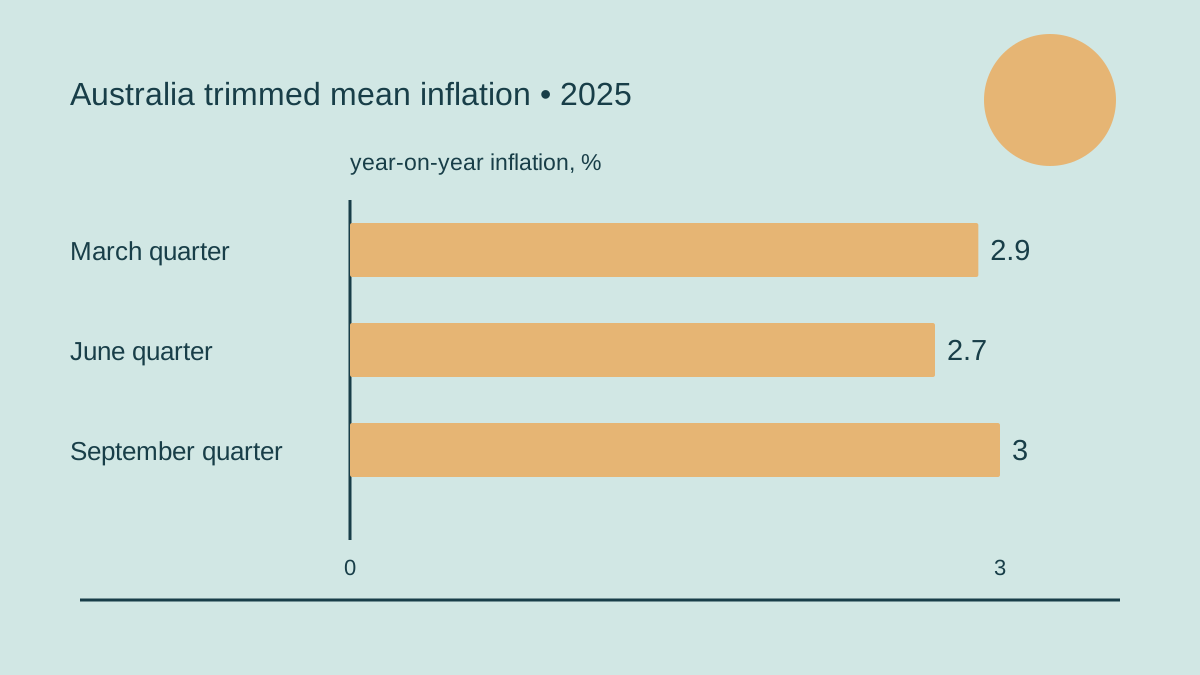
A second quarter-point cut on 20 May took the rate to 3.85 per cent. March-quarter annual trimmed mean inflation was 2.9 per cent, below 3 per cent for the first time since 2021, and headline inflation was 2.4 per cent. The board judged inflation risks more balanced and expected international developments to weigh on activity. Its forecasts placed underlying inflation near the target midpoint through much of the projection period. It also considered a severe downside scenario, saying monetary policy could respond decisively if international events materially affected domestic activity and inflation.
The board paused on 8 July rather than following the May cut immediately. Monthly price information was marginally stronger than expected, although broadly consistent with the quarterly forecast. The statement said it could wait for more information to confirm that inflation was moving sustainably towards 2.5 per cent. It also introduced an unattributed voting record: six members supported the decision and three opposed it. Private demand and real incomes were recovering gradually, while businesses in some sectors still found weak demand constrained price increases. Productivity weakness continued to complicate the assessment of labour costs.
On 12 August, a unanimous decision lowered the rate to 3.60 per cent, completing seventy-five basis points of cuts since the year began. June-quarter annual trimmed mean inflation had fallen to 2.7 per cent and headline inflation to 2.1 per cent. Staff forecasts assumed gradual easing and further moderation of underlying inflation towards the target midpoint. June unemployment was 4.3 per cent, with a quarterly average of 4.2 per cent. The board described slight labour-market easing while noting continued recruitment constraints. It remained cautious about demand, supply and the delayed effects of earlier monetary easing.
Recovery and renewed price pressure
The 30 September decision held the rate as private demand recovered somewhat faster than expected. The board said private consumption was taking over from public demand as a growth driver, supported by rising real incomes and easier financial conditions. Housing activity was strengthening and credit remained readily available. August unemployment was unchanged at 4.2 per cent, although employment growth had slowed slightly more than forecast. Partial price information suggested September-quarter inflation might exceed the August forecast. The board emphasised that earlier rate cuts had begun to have an effect, but their full impact would take time.
The 4 November hold followed September-quarter trimmed mean inflation of 1 per cent in the quarter and 3 per cent over the year, materially above the August forecast. Headline inflation rose to 3.2 per cent annually, partly reflecting the end of electricity rebates in several states. The board judged some underlying acceleration temporary, but its forecast placed underlying inflation above 3 per cent in coming quarters before settling at 2.6 per cent in 2027. That projection incorporated a technical assumption of another cut in 2026. The actual November decision was unanimous and unchanged.






Leave a comment