
Joy Business reported on 17 September 2025 that the Bank of Ghana had lowered its policy rate by 350 basis points, from 25% to 21.5%. Governor Johnson Asiama announced the majority decision after the committee’s 126th meeting. The bank expected inflation to enter its 8% target range, with a two-point margin, by the fourth quarter’s end. Asiama identified possible utility-tariff increases as a price risk. He attributed the cedi’s strength to monetary policy, liquidity management, fiscal consolidation and foreign-exchange inflows.
Recovery and credit in 2021
The earlier policy path included a hold at 14.5% in the release of 22 March 2021. February inflation was 10.3%, just above the 8% target’s two-point band. The bank identified oil prices and budget revenue measures as near-term risks. Monetary expansion nevertheless continued: base money grew 34.8% annually and broad money 29.1%. Nominal private-sector credit grew 7.4%, compared with 21.8% a year earlier, while real credit contracted 2.7%. The bank attributed weaker lending to constrained demand and expected inflation to return within the target band during the second quarter.
On 31 May 2021, the committee reduced the policy rate by 100 basis points to 13.5%. Its assessment linked easing inflation to lower food prices, base effects, tight monetary conditions and a stable exchange rate. New bank advances during January–April totalled 10.5 billion cedis, against 10.9 billion in the same period of 2020. Restructured loans stood at 4.65 billion cedis in March, representing 9.8% of the industry portfolio. The bank retained pandemic relief measures and noted that rents and transport fares still needed monitoring in the inflation outlook.
The release of 26 July 2021 kept the rate at 13.5%. The committee judged inflation and growth risks broadly balanced, with inflation expected to remain within the target band unless fiscal pressures intensified. It expressed concern that sluggish new lending could weaken the recovery. In its assessment, pandemic uncertainty had raised credit risks, while high yields on government securities encouraged banks to invest in those instruments. The committee described this as crowding out private-sector credit. It also expected banks to withstand mild to moderate credit shocks, while calling for close monitoring of capital and liquidity buffers.
On 27 September 2021, the committee again held the rate at 13.5%. August inflation had risen to 9.7%, with food inflation at 10.6% and non-food inflation at 8.7%. The bank expected the harvest to ease food-price pressures, but called for vigilance against further effects on other prices. New loans and advances in January–August totalled 21.6 billion cedis. The non-performing loan ratio reached 17.3%, compared with 15.5% in August 2020. The bank attributed repayment difficulties partly to the pandemic and noted that banks’ investments in high-yielding government securities continued to constrain private-sector lending.
Inflation pressures return
The decision of 22 November 2021 raised the policy rate by 100 basis points to 14.5%. October inflation had reached 11%, against 7.5% in May. The committee noted that both food and non-food prices contributed to the increase and that its core measures indicated broader pressures. It identified global inflation, energy costs, food-price uncertainty and investor behaviour as risks. Pandemic regulatory relief remained in place to support recovery. The bank also described currency pressures associated with wider sovereign spreads, while judging that reserve buffers had moderated the pace of depreciation.
Tightening and reserves in 2022
On 31 January 2022, the committee kept the rate at 14.5%. It considered the effects of the November increase still to be working through the economy. Inflation remained above the medium-term target band, and the bank expected a return within roughly four quarters. Oil costs, transport prices, food uncertainty and the fiscal outlook featured among its risks. The committee also considered the announced 20% expenditure cut important for moderating pressures. Its release described wider sovereign spreads and restricted access to international capital markets, while stressing that firm implementation of fiscal measures would matter.
Reserve and capital measures
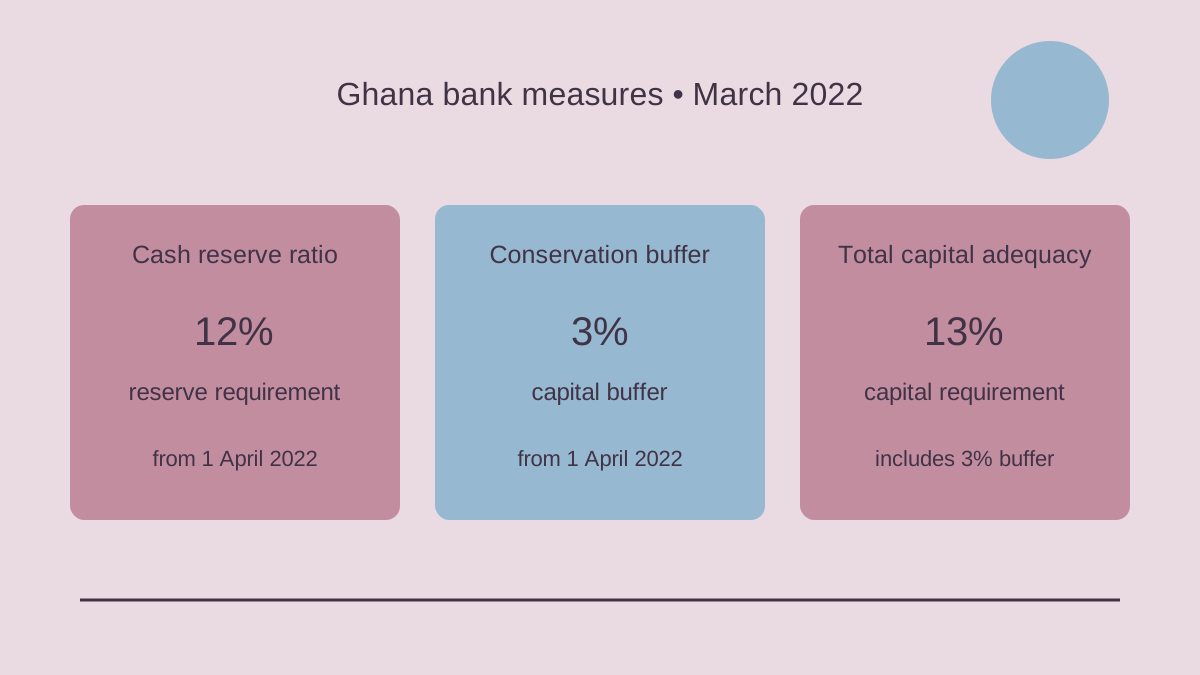
The release of 21 March 2022 increased the rate by 250 basis points to 17%. February inflation was 15.7%, above the target band. The bank identified currency depreciation, petroleum prices and transport costs as risks. It announced additional requirements for universal banks, effective from 1 April 2022:
- The cash reserve ratio increased to 12%.
- The capital conservation buffer returned to 3%, bringing total capital adequacy to 13%.
- Provisioning for loans in the Other Loans Exceptionally Mentioned category returned to 10%.
On 23 May 2022, the committee raised the rate by 200 basis points to 19%. Its assessment described inflation pressures extending beyond food and energy, with a stronger growth recovery narrowing the negative output gap. The bank considered the balance of risks concentrated on inflation. It identified production inputs, imported prices, petroleum adjustments, transport, possible utility increases and wages as potential pressures. Despite a better trade balance, it described losses of reserves linked to financial outflows and repatriated profits. The release also noted weaker business and consumer confidence amid currency depreciation and rising input costs.
The committee held the rate at 19% on 25 July 2022 to observe the effects of its recent measures. June’s interbank weighted average rate had risen to 19.92%, from 12.68% in December 2021; average bank lending rates rose to 24.27%, from 20.04%. Gross international reserves fell to $7.7 billion, covering 3.4 months of imports, against $9.7 billion and 4.3 months at December’s end. The committee also noted the government’s announced intention to seek IMF support. It expected an agreed programme to strengthen monetary and fiscal coordination.
On 28 November 2022, the committee increased the rate by 250 basis points to 27%. October annual inflation had reached 40.4%. The bank said monthly inflation had previously eased from 5.1% in May to 1.9% in August, before petroleum, utility and transport adjustments interrupted that decline. It also attributed currency pressures partly to investors’ concerns about possible debt restructuring. Its forecast envisaged inflation peaking in early 2023 and reaching about 25% by year-end, conditional on tight monetary policy and liquidity absorption. The proposed debt exchange remained part of the fiscal adjustment outlook at this meeting.
Debt exchange and bank capital
The committee raised the rate by 100 basis points to 28% on 30 January 2023. It described weaker domestic activity and inflation pressures that reduced the real value of rapid nominal credit growth. Its risk assessment identified pressure on banks’ solvency and liquidity ahead of the domestic debt exchange, prompting regulatory relief to preserve stability. The government’s staff-level agreement with the IMF remained conditional on domestic and external debt restructuring and financing commitments before board consideration. The committee judged that tighter liquidity conditions were needed while these adjustments proceeded and expected the proposed measures to support stability.
Domestic-currency reserve tightening
On 27 March 2023, the committee increased the rate by 150 basis points to 29.5%. It also raised the reserve ratio on banks’ domestic-currency deposits from 12% to 14%, effective from 13 April, and announced stronger liquidity operations. The bank judged that the debt exchange and economic challenges had weakened capital buffers, although banks remained liquid. It called for bank contingency measures supported by regulatory relief. A memorandum on ending central-bank budget financing had been finalised with the finance ministry but was still awaiting signature. The committee regarded these policies as necessary to reinforce disinflation.
The rate remained at 29.5% in the release of 22 May 2023. The committee noted approval of the $3 billion IMF Extended Credit Facility arrangement and considered it supportive of recovery, conditional on fiscal and structural policy implementation. Bank returns for January–April indicated improving profitability and solvency, following debt-exchange losses recorded in audited 2022 accounts. The bank attributed disinflation to tight policy, liquidity operations, relative currency stability and lower petroleum prices. By this meeting, the memorandum ending central-bank budget financing had been signed. The committee retained the rate while these policies supported the adjustment programme.
The rate increased by 50 basis points to 30% on 24 July 2023. Inflation had risen from 41.2% in April to 42.2% in May and 42.5% in June. The bank identified food prices, new taxes and utility adjustments among the influences. It reported that central-bank budget financing had remained zero during the first half. Bank profits had recovered after 2022 debt-exchange losses, but capital rebuilding still depended on sustained earnings and shareholder injections. The committee also called for early operation of the financial stability fund to support eligible banks.
The committee kept the rate at 30% on 25 September 2023. It considered inflation’s renewed decline and improving economic conditions evidence of progress under the adjustment programme. Its assessment linked rebuilding reserve buffers to the current-account surplus, gold purchases, mining-sector inflows and repayment of short-term external liabilities. Further inflows from the cocoa syndicated loan and the IMF were still expected. The committee regarded oil prices and utility adjustments as risks to continued disinflation. It retained the rate and said it would respond if inflation departed from its outlook, which remained conditional on the absence of unexpected shocks.
A unified reserve requirement
On 27 November 2023, the committee held the rate at 30% and changed reserve requirements. From 30 November, banks had to hold a unified 15% reserve ratio on total deposits, including foreign-currency deposits, in cedis. The stated purpose was to reinforce liquidity operations against structural excess liquidity and support disinflation. The bank still considered inflation high relative to its target. It described private credit as constrained by banks’ risk aversion, tight conditions and credit risks. Improved reserves provided a cushion against external vulnerabilities, including the delayed cocoa loan, while further inflows remained part of the outlook.
Reserve rules and recovery in 2024
On 29 January 2024, the committee cut the rate by 100 basis points to 29%. It described improved bank liquidity and profitability after domestic debt restructuring, while recognising elevated credit risks. Capital restoration was being monitored against approved plans. The committee attributed the preceding year’s disinflation to monetary tightening, favourable oil prices and relative currency stability. Its forecast placed inflation at 13–17% at the end of 2024, then within the medium-term 6–10% range during 2025. These remained projections subject to fiscal discipline and a tight monetary stance.
Reserves linked to lending
The rate stayed at 29% on 25 March 2024. The committee introduced differentiated reserve ratios from April: banks with loan-to-deposit ratios above 55% faced a 15% requirement, those between 40% and 55% faced 20%, and those below 40% faced 25%. It reported that more than half of 23 banks were fully capitalised. Most remaining banks had completed more than two-thirds of their required recapitalisation by the end of 2023. The bank nevertheless identified weak private credit and risks from transport fares, utilities, fuel and exchange-rate changes in its assessment.
The committee held the rate at 29% on 27 May 2024. The bank reported reserves covering three months of imports at April’s end and monetary gold exceeding 26.6 tonnes, valued at approximately $2.1 billion. It described efforts with the banking association to simplify foreign-payment documentation and reduce incentives to use informal markets. It had also absorbed some corporate foreign-exchange demand directly, reducing demand passing through commercial banks. The inflation outlook remained exposed to currency pressures and transport adjustments. The forecast’s 13–17% year-end band referred to the programme’s monetary-policy consultation clause, separate from the permanent target.
The release of 26 July 2024 kept the rate at 29%. The committee described resilient activity despite tight policy, but weaker business and consumer sentiment after May currency depreciation and high June food prices. It attributed reserve accumulation to gold exports, remittances, suspended debt payments and the domestic gold purchase programme. Those buffers were expected to support currency stability against external shocks. The inflation outlook nevertheless faced risks from exchange-rate pressures, utility adjustments and petroleum prices. The committee judged that maintaining tight monetary conditions alongside fiscal consolidation was necessary to preserve the expected disinflation path.
A September reduction
On 27 September 2024, the committee lowered the rate by 200 basis points to 27%. It reported five consecutive monthly declines in headline inflation, amounting to 5.4 percentage points, and a 6.9-point fall in core inflation over the same comparison period. The bank judged inflation risks broadly balanced. Its forecast still envisaged 13–17% inflation at year-end and a return to the medium-term 6–10% range by the end of 2025, barring unexpected shocks. It also described stronger growth and improving external payments, attributing reserve accumulation partly to gold exports and multilateral financial inflows.
The committee held the rate at 27% on 29 November 2024. Its forecast for average inflation one year ahead had increased from 19% to 20.1%, and the expected return to the 6–10% target shifted from the third to the fourth quarter of 2025. Food prices, earlier currency depreciation, fuel and utilities featured among the pressures. The bank judged that prior provisioning would limit banks’ exposure to Eurobond restructuring losses. It also noted a staff-level agreement on the programme review, with an additional $360 million IMF disbursement expected only after successful board consideration.
Liquidity and the 2025 decisions
The rate remained at 27% on 27 January 2025. The committee described an elevated inflation profile driven largely by food prices in the preceding quarter. It linked those pressures to dry conditions, delayed rains and supply-chain weaknesses. The expected return to the 8% target, with a two-point margin, had an extended horizon and depended on renewed fiscal consolidation. The bank also committed to enforcing recapitalisation plans for banks with capital gaps and intensifying supervision of non-performing loans. Stronger gold exports and reserve buffers supported its external assessment, while energy-sector challenges remained a risk.
An expanded sterilisation toolkit
On 28 March 2025, the committee raised the rate by 100 basis points to 28%, by majority decision. It attributed excess liquidity partly to the expansionary fiscal stance of 2024 and considered restraint necessary to protect disinflation. Alongside the rate change, it announced a 273-day instrument to absorb liquidity, closer monitoring of banks’ net open foreign-exchange positions and a review of the reserve-ratio structure. The bank described improving solvency, liquidity and profitability but still-high credit risks. It said undercapitalised banks would remain under close supervision while the policy framework was adjusted.
The committee unanimously held the rate at 28% on 23 May 2025. April inflation was 21.2%, after four consecutive monthly declines. Gross international reserves reached $10.7 billion, covering 4.7 months of imports. The committee nevertheless considered inflation too high to loosen policy. It changed the currency treatment of required reserves from 5 June: foreign-currency deposits would require foreign-currency reserves, and domestic-currency deposits domestic-currency reserves. The bank’s forecast brought the expected return to the medium-term inflation target forward to the first quarter of 2026. That projection remained conditional on tight policy, currency stability and fiscal consolidation.
The committee cut the rate by 300 basis points to 25% on 30 July 2025, by majority decision. June inflation had fallen to 13.7%, from 18.4% in May. Gross international reserves stood at $11.1 billion, equivalent to 4.8 months of imports. The first-half current-account surplus was $3.4 billion, while the overall balance-of-payments surplus was $2.2 billion. The bank described improving capital, liquidity and profitability, with the non-performing loan ratio easing as credit grew faster than problem loans. Its forecast envisaged inflation entering the target band by year-end, while recognising trade-related supply risks and possible utility increases.
Banking conditions at the cutoff
The bank’s 17 September 2025 statement also detailed banking conditions. August inflation was 11.5%, against 12.1% in July. Average lending rates fell from 26.6% to 24.2% over those months. Capital adequacy without regulatory relief rose to 17.7%, from 10.2% in August 2024. The non-performing loan ratio fell to 20.8%, from 24.8% a year earlier, although credit risk remained a concern. The committee changed banks’ single-currency net open position limit from plus or minus 5% to a range between zero and minus 10%, effective from 1 October 2025.






Leave a comment