
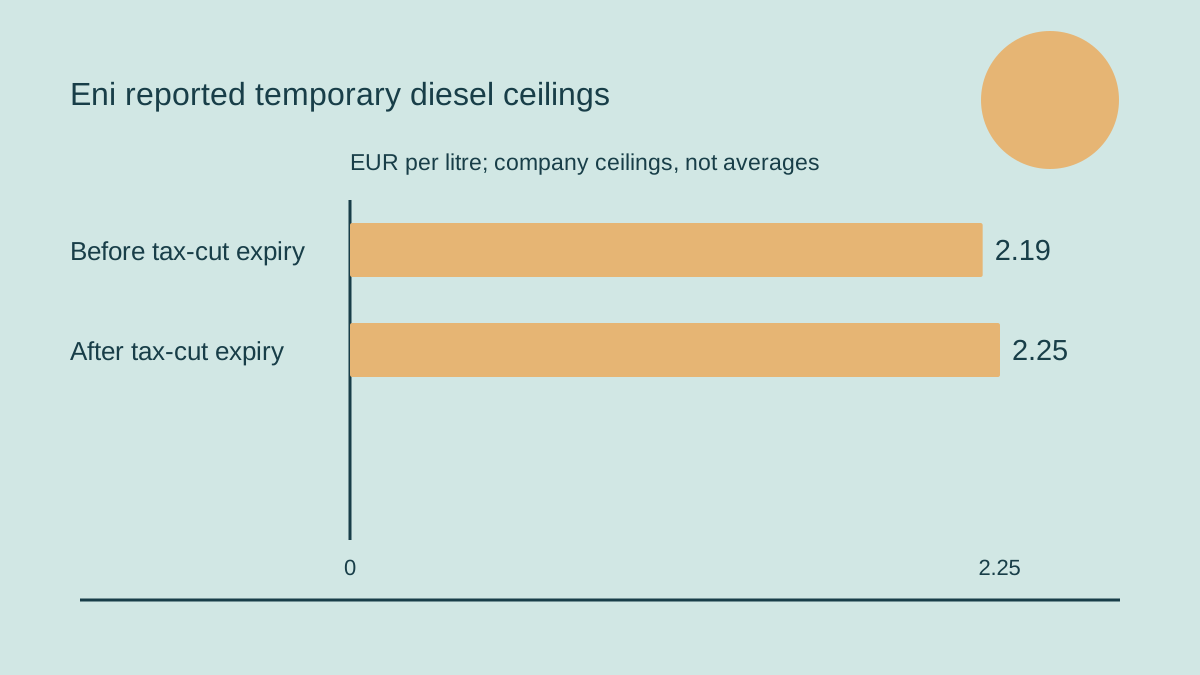
Euronews reported on 7 October that Italy’s temporary diesel excise reduction had expired on 5 October, when its remaining value was 6.1 cents per litre. A replacement mechanism using additional VAT revenue required a decree that had not yet been issued. Eni reportedly moved its temporary diesel-price ceiling from €2.19 to €2.25 per litre. Those are company ceilings, not nationwide average pump prices. The report also described European support proposals still under discussion.
The episode exposes a recurring problem in emergency energy policy: a measure can end before its replacement becomes operational. For consumers, the relevant question is what they pay when they refuel. For governments, the question includes the cost of support, who receives it and whether a temporary intervention can be withdrawn predictably. For retailers and suppliers, it includes how changes in taxes interact with wholesale costs and commercial pricing. These perspectives meet at the pump, but they do not describe the same mechanism.
The useful analytical question is therefore not whether one headline price is high or low. It is how temporary relief changes the final bill, what happens at expiry and how the public can distinguish a promise from a measure already in force. Answering it requires careful treatment of price ceilings, observed prices, tax reductions and supply interventions. A policy discussion becomes less informative when those different instruments are described as if each produces an identical reduction for every motorist.
A tax reduction, a price ceiling and an average are different measures
A specific tax reduction changes one component of the cost of supplying a litre of fuel. A retail price ceiling describes an upper limit within its stated scope. An average price summarises observed transactions or quotations across a defined sample. A movement in one of these measures does not establish an equal movement in the others. The distinction is particularly important when a company voluntarily caps a price: the arrangement should not be described as a statutory limit applying to every filling station.
The two Eni values reported by Euronews illustrate this point. Their difference can be calculated, but the calculation does not show what every customer paid or how much the national average changed. Stations might sell below a ceiling, and the scope of a commercial arrangement may differ from the scope of a national tax measure. A responsible comparison keeps the company attribution, the unit and the period attached to the numbers. It avoids turning a maximum into a representative price.
A price average also depends on its collection method. It can vary according to whether the sample includes self-service or staffed service, which locations are represented and when prices are recorded. An average based on listed prices may answer a different question from one weighted by actual sales. Neither is automatically wrong, but comparisons should use consistent definitions. A change in the composition of the sample can otherwise look like a change in the market itself.
For policy evaluation, it is useful to follow the same kind of price before and after a measure changes. This does not by itself establish causation, because wholesale conditions may move at the same time. It does provide a more coherent starting point than comparing a company ceiling with an unrelated national average. An analyst can then ask which other costs changed and whether the observed movement is consistent with the expected tax effect.
Clear labelling is also a consumer issue. People making a purchase should be able to see the price that applies to their chosen fuel and service. A public announcement about relief should identify whether it concerns the tax rate, the final displayed price or a reimbursement received later. When these are confused, a customer can reasonably expect an immediate saving that the scheme was never designed to deliver in that form.
Expiry creates an implementation test
Temporary measures require an end date because governments need to define their fiscal commitment and retain the ability to change policy. But the end date becomes operationally difficult when a replacement is still being discussed. A ministerial intention, a draft proposal and an effective instrument are different stages. Businesses cannot reliably implement a change whose legal basis, calculation method or commencement date remains unsettled. Consumers cannot know the final effect from a political announcement alone.
This is why the transition deserves as much attention as the initial launch. A policy can be well designed in principle but poorly sequenced in practice. Officials need to consider how much notice suppliers require, what happens to existing stock and how tax treatment is communicated across the supply chain. These are general implementation questions, not claims that a particular Italian procedure was breached. Their purpose is to show what an assessment should examine before declaring a replacement ready.
An automatic adjustment mechanism can reduce the need for repeated discretionary decisions, but it still needs precise rules. The trigger must be measurable, the calculation must be reproducible and the timing must be clear. If the mechanism uses a price index, the relevant index and publication lag matter. If it uses additional tax receipts, the definition of additional receipts matters. A rule that sounds simple in a headline may depend on several choices that affect when relief reaches the market.
There is also a communication risk at expiry. Describing the withdrawal of a temporary reduction as an entirely new permanent tax can misrepresent the policy history. Describing a promised replacement as already available can misrepresent current support. The useful account gives the earlier measure, its expiry and the status of the next measure separately. That allows readers to understand what changed without assuming that the debate has already produced an implemented solution.
Predictability can itself be valuable. Households and transport businesses cannot control the tax timetable, but they can plan more effectively when the dates and scope are known. Predictability does not guarantee a low price. It reduces uncertainty about one component of that price and about the government’s response. A temporary measure with clear review criteria may therefore be easier to evaluate than a sequence of extensions announced only at the last moment.
Using VAT receipts does not remove the fiscal choices
A proposal to recycle additional VAT receipts into fuel relief is appealing because it connects a price shock with a potential source of funding. But the fiscal relationship requires careful definition. A higher price can increase the amount of an ad valorem tax charged on a purchase, while reduced consumption can offset part of that effect. Actual revenue therefore depends on both price and quantity, as well as the applicable tax treatment. A headline about higher prices is not a complete revenue forecast.
A government would need a baseline against which additional revenue is measured. It could compare receipts with a forecast, a previous period or a reference price, but these choices produce different results. The baseline also needs to handle seasonality and changes in demand. If the support commitment is made before the receipts are known, the government carries a timing risk. If relief waits until receipts are confirmed, consumers may experience a delay.
The allocation decision remains political and economic even when a funding source is identified. Broad per-litre relief distributes benefits according to fuel purchases. A targeted payment can direct more support to a specified group but requires eligibility rules and an administrative process. Neither instrument can be judged solely by the amount announced. The assessment should examine who receives support, how quickly it arrives and what the arrangement costs to administer.
There is a distinction between gross revenue and resources available for a new commitment. A government budget already contains obligations and forecasts. Unexpected receipts may improve the fiscal position, but using them for one measure still means they cannot fund another purpose or reduce borrowing by the same amount. This does not establish that fuel relief is inappropriate. It explains why describing it as costless would obscure the choice being made.
As historical context, Article 4 of Council Directive 2003/96/EC defines a taxation level excluding VAT and establishes minimum levels for covered energy products. This provision illustrates why VAT and quantity-based fuel taxation should not be treated as one undifferentiated levy; it is not a determination of the legality of a specific 2026 proposal.
Pass-through needs evidence rather than an assumption
The economic aim of a tax reduction may be to lower the price paid by consumers, but the observed result depends on how the market responds. Suppliers and retailers can face changing wholesale prices, distribution costs and competitive conditions at the same time. A tax change can be partly obscured by another cost movement. Equally, a retail price decline can occur for reasons other than the tax measure. The question is what would have happened under otherwise comparable conditions.
That counterfactual is difficult to observe directly. A practical evaluation might compare consistent price series, examine wholesale movements and consider areas with different competitive conditions. It should state the limits of the analysis rather than announce an exact pass-through rate without a defensible method. A before-and-after chart can show a movement. It cannot, on its own, divide that movement into tax effects, wholesale effects and changes in commercial margins.
The same caution applies when relief expires. If a displayed price rises, the tax change may be relevant, but the total movement still needs context. A company’s explanation can provide evidence about its pricing decision without representing the whole market. The analyst should preserve that attribution and avoid claiming that every retailer responded in the same way. The distinction allows commercial announcements to inform the discussion without becoming a substitute for market data.
Competition is relevant because customers’ ability to compare alternatives can influence pricing behaviour. However, comparison has costs: drivers may need to travel farther, the available information may be stale and service conditions may differ. A useful consumer price comparison should therefore specify the product and service rather than rank loosely comparable quotations. These considerations are general analytical factors, not evidence about the conduct of any named Italian retailer.
For policymakers, the important lesson is to define the intended outcome before selecting the instrument. If the purpose is rapid broad relief, a measure should be assessed for speed and reach. If the purpose is assistance to households with limited alternatives, eligibility and distribution matter more. If the purpose is supply resilience, the evaluation should examine availability and disruption. A single price observation cannot establish success against all of these objectives.
National relief and supply measures operate on different timelines
A tax intervention acts through the fiscal component of a purchase. A supply intervention aims to change the availability or cost of the fuel itself. Coordination across markets can address a different problem from compensation paid to domestic consumers. These instruments can coexist, but their mechanisms and implementation periods should be stated separately. A discussion of international cooperation should not imply that an agreed principle immediately lowers the price at every station.
Supply measures also need an operational account. An announcement concerning reserves, procurement or refinery coordination becomes meaningful through volumes, product suitability, delivery timing and the ability to move fuel where it is needed. Broad statements of intent do not settle those details. It is therefore reasonable to distinguish announced cooperation from completed delivery and from an observed price effect. Each step requires its own evidence.
The same applies to proposed regulatory changes. A request to revise a rule and an adopted change are different states. Reporting should identify the institution responsible, the stage reached and the remaining decisions without predicting an outcome as certain. For the October discussion described by Euronews, the appropriate historical boundary is the information available on 7 October. Later decisions should be reported as later developments rather than silently inserted into an account of what was known then.
A useful progress report would therefore answer four questions. What support is currently effective? What has merely been proposed? Which price measure is being used to judge the result? And what evidence connects the instrument to the observed outcome? These questions are more useful than treating every announced amount or ceiling as a comparable saving. They make implementation gaps visible and keep future promises distinct from present entitlements.
- Identify which support measures are currently effective.
- Separate announced proposals from implemented rules.
- Compare prices using the same product and measurement basis.
- Explain the evidence linking relief to observed outcomes.
The expiration of Italy’s diesel reduction is consequently a test of policy sequencing as well as affordability. A replacement can be evaluated only when its rules, financing and effective date are clear. The reported company ceiling provides a specific pricing example, not a national market verdict. A credible assessment will follow the implemented measures and comparable price evidence, while recognising that temporary tax relief, targeted assistance and supply coordination each solve a different part of the energy-price problem.

















Leave a comment