
Mexico lowered its overnight interbank target to 9% on March 27, 2025, effective the following day, Interfax reported on March 28. The bank’s unanimous decision allowed for further comparable reductions while retaining a restrictive stance. Earlier announcements show how inflation measures and risks changed along the way.
Inflation and tightening
The record begins with inflation pressures exceeding the bank’s expectations. On February 10, 2022, the board raised the target to 6%, with four members favouring a 50-basis-point increase and one preferring 25 basis points. January’s annual headline inflation was 7.07%, and core inflation was 6.21%. The economy had contracted slightly in the preceding quarter, with considerable unused capacity and differences across sectors. Yet inflation pressures had proved larger and longer lasting than anticipated. The board was concerned about their spread into expectations and price setting, while tighter global financial conditions added another challenge.
On March 24, 2022, a unanimous increase took the target to 6.5%. Annual headline and core inflation in the first half of March stood at 7.29% and 6.68%. Pandemic-related disruptions were now joined by pressures associated with geopolitical conflict. The bank raised both inflation forecasts across the horizon and expected convergence toward the 3% target in the first quarter of 2024. Economic recovery might have resumed early in the year, but uncertainty and unused capacity remained. The announcement therefore paired a tentative activity improvement with a deterioration in inflation risks and a later expected return to target.
The May 12, 2022 decision raised the target to 7%. Four members chose a 50-basis-point increase; one wanted 75 basis points. April’s annual headline inflation had reached 7.68%, and core inflation 7.22%, levels the bank described as the highest since January 2001. Pandemic and geopolitical pressures were compounded by strict lockdowns in China. Forecasts moved upward, although the expected convergence period remained the first quarter of 2024. Preliminary activity data suggested a first-quarter rebound with substantial capacity still unused. The board’s guidance now explicitly allowed consideration of stronger action as the inflation environment grew more complex.
A larger step followed on June 23, 2022: the target rose to 7.75% in a unanimous 75-basis-point increase. Annual headline and core inflation in the first half of June were 7.88% and 7.47%. The bank expected gradual economic recovery and diminishing spare capacity, while global financial conditions kept tightening. It raised the headline forecast through the third quarter of 2023 and the core forecast across the entire horizon. The risk balance was significantly tilted toward higher inflation. Guidance retained the possibility of similarly forceful increases if conditions required them, rather than setting an automatic sequence of equal steps.
On August 11, 2022, another unanimous 75-basis-point rise brought the target to 8.5%. July’s annual headline inflation was 8.15%, with core inflation at 7.65%. Second-quarter growth had continued the gradual recovery at a pace similar to the first quarter, and spare capacity had diminished. Nevertheless, risks to activity pointed downward. Inflation forecasts were again raised through the third quarter of 2023, while the expected convergence date remained in early 2024. The board would determine the size of future increases from prevailing conditions. This assessment combined recovering domestic activity with both external uncertainty and inflation pressures that remained stronger than anticipated.
Longer persistence
The September 29, 2022 increase took the target to 9.25%, again unanimously. Annual headline and core inflation in the first half of September had reached 8.76% and 8.27%. The bank now expected the effects of inflation shocks to take longer to fade. It raised forecasts across the whole horizon and pushed expected convergence toward 3% to the third quarter of 2024. Activity was expected to slow relative to the first half of the year even as spare capacity was expected to diminish. The decision marks a revision in the expected duration of the inflation episode alongside another substantial increase in the policy rate.
Diverging inflation measures
On November 10, 2022, the target reached 10%. Four members supported a 75-basis-point rise, while one preferred 50 basis points. October’s annual headline inflation had eased to 8.41% as the non-core component declined. Core inflation, however, kept rising to 8.42%. Short-term headline forecasts were reduced slightly while core forecasts moved upward. Third-quarter growth had exceeded expectations, bringing activity close to its pre-pandemic level. Although some commodity and supply-chain pressures were subsiding, the bank retained an upward inflation-risk balance. The divergence between the two inflation measures helps explain why headline relief accompanied continued tightening.
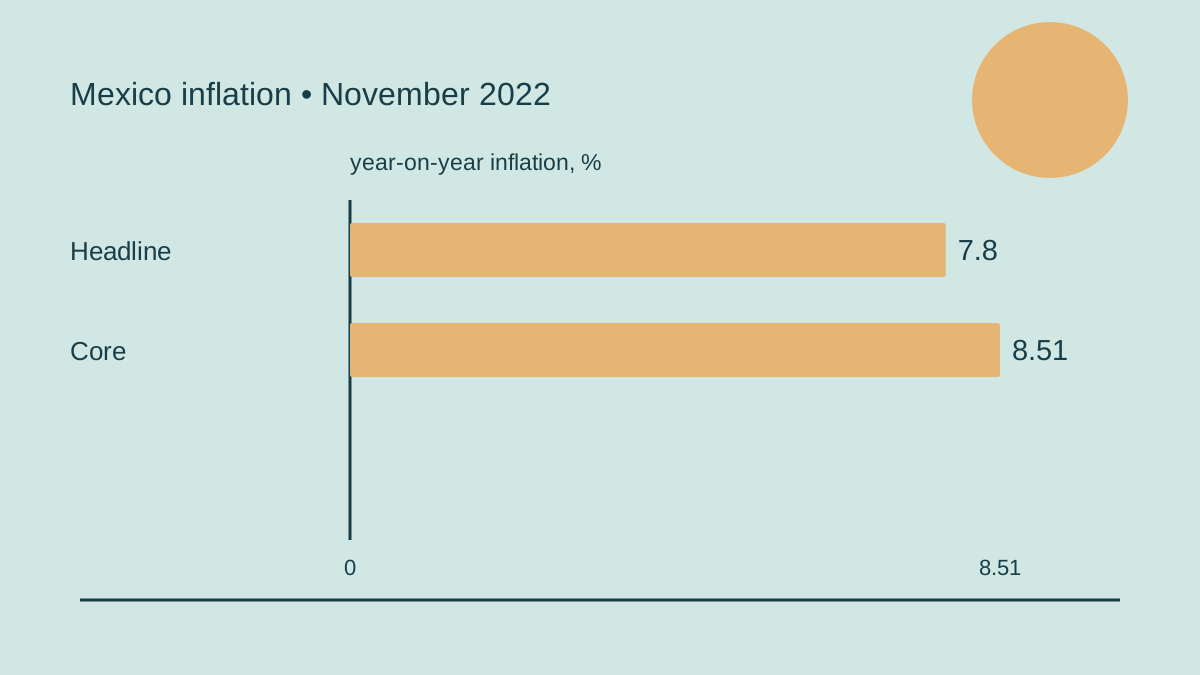
The December 15, 2022 increase was smaller, lifting the target to 10.5%. Four members supported 50 basis points and one preferred 25. November’s annual headline inflation had fallen to 7.80%, but core inflation kept climbing to 8.51%. Expectations likewise separated: those for headline inflation for 2022 and 2023 declined, while core expectations edged higher. The bank anticipated slower recovery in the fourth quarter and still expected convergence toward target in the third quarter of 2024. It considered another increase necessary at the next meeting, leaving subsequent adjustments dependent on conditions. A smaller step therefore retained a tightening direction.
On February 9, 2023, the board unanimously raised the target to 11%. January’s annual headline inflation was 7.91%, while core inflation reached 8.45% and exceeded expectations. Food-merchandise inflation had declined more slowly than anticipated, and services inflation had rebounded. Forecasts were increased across the horizon, with convergence now expected in the fourth quarter of 2024. Meanwhile, economic growth had lost momentum late in the preceding year. The board maintained the previous increase’s magnitude in response to core dynamics but allowed that the next upward adjustment could be smaller, depending on incoming information and the tightness already attained.
The March 30, 2023 decision slowed the increase to 25 basis points, bringing the target to 11.25% unanimously. Annual headline inflation in the first half of March was 7.12%, with core inflation at 8.15%. Headline inflation had fallen more than expected through the non-core component, while core inflation eased gradually. Banking turbulence in the United States and Europe had only limited domestic effects, according to the bank; local institutions exceeded regulatory liquidity and capital requirements. Activity continued moderate growth with a strong labour market. The smaller increase took account of the policy stance already reached and the remaining inflation challenge.
An extended hold
On May 18, 2023, the board unanimously held 11.25%. April’s annual headline inflation had fallen to 6.25%, and core inflation to 7.67%. The core measure was now declining more markedly, but both readings remained high. Activity had expanded faster in the first quarter, and the labour market stayed strong. The board recognised that disinflation had begun as several pressures eased, yet judged the outlook complex and uncertain. It expected to keep the rate at its existing level for an extended period. This hold translated the progress already observed into a maintenance phase, with convergence still projected for late 2024.
The June 22, 2023 hold again retained 11.25% unanimously. Annual headline and core inflation in the first half of June stood at 5.18% and 6.91%. Non-core inflation was only 0.03%, a historically low reading that sat alongside much higher core pressure. Activity remained resilient, employment conditions strong, and growth risks balanced in the bank’s assessment. Headline forecasts were lowered slightly for some quarters while core projections barely changed. The board still considered an extended hold necessary. The unusually low non-core measure therefore formed part of the falling headline rate without eliminating the persistence visible in the core reading.
On August 10, 2023, the target remained at 11.25% by unanimous decision. July’s annual headline inflation was 4.79%, core inflation 6.64%, and non-core inflation an atypical minus 0.67%. Growth had exceeded expectations and labour conditions remained strong. The bank left headline forecasts broadly unchanged but raised short-term core forecasts marginally. It continued to call for an extended hold. The negative non-core reading and the still elevated core measure describe different parts of the price picture. Their coexistence helps explain why the board’s assessment of disinflation progress did not yet produce a reduction in the overnight target.
Revised convergence horizon
The September 28, 2023 meeting held 11.25% unanimously but revised the forecast horizon. Annual headline and core inflation in the first half of September were 4.44% and 5.78%, while non-core inflation was 0.48%. Services pressures persisted, and activity had been more resilient than expected. The bank raised forecasts throughout the horizon for a slower decline in inflation and moved expected convergence toward target to the second quarter of 2025. The peso had depreciated amid volatility, and medium- and long-term government yields had increased. An unchanged rate thus accompanied a changed assessment of how long disinflation would take.
On November 9, 2023, another unanimous hold kept 11.25%. October’s annual headline inflation was 4.26% and core inflation 5.50%; non-core inflation remained unusually low at 0.56%. Robust growth and a strong labour market coexisted with continued disinflation. The bank still expected convergence toward target in the second quarter of 2025. Its guidance now described maintaining the rate for some time, acknowledging the progress made while retaining a challenging outlook. This wording softened the description of duration without announcing an immediate cut. The decision remained a hold, with longer-term inflation expectations still above the target in the published assessment.
The December 14, 2023 hold retained 11.25% unanimously. November’s annual headline inflation edged up to 4.32% because of the non-core component, while core inflation declined to 5.30%. The bank expected food-merchandise and services inflation to fall more gradually than previously forecast, raising projections for some quarters. Expected convergence remained in the second quarter of 2025. Growth and labour conditions were still strong, and guidance retained a hold for some time. The price components again moved differently, while the forecast revision reflected persistence within the disinflation process rather than an assessment that all earlier progress had reversed.
Opening to adjustment
On February 8, 2024, the board unanimously maintained 11.25%. January’s annual headline inflation had increased to 4.88% following a non-core rebound, while core inflation continued falling to 4.76%. Specific supply shocks lifted the short-term headline forecast, but expected convergence remained in the second quarter of 2025. Late-year growth had slowed more than anticipated, although the labour market remained strong. Guidance now allowed the board to consider rate adjustments at coming meetings, depending on information, inflation progress and remaining challenges. The policy discussion was opening to possible adjustment while the benchmark itself and the bank’s policy stance remained restrictive.
The first reduction in this sequence came on March 21, 2024, taking the target to 11%. Four members favoured the 25-basis-point cut and one preferred a hold. February’s annual headline inflation had declined to 4.40%, partly as non-core pressures reversed; core inflation fell to 4.64%. The peso had appreciated with lower volatility, and the bank expected stronger first-quarter activity than in the weak preceding quarter. It recognised easing shocks and ongoing disinflation but stressed prudent, information-dependent decisions. The lower rate was expressly described as retaining a restrictive stance, with expected convergence still in the second quarter of 2025.
On May 9, 2024, the board unanimously held 11%. Between February and April, annual headline inflation rose from 4.40% to 4.65%, while core inflation fell from 4.64% to 4.37%. Supply effects on non-core prices and more persistent services inflation complicated the outlook. Forecasts were raised for the next six quarters, and expected convergence moved to the fourth quarter of 2025. Weak activity was expected to have continued into the first quarter despite a strong labour market. The hold illustrates how the first reduction was followed by reassessment: falling core inflation remained relevant, but the projected duration of pressures had lengthened.
The June 27, 2024 decision kept 11% with four members favouring a hold and one a 25-basis-point cut. Annual headline inflation rose from April’s 4.65% to 4.78% in the first half of June; core inflation declined from 4.37% to 4.17%. The peso’s substantial depreciation pushed inflation projections upward, partly offset by weaker activity. Growth risks leaned downward, and expected convergence remained in late 2025. The board foresaw that conditions might allow discussion of adjustments as global shocks faded. This assessment explicitly weighed currency pressure against economic weakness while retaining the restrictive rate setting and a conditional path forward.
On August 8, 2024, three members supported a cut to 10.75% and two preferred holding. July’s annual headline inflation had risen to 5.57% through a substantial non-core increase, while core inflation reached 4.05% after eighteen consecutive declines in monthly annual-rate readings. The core component’s contribution to headline inflation was 3.07 percentage points, compared with 6.32 percentage points in November 2022. Those contribution figures are distinct from the core inflation rate. With weak activity and supply shocks expected to fade, the board judged reducing restriction appropriate while keeping policy restrictive. Expected convergence remained in the fourth quarter of 2025.
Easing amid uncertainty
The September 26, 2024 reduction brought the target to 10.5%, with four votes for the cut and one for a hold. Annual headline inflation fell from July’s 5.57% to 4.66% in the first half of September as some non-core supply shocks reversed. Core inflation continued declining to 3.95%. Activity was weak, employment growth had slowed, and the peso remained volatile. Short-term forecasts were lowered slightly for some quarters. The board expected further adjustments while retaining restriction. Its decision therefore combined a partial reversal of earlier supply pressure with continued core disinflation and an assessment of weaker economic conditions.
On November 14, 2024, the board unanimously cut the target to 10.25%. October’s annual headline inflation had rebounded to 4.76% because of non-core supply shocks, but core inflation kept falling to 3.80%. The short-term headline forecast was raised, while expected convergence remained in late 2025. The peso had depreciated amid volatility associated with the United States election, and medium- and long-term yields had increased. Third-quarter activity appeared stronger than in the preceding stagnant quarters, yet weak dynamism was expected in 2025. The rate reduction reflected the bank’s assessment of continuing core improvement despite a renewed rise in the headline measure.
The December 19, 2024 cut took the target to 10% unanimously. Annual headline inflation fell from October’s 4.76% to November’s 4.55%, and core inflation from 3.80% to 3.58%. Merchandise inflation was low, but services inflation had moderated only gradually. Greater services persistence led to higher forecasts and an expected convergence date in the third quarter of 2026. Possible tariffs added uncertainty that could push inflation in either direction. The board allowed for larger reductions at some meetings while maintaining restriction. The decision paired further easing with a longer projected disinflation horizon and continued attention to the changing risk balance.
On February 6, 2025, four members supported a larger cut to 9.5%, while one preferred a smaller reduction. Annual headline and core inflation in the first half of January were 3.69% and 3.72%. The economy had contracted in the fourth quarter, employment growth had slowed, and growth risks leaned downward. The board described a new stage: bringing inflation from a level near its pre-pandemic average toward 3%. It allowed comparable further calibration while maintaining restriction and expected headline convergence in the third quarter of 2026. The larger step therefore remained connected to the inflation objective and to weak activity.
- Expectations influence price setting.
- Non-core inflation approached zero.
- Currency and activity risks interacted.






Leave a comment