
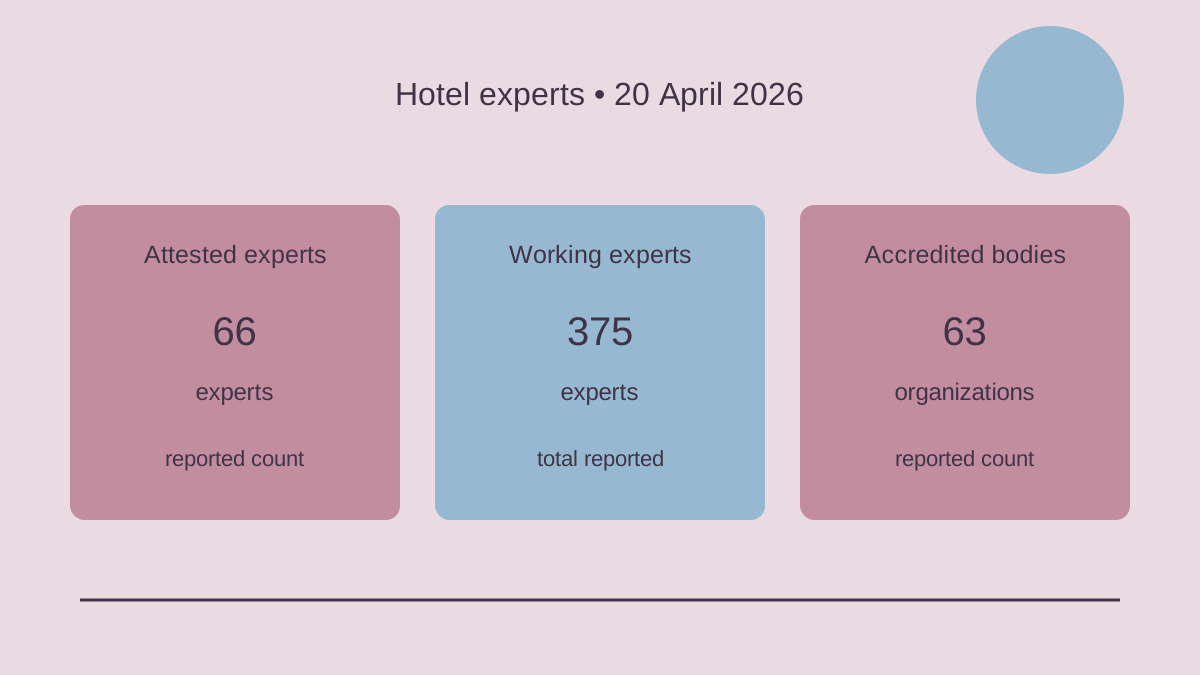
By April 20, 2026, 3,500 hotels in Russia had received stars under the new rules, exceeding 40% of registered starred properties, Rosakkreditatsiya reported. They included nearly 1,800 three-star hotels, 811 four-star, 560 two-star, 130 one-star and over 170 five-star properties. The broader registry contained 29,200 accommodation facilities, including almost 22,400 hotels. Agency head Dmitry Volvach reported 66 attested experts out of 375 working in 63 accredited organizations. Territorial-office examinations were planned from May, with all experts due to complete attestation by September 1.
The registry reform agenda
The earlier agenda covered registration and classification. On March 14, 2024, Economy Minister Maxim Reshetnikov asked Rosakkreditatsiya to count accommodation facilities and include them in the registry. He called for a simpler procedure, action against trading in certificates, and personal responsibility for experts. The minister also proposed accessible information services for guests and integration with booking platforms. In his account, the registry would connect tools ranging from statistical recording to tax benefits, while hotel requirements would be discussed with the industry and raised gradually.
The government’s October 2024 account described both the existing hotel stock and classification activity during the year. On October 16, Deputy Prime Minister Dmitry Chernyshenko reported 24,000 hotels with more than 910,000 classified rooms. Over 5,000 additional hotels, representing 207,000 rooms, had undergone classification since January; 750 were doing so for the first time. Chernyshenko attributed the additions partly to previously unrecorded businesses entering the formal market and partly to new properties. Separately, he reported 4,500 rooms commissioned that year using support through the national project.
Industry representatives raised a different question: whether easier entry would weaken the incentive to seek stars. At the control authorities’ forum on November 2, 2024, Russian Union of Travel Industry president Ilya Umansky supported hotel classification but proposed eventually removing the category without stars. He considered self-assessment an effective instrument for market access, yet predicted more classification violations and less interest in star ratings. Umansky said many hotels preferred the simplified route to avoid additional difficulties. His intervention set out the union’s position while the new classification arrangements were being discussed.
Listings and recorded categories
The proposed booking-platform checks were described before parliamentary passage. On November 2, 2024, ministry official Natalya Savelyeva said online services would need to compare their property listings with Rosakkreditatsiya’s registry. She described regional oversight covering registry inclusion, compliance with the accommodation type, and consistency between advertised categories and recorded categories. Her example was a property recorded as one-star but advertised as five-star. Regions would designate the bodies carrying out the checks. These arrangements formed part of the ministry’s bill, discussed at the same control authorities’ forum as the industry’s objections.
On November 21, 2024, the State Duma adopted the classification bill in its final reading. Its scope included mandatory classification of accommodation facilities while allowing specified exempt institutions to participate voluntarily. Residential premises were excluded from the accommodation definition. Sanatoria included in the resort-fund register were to enter the accommodation register automatically, with an optional route to stars, deputy Nadezhda Shkolkina explained. The legislation also addressed periodic confirmation of classification organizations’ competence every three years. Its general commencement date was January 1, 2025, with separate dates for particular provisions.
The last classification report of 2024 showed how substantial the category without stars remained. In its December 25 release, Rosakkreditatsiya reported 7,632 hotel classifications from January through December, 42.5% more than in 2023. Around 4,000 hotels received the status without stars, more than half of the reported total. The agency listed 203 one-star and 651 two-star properties, alongside 845 four-star and 171 five-star classifications. It also reported 64 newly registered classification organizations during the year. The figures described classification activity before the expanded system began operating in January.
Early implementation results
The first new-system star award reported by Roskachestvo concerned Karavella in central Tuapse. On March 5, 2025, the organization said its tourism classification body had awarded the hotel three stars. The release also gave an early national application snapshot: 2,051 accommodation facilities had applied during January and February, and 1,376 applications had been approved. Recreation bases accounted for 769 approvals, campsites for 129, with the remainder involving hotels. Separately, 118 hotels had applied for the second stage, in which an accredited organization evaluates a property for a star category.
A later provider milestone showed the range of properties being assessed. On April 22, 2025, Roskachestvo announced its hundredth accommodation classification, covering properties in ten regions. The milestone property was the four-star Radisson Hotel Ulyanovsk, with 174 rooms, fourteen conference halls and two restaurants.
- The organization described assessment dimensions including technical equipment, room condition, service quality, staff preparation and infrastructure for business and tourist use.
Its examples also included hotels, hostels and an apartment complex. The classifications were carried out through the Hospitality subsystem on the accreditation service’s portal.
By early June, the agency was reporting registry coverage and completed self-assessment as separate measures. At the classification council meeting reported on June 11, 2025, Nazariy Skrypnik put the registry at nearly 25,400 accommodation facilities with 969,700 rooms. More than 6,000 facilities had completed the new procedure; almost 2,600 of those had previously been absent from the formal accommodation records. The agency head reported about 150 self-assessments a day.
Council responsibilities
The classification council gave the reform an institutional agenda beyond registering properties. At its first expanded meeting on June 11, 2025, Maxim Reshetnikov said the system should create equal conditions for businesses and help tourists choose suitable accommodation. He identified the council’s tasks as considering hotel complaints, preparing recommendations to suspend or terminate star categories, and approving training programs for the experts assigning them. The minister connected these responsibilities with trust in assessments of hotel-service quality. The meeting took place at the Travel! international tourism forum, bringing those governance questions into the reform’s public discussion.
Guesthouses and specialist preparation
Guesthouses followed a separate experimental framework established by the law signed on June 7, 2025. The experiment was scheduled for September 1, 2025 through December 31, 2027. It covered an individual residential house, or part of one, used for temporary accommodation. The original law required individual ownership, recorded cadastral and ownership information, suitable land use, and no demolition decision concerning an unauthorized building. Its classification procedure allowed the owner to assess compliance and submit the supporting information. Where several qualifying houses belonged to one person, only one could enter the experimental registry.
Expert preparation had its own implementation timetable. In a July 2, 2025 announcement, Roskachestvo scheduled the start of an advanced-training course for July 14. Its academy had developed the Fundamentals of Accommodation Classification program, approved by the council at the Economy Ministry. The provider described training in classifying hotels and other accommodation, developing and implementing conformity-assessment procedures, and applying new regulatory documents. It linked the program to Government Resolution No. 1953 of December 27, 2024, and to stricter expert qualifications, revised organizational accreditation and new specialist-attestation rules introduced in 2025.
The penalty proposals separated several kinds of non-compliance. On June 20, 2025, the Duma committee approved second-reading amendments proposing fines for unregistered accommodation, breaches of requirements for the recorded type, misleading category advertising and missing registry identifiers. For legal entities, proposed first-offence penalties were respectively 300,000–450,000, 100,000–170,000, 100,000–150,000 and 30,000–50,000 rubles. The July 7 enactment introduced the revised accommodation provision in the Administrative Code. Article 14.39 also covered new accommodation contracts during suspended classification and missing links to registry records, with separate provisions for repeat offences and unfulfilled orders.
Completing the September transition
The July registry update showed the coexistence of new assessments and transferred records. On July 28, 2025, Rosakkreditatsiya reported that more than 10,000 hotels, campsites, sanatoria and recreation bases had completed self-assessment and entered the unified registry since the beginning of the year. The registry itself contained more than 26,000 facilities. The agency reminded properties carried over from the previous register to complete self-assessment and attach supporting conformity documents by September 1. Dmitry Volvach said facilities missing the required assessment and registry inclusion by that deadline could not continue operating or appear on travel aggregators.
Digital support was presented as part of completing the transition. At an August 2025 conference reported on August 6, the Economy Ministry described photographic confirmation through the Inspector mobile application. Dmitry Volvach said the Hospitality subsystem, integrated with the accreditation service’s information system, could process up to 100,000 accommodation applications a day. Actual receipts, he reported, exceeded 2,000 applications a week. From August 1, the support service and participant chat were operating around the clock. Volvach said the system had undergone a six-month stress test and was prepared for maximum demand.
The September 1, 2025 report described the composition of facilities that had completed self-assessment by late August. Rosakkreditatsiya put the total at 21,000, including 7,000 new entries. Approximately 16,000 were hotels and 4,000 recreation bases, with almost 500 campsites and 500 sanatoria. Classified properties contained more than a million rooms. Volvach reported over 1,000 applications daily toward the end of August and said 70% of hoteliers completed the procedure on their first attempt, with the remainder on their second. The report combined the completed-property snapshot with the agency’s account of submission outcomes.
Infrastructure barriers
Camping and glamping operators faced particular difficulties, according to industry lawyer Georgy Mokhov in a September 2, 2025 report. He cited land and ownership issues, missing permanent water or electricity, transport access, equipment and addresses absent from the federal address system. The report also described an August letter from the Natural Resources Ministry requesting separate requirements and extra time for accommodation in protected areas. The ministry cited remote locations, limited utilities and environmental obligations. The September 1 registry snapshot listed 32,658 registered facilities, of which 23,791 were active under the new classification rules.
Regional classification support
Perm Krai introduced financial assistance alongside regional oversight. Roskachestvo’s September 3, 2025 announcement described a tourism small-business measure covering up to 80% of classification costs, with compensation through the My Business centre capped at 60,000 rubles. The property owner would pay the remaining 20%. Applications were accepted through September 30, with the service conditions running until year-end. The arrangement involved the accredited Roskachestvo Tourism body. Regional tourism minister Yulia Vetoshkina said the initiative sought compliance and reliable accommodation information for guests; the announcement also identified the regional ministry’s supervisory role.
Implementing standards gave the guesthouse experiment specific accommodation parameters. In its September 2, 2025 account of the approved regulation, the Economy Ministry described a maximum of fifteen guest rooms and forty-five guests at one time. Minimum room areas were nine square metres for single occupancy, twelve for double occupancy and six per guest in shared rooms. Fire detection, firefighting equipment, working ventilation and permanent internet access were required. Deputy Minister Dmitry Vakhrukov described free owner self-assessment supported by photographs. Regions could add requirements reflecting local conditions under the experimental framework.
Expert examinations and platform enforcement
Expert attestation reached its first reported results in autumn. On October 3, 2025, Rosakkreditatsiya announced that the first group had passed under the new rules following the attestation commission’s initial meeting. Candidates came from Roskachestvo’s accredited organization and SK Hotel Management. They completed a test on tourism legislation and proceeded to an oral interview covering their declared areas of attestation. The agency said the attested experts could award stars to hotels and sanatoria.
Platform enforcement produced a more practical account in January 2026. In the January 28 report, Ostrovok head Darya Kochetkova said aggregators had disconnected about 1,700–2,500 guesthouses each, depending on their databases, in the experiment’s territories. Classification difficulties included buildings outside residential stock and owners with several properties. She said many hotels that had missed the earlier deadline had subsequently completed classification and returned to booking platforms. Aggregators continued working with the ministry, accreditation service and regions on data exchange. The ministry separately reported 5,500 guesthouses classified and registered by late January.
Registry coverage in 2026
The February update placed the accommodation and guesthouse figures alongside one another. On February 17, 2026, the Economy Ministry reported 28,000 registered accommodation facilities with 967,000 rooms. It described 12,500 properties previously absent from the registry as having entered the formal sector. Separately, 6,000 guesthouses had entered since September in seventeen regions and Sirius. Maxim Reshetnikov said four further regions were due to join the experiment in September: Adygea, Buryatia, Astrakhan and Nizhny Novgorod.
The nationwide proposal was developed further at the March 4, 2026 government meeting. Reshetnikov reported 6,500 guesthouses included through the experiment in seventeen regions. He proposed extending the mechanism across the country through powers that regions could choose to exercise. The minister said his department was ready to develop and submit a bill with deputies. He described registry entry as supplying room and infrastructure information with photographs. The same report cited over 28,000 accommodation facilities overall, including 13,000 newly formalized properties.






Leave a comment