
Interfax reported on 21 July 2026 that the National Bank of Tajikistan had cut its refinancing rate by 0.5 percentage points to 7% in the first half. Inflation reached 2.4% over that period and 4.1% annually in June, against a 5% target with a two-point margin. It held 39 securities auctions worth 82.5 billion somoni and attracted about 2 billion daily overnight. The dollar rate rose 0.17%, from 9.2513 to 9.2674 somoni. Stable prices, favourable economic conditions and weaker inflation risks informed the cut.
Easing before the pandemic
The cycle included an extraordinary decision recorded on 31 May 2019. The bank lowered the refinancing rate by 1.5 percentage points to 13.25%, effective from 3 June 2019. Its release put price growth over January–April at 2.5%. The bank expected a new agricultural harvest and lower demand for fuel and fertilisers to reduce seasonal pressures during the second quarter. It also cited declining international food prices in its outlook for domestic prices. Currency changes, geopolitical uncertainty and developments in trading partners remained potential risks in the bank’s assessment at that meeting. Its inflation target was 7%, with a two-point margin.
At the meeting recorded on 25 July 2019, the refinancing rate remained at 13.25%. The release reported annual inflation of 8.7% at the end of the first half, 3.1 percentage points above the corresponding earlier period. The bank attributed the price dynamics to supply conditions, seasonal factors and demand. Its assessment also identified world prices and trading partners’ exchange rates as possible sources of pressure. Higher tariffs for some services could increase production costs and inflation, it said. The bank stated that subsequent rate discussions would take account of inflation risks, developments and forecasts.
The decision published on 28 November 2019 reduced the rate by one percentage point to 12.25%. Price growth over January–October was 6.6%, while annual inflation stood at 7.3%. The bank associated earlier pressures with seasonal effects, reduced supplies of some domestically produced foods, imported food prices and housing services. It said those influences had weakened during the second half. Its outlook nevertheless retained risks from incomes, administered prices and world food costs. For the first quarter of 2020, the bank anticipated a temporary increase in annual inflation, with the target maintained over the medium term. Federal Reserve policy could support currency stability, it said.
Pandemic measures and liquidity
In its release of 1 May 2020, the bank announced a one-point reduction to 11.75%, effective that day. Annual inflation in March had reached 9.3%, up 1.5 percentage points from the comparable previous period. The bank described pandemic restrictions on cross-border goods movements and trade as risks to imported prices, investment, incomes and the currency. It also identified possible financial risks for lenders. At the same time, its decision incorporated expected relief from the domestic agricultural harvest and restrictions on exports of certain foods. The release presented the cut as monetary support for the economy.
A further one-point cut brought the refinancing rate to 10.75% from 3 August 2020, according to the release published on 5 August 2020. Annual inflation in June was 8.4%. The bank also reported its first-half operations: overnight deposits attracted a cumulative 153.1 billion somoni, while 60 securities auctions totalled 7.3 billion. Targeted foreign-exchange interventions financed from international reserves amounted to $104.3 million. The bank said these currency sales served importers of essential goods, including food, fuel, medicines and fertilisers. It attributed reduced currency pressure and domestic price stabilisation in June partly to that intervention.
The October 2020 decision kept the rate at 10.75%. The bank’s release reported annual inflation of 6.6% in September, down 1.5 percentage points from the corresponding previous period. It said export difficulties had diverted some fresh agricultural produce towards domestic markets, helping lower prices. Household purchases made during the initial pandemic shock had also moderated demand in the following quarter, in its assessment. A third-quarter survey put households’ expected price change over the next twelve months at up to 7.9%. The bank retained uncertainty about world economic conditions and possible external risks in its decision. Lower essential-food production was another fourth-quarter inflation risk.
Reserve operations in 2020
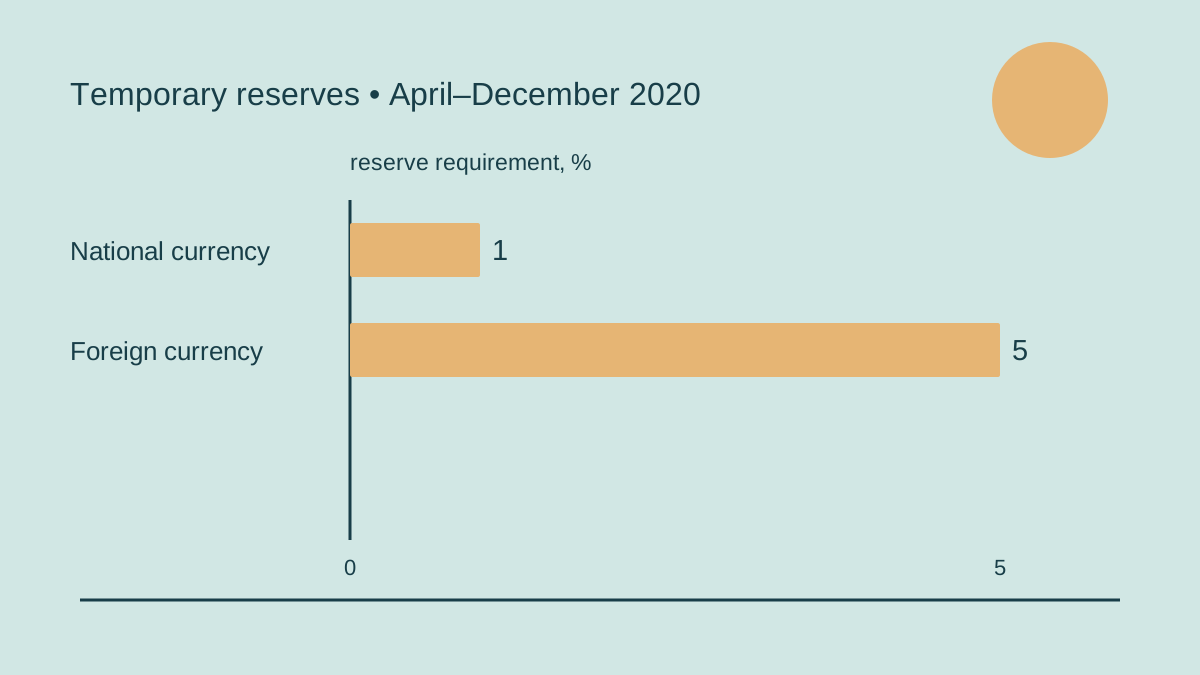
The bank’s 11 February 2021 report put 2020 inflation at 9.4%. Food prices increased 13%, non-food prices 5.8% and service prices 4%. Securities issued during the year amounted to 14.3 billion somoni, and overnight deposits averaged 1.2 billion daily. The bank also described temporary reserve relief applied from 1 April 2020 to 31 December 2020:
- The reserve requirement for national-currency deposits and similar liabilities was set at 1%.
- The corresponding foreign-currency requirement was set at 5%.
- The bank estimated lenders’ additional liquidity at 241.7 million somoni.
Recovery and renewed tightening
At its meeting on 27 July 2021, the monetary-policy committee raised the rate by one percentage point to 13%, effective from 2 August 2021. The release published on the effective date put June annual inflation at 9%. Food prices rose 10.5%, non-food prices 8.4% and services 5.1%. The bank linked price pressures to the global recovery, higher imported goods prices, freight charges and inflation expectations. Domestic incomes, economic growth and seasonal conditions also featured in its assessment. It said the purpose of the increase was to return inflation to the established objective over the medium term.
Banking liquidity in 2021
The banking report of 2 February 2022 described several liquidity instruments used during 2021. Securities auctions amounted to 7.9 billion somoni, and overnight deposits attracted an average of 900 million daily. Reserve requirements for deposits and similar liabilities were 3% in the national currency and 9% in foreign currencies. To provide liquidity, the bank supplied lenders with 720 million somoni in short-term loans, 17.7 times the previous year’s amount. At the end of 2021, the system’s current-liquidity ratio was 87.7%, against a 30% requirement.
Inflation risks during 2022
On 11 February 2022, the committee kept the refinancing rate at 13.25%. Its release put inflation in 2021 at 8%, down 1.4 percentage points, and real economic growth at 9.2%. The bank said imported food and fuel prices and the cost of transporting goods had contributed to domestic pressures. Its outlook for 2022 considered further reopening of borders and growth in tourism, services and logistics. According to the bank, the resulting demand could sustain imbalances between supply and demand and raise world food and fuel prices in the short term.
The committee’s meeting on 13 May 2022 again left the refinancing rate at 13.25%. The bank attributed this decision to potential internal and external risks, continuing inflation pressures and expectations. Its stated objective was to keep inflation within the established guide over the medium term.
On 19 August 2022, the committee increased the refinancing rate by 0.25 percentage points to 13.5%. The bank’s explanation referred to persistent inflation pressures, unstable world prices and rising inflation expectations among households. It also considered potential risks arising inside the country and abroad.
The committee reduced the rate by 0.5 percentage points to 13% on 25 October 2022. Annual inflation in September was 5.7%, 3.9 percentage points below the comparable earlier period. Cumulative inflation over January–September was 3.1%, down 2.2 points. The bank attributed international pressures to disrupted supply chains, logistics costs and instability in food, fuel and fertiliser markets. Its decision also incorporated relative improvement in household expectations and inflation’s position against the established objective.
Disinflation and the 2023 decisions
The committee’s decision on 3 February 2023 lowered the refinancing rate by two percentage points to 11%. The release put 2022 inflation at 4.2%, down 3.8 percentage points from the preceding year, against an objective of 6% with a two-point margin. The bank cited relatively improved household expectations and assessments by international organisations of lower global inflation risks. It also discussed the effects that geopolitical tensions, trade conflicts, pandemic consequences and sanctions against Russia had exerted on prices during 2022. Those international developments formed part of the bank’s explanation of the pressures reviewed when it changed the rate.
Funding reported for 2022
The annual report published on 15 February 2023 described 103 securities auctions during 2022, totalling 9.6 billion somoni. Overnight deposits attracted an average of 700 million somoni daily. Year-end deposit balances reached 15.5 billion somoni, up 52.6%, with national-currency deposits accounting for 55.7% of the total. Loans issued during the year amounted to 14.4 billion somoni. Of the deposit balance, 7.4 billion belonged to legal entities and 8.1 billion to individuals. Lending to production businesses accounted for 36.6% of loans issued, or 5.3 billion somoni.
On 28 April 2023, the committee cut the refinancing rate by one percentage point to 10%. Annual inflation in March was 3.6%, down 3.7 percentage points from the corresponding previous period. The bank described a relative recovery in the world economy, stabilising prices, restored supply chains and lower transport costs during the first quarter. It also cited growth in tourism and aviation services. In its assessment, weaker international inflation factors and moderate exchange-rate movements had supported domestic prices and household expectations, particularly during January–March. International organisations’ forecasts of lower inflation risks also informed the decision.
The committee held the refinancing rate at 10% on 28 July 2023. The bank cited a downward trend in world commodity prices and the potential effects of internal and external economic risks. Its release also described inflation as below the target and household inflation expectations as improving.
The next decision, dated 27 October 2023, again kept the refinancing rate at 10%. The bank’s explanation referred to changes in world commodity prices and the possible impact of domestic and external risks on the economy. At this meeting, its release described inflation as within the target.
The lower rate path in 2024
On 9 February 2024, the committee lowered the refinancing rate by 0.5 percentage points to 9.5%. The bank said its decision took account of stabilising goods prices both domestically and internationally. It also considered forecasts of the potential impact of economic risks and inflation’s position below the established target.
Deposits and lending in 2023
The report published on 13 February 2024 put inflation during 2023 at 3.8%. The bank conducted 108 securities auctions worth 8.9 billion somoni, while overnight deposits attracted a daily average of 721.9 million. Year-end deposit balances stood at 19.5 billion somoni, with 55.5% denominated in the national currency. Weighted average lending rates during the year were 23.2% for national-currency loans and 11.8% for foreign-currency loans. The banking system’s liquidity ratio at the end of 2023 was 81%. Deposits had increased 25.5% from the end of 2022.
The committee’s meeting on 26 April 2024 approved a further reduction of 0.25 percentage points, setting the refinancing rate at 9.25%. The bank attributed the move to stabilisation in domestic and international goods prices and inflation remaining below the established target.
On 31 July 2024, the committee cut the rate by another 0.25 percentage points to 9%. The bank cited stabilising domestic and international goods prices, a favourable forecast for the main macroeconomic indicators and stable household inflation expectations. It described inflation as below the lower boundary of the target range.
Further reductions in 2025
The committee reduced the refinancing rate by 0.25 percentage points to 8.75% on 6 February 2025. Its release again identified stabilising domestic and international goods prices as a consideration. The bank also took account of forecasts for the impact of potential economic risks and inflation remaining below the established target.
Operations during 2024
The annual information published on 10 February 2025 put inflation in 2024 at 3.6%. During that year, the bank held 120 securities auctions totalling 12 billion somoni. Overnight deposits attracted a daily average of 1.1 billion somoni. At the end of 2024, deposit balances reached 25.5 billion somoni, up 31.2% from the corresponding earlier date. The national currency accounted for 60.5% of deposits and foreign currencies for 39.5%. The bank reported food-price growth of 3%, non-food growth of 4% and financial-service price growth of 4.8%.
On 30 April 2025, the committee lowered the refinancing rate by 0.5 percentage points to 8.25%. The bank said it had considered developments in domestic and international goods prices. Its assessment also included relative strengthening of the national currency, inflation near the lower boundary of the target range and stable inflation expectations.
A reserve schedule for liquidity management
At an extraordinary meeting on 28 May 2025, the committee approved the schedule of required reserves in the national currency for 2025. The bank described two objectives for this decision: providing conditions for the transition towards inflation targeting and improving liquidity management by credit and financial institutions.
The committee cut the refinancing rate by 0.5 percentage points to 7.75% on 31 July 2025. The bank cited stable domestic and world goods prices, a relatively stable national currency and moderate inflation expectations. It also described inflation as being near the lower boundary of the target range.
On 29 October 2025, the committee reduced the refinancing rate by 0.25 percentage points to 7.5%. Its release described inflation as below the lower boundary of the established target range. The bank also considered stability in domestic and world goods prices, relative stabilisation of the national currency and moderate inflation expectations.
Banking conditions reported in 2026
At the press conference reported on 11 February 2026, the bank put 2025 inflation at 3.5%. It reported 110 securities auctions worth 63.6 billion somoni during 2025. Year-end deposit balances reached 33.9 billion somoni, with 62.5% denominated in the national currency. Weighted average lending rates for the year were 22.6% in the national currency and 11.7% in foreign currencies. Loans issued during 2025 totalled 30 billion somoni, while the outstanding loan portfolio at year-end was 26.1 billion. The annual report recorded the separate flow of new lending and the portfolio remaining outstanding.






Leave a comment