
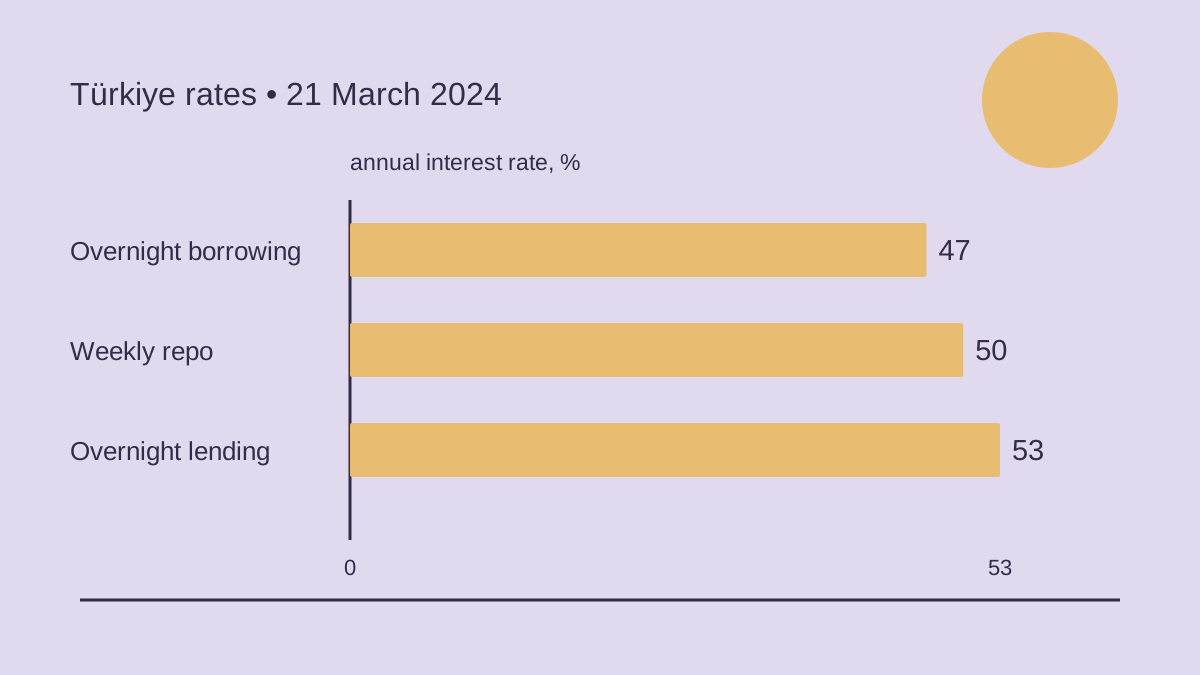
Türkiye raised its weekly repo rate from 45% to 50% on March 21, 2024, after February’s pause, Interfax reported. The central bank also set overnight borrowing and lending rates 300 basis points below and above that benchmark. Services had led higher-than-expected underlying monthly inflation. Earlier releases trace the changing credit, deposit and liquidity framework.
The lira framework before easing
The earlier framework began from a different assessment. On January 20, 2022, the committee retained a 14% weekly repo rate while reporting strong domestic activity supported by external demand. It expected a current-account surplus during the year and linked a sustained improvement in that balance to price stability. Inflation was attributed to currency-market pricing distortions, supply constraints and demand developments. Commercial and consumer lending remained under observation. Alongside the unchanged rate, the bank was reviewing its policy framework to give the lira priority across its instruments. The surplus remained an expectation in this statement.
On February 17, 2022, another hold at 14% put investment finance more explicitly into the explanation. The committee considered long-term investment credit denominated in lira important to the current-account improvement associated with price stability. Its review now described the objective as a lasting shift toward the domestic currency. Supply pressures in energy and other commodities still featured in the inflation assessment, together with demand. Thus the rate decision sat beside a proposed change in the currency and purpose of financing.
The March 17, 2022 decision again left the rate at 14%, but the current-account discussion became more cautious. Energy prices posed risks to the balance as regional conflict increased uncertainty. The committee also stressed credit growth, including long-term investment loans, and the use of borrowed funds for real economic activity as matters of financial stability. Its expectation of disinflation depended on policy measures, base effects and resolution of the conflict. These qualifications matter: the announcement contained an intended route toward lower inflation, rather than evidence that the energy shock had already been absorbed or that credit allocation had achieved its objective.
On April 14, 2022, the committee kept the same rate but decided to strengthen its macroprudential measures. Its account of inflation emphasised adverse supply shocks involving energy, food and agricultural commodities, alongside pricing distortions. Concerns about global food security and transport costs sat beside an assessment of strong domestic activity supported by external demand. Energy costs still threatened the current account. The additional measures therefore belonged to a framework that was watching both the volume of credit and the destination of funds. Keeping the weekly repo rate unchanged did not mean that the committee intended to leave its other instruments unchanged.
Credit, collateral and liquidity
The May 26, 2022 hold at 14% added a practical implementation point. The review of collateral and liquidity policies had been completed, and the resulting actions were to be introduced. Further macroprudential measures remained possible. The committee continued to identify energy and food supply shocks as inflation drivers while linking its broader review to a more durable use of the lira. Collateral and liquidity consequently appeared within the announced policy response even without a change in the headline rate. Their announced implementation followed the completed review, placing changes in the operating tools alongside the commitment to a more durable role for the domestic currency.
By June 23, 2022, the bank still retained the 14% rate and described second-quarter growth as robust, with help from external demand. Tourism-related improvements supported the current-account assessment, although energy-price risks continued. Credit growth and the allocation of financing to real activity remained under scrutiny, with additional macroprudential action available if needed. Collateral and liquidity policies were also to continue supporting transmission. The juxtaposition is useful: an improving tourism contribution did not remove the energy exposure identified in the same release. The committee’s favourable activity assessment and its monitoring of financial channels were parts of one dated decision.
The July 21, 2022 meeting closed this stretch of unchanged decisions with another 14% rate. Tourism continued to improve the current account, but high energy prices and recession risks among major trading partners kept vulnerabilities in view. Credit growth had lost momentum; the committee nevertheless continued to monitor where funds were being used. Its expectation of disinflation remained conditional on the measures being implemented and the resolution of regional conflict. The July statement therefore supplies the setting immediately before easing began: weakening credit momentum was already recognised, while the external-demand and energy risks had not disappeared from the bank’s published assessment.
Rate cuts and the lending gap
The first cut came on August 18, 2022, when the rate fell from 14% to 13%. Leading indicators suggested that activity was losing momentum in the third quarter. The committee wanted financial conditions to support industrial production and employment amid greater uncertainty about global growth. It also identified a widening gap between the policy rate and loan rates as a problem for transmission and decided to strengthen the relevant macroprudential tools. The easing decision therefore had two dimensions: a lower benchmark and attention to the gap separating that benchmark from the rates charged on loans.
On September 22, 2022, the rate declined from 13% to 12%. The committee described signs of a growth slowdown since July, attributing them to weaker foreign demand. It continued to favour supportive financial conditions for production and employment and considered the new rate adequate for the outlook then available. The policy-to-loan-rate spread remained under monitoring as macroprudential measures were implemented. This was a dated assessment of the appropriate setting, with the transmission gap still on the agenda.
The October 20, 2022 reduction was larger, taking the rate from 12% to 10.5%. Weaker foreign demand was putting pressure on manufacturing, although its effects on domestic demand and supply capacity were still described as limited. Supportive financing remained important to the committee’s production and employment objectives. It also considered a similar reduction at the following meeting and then ending the cutting cycle. That guidance placed a possible endpoint beside the current action. Reading the prospective wording carefully preserves the distinction between the reduction actually adopted in October and the next decision that the committee was considering.
On November 24, 2022, the committee lowered the rate from 10.5% to 9% and ended the cutting cycle that had begun in August. Its explanation stressed growing risks to global demand and more pronounced manufacturing pressures from weaker foreign demand. Supportive finance was intended to sustain gains in investment and supply capacity through production and employment. At the same time, the spread between policy and loan rates remained under observation, with further measures to support transmission envisaged. Ending the sequence of benchmark cuts therefore left a continuing role for the other tools described in the release.
The December 22, 2022 decision retained the 9% rate. Strong growth in the first three quarters contrasted with late-year indicators of slower expansion linked to weaker foreign demand. The committee again judged the rate adequate amid risks to global demand and favoured financial conditions supporting investment and supply capacity. It also said funding channels would be aligned with its objectives for a greater role of the lira. That detail extends the policy record beyond the completed rate-cut sequence. The December hold carried an announced direction for financing channels even though the headline interest rate stayed at its November level.
Recovery before the policy reversal
On January 19, 2023, the committee held the rate at 9% while describing a change in the balance of demand. Stronger domestic demand had compensated for the slowdown associated with foreign demand in late-2022 indicators. International recession concerns nevertheless persisted. Funding channels were to follow the objectives of the bank’s 2023 lira strategy, and supportive financial conditions remained linked to industrial production and employment. The statement therefore combined a domestic offset to weaker external activity with continued concern about the global outlook. The unchanged rate belonged to that specific assessment rather than to an announcement that all demand risks had disappeared.
The earthquake changed the immediate policy setting. On February 23, 2023, the rate was reduced from 9% to 8.5% as the committee prioritised financial conditions supporting recovery. Effects on production, consumption, employment and expectations were being evaluated, while earthquake-related imbalances between supply and demand were monitored for their inflation implications. The committee expected a near-term effect on activity without a permanent medium-term impact on the economy. That was its outlook at the meeting, not a retrospective finding. The measured reduction was presented as adequate to support recovery while maintaining price and financial stability.
On March 23, 2023, the rate remained at 8.5%. The committee continued to prioritise supportive conditions for earthquake recovery and to monitor the inflation implications of the resulting supply-demand imbalances. Its international assessment now included threats to financial stability and coordinated steps involving swap arrangements and new liquidity facilities. The decision thus placed a domestic recovery objective alongside a more unsettled external financial environment. Expectations about the earthquake’s medium-term economic impact remained prospective. Keeping those elements together gives the March hold its context: the release maintained support while the bank was still evaluating the disaster’s economic effects.
The changing recovery assessment
The April 27, 2023 hold at 8.5% brought a more specific recovery observation. Leading indicators suggested that economic activity in the earthquake area was recovering faster than expected. The committee nevertheless continued monitoring the disaster’s supply-demand effects on inflation and retained its supportive financial stance. Abroad, successive bank failures were identified as a source of financial-stability risk. The recovery observation was therefore one element within a wider assessment of domestic and international uncertainty. It did not remove the committee’s continuing monitoring task, and the statement still framed the chosen rate as appropriate for supporting the necessary recovery.
On May 25, 2023, another 8.5% hold continued this approach. Recent data again pointed to recovery in the earthquake area progressing faster than expected. Yet increasing domestic consumption, high energy prices and weak activity among trading partners kept current-account risks alive. Supportive finance remained a priority, with earthquake-related inflation effects still under review. The combination matters for the subsequent policy record: the bank recognised stronger consumption while retaining the recovery-oriented stance. Its May announcement contained both that demand observation and the decision to hold, making the published assessment more informative than the unchanged benchmark considered alone.
Tightening and bank funding
The direction changed on June 22, 2023, when the rate rose from 8.5% to 15%. The committee announced the start of tightening to establish disinflation, anchor expectations and control worsening pricing behaviour. Strong domestic demand, cost pressures and persistent services inflation were identified as drivers of a higher underlying inflation trend. The bank also proposed gradual simplification of its microprudential and macroprudential framework, guided by impact analysis, while retaining support for strategic investment improving the current account. The reversal therefore combined a new rate direction with a planned reconsideration of the surrounding regulatory framework.
On July 20, 2023, the rate increased from 15% to 17.5%. The inflation assessment specified wage and exchange-rate cost pressures, sticky services prices and strong domestic demand, with tax changes and deteriorating pricing behaviour adding risks. Quantitative tightening and selective credit tightening were adopted alongside the rate increase. These additional decisions show that the policy response extended beyond the price of the benchmark operation. The committee also expected better external financing, rising reserves and tourism-related current-account improvement to help price stability.
The August 24, 2023 increase took the rate from 17.5% to 25%. Rising oil prices and worse-than-expected inflation expectations and pricing behaviour suggested year-end inflation near the upper bound of the forecast range. The committee still expected disinflation in 2024 under the tightening stance. Regulations aimed at increasing the share of lira deposits were described as strengthening transmission, alongside continued quantitative and selective credit tightening. The deposit emphasis is an important part of this stage: the published response addressed the composition of bank funding as well as the benchmark rate and the inflation outlook.
On September 21, 2023, the rate moved from 25% to 30%. July and August inflation had exceeded expectations, but the committee assessed that tax changes and wage and exchange-rate cost pressures had largely passed through to prices. It expected the underlying monthly inflation trend to decline. Demand, sticky services inflation, oil prices and expectations still posed upside risks. Lira-deposit measures and quantitative and selective credit tightening remained part of the response. The assessment distinguished a cost adjustment considered largely transmitted from inflation pressures still active, helping explain why the bank continued tightening despite its expected improvement in the monthly trend.
The October 26, 2023 decision raised the rate from 30% to 35%. Third-quarter inflation had exceeded expectations, while earlier tax, wage and exchange-rate effects were again assessed as largely passed through. Domestic demand, services-price persistence and inflation expectations continued exerting upward pressure, and geopolitical developments added oil-price risks. The bank intended further measures to increase the lira-deposit share, together with quantitative and selective credit tightening. Its continued rate rise therefore accompanied both an assessment of ongoing price pressures and planned reinforcement of transmission. The expected decline in underlying monthly inflation did not constitute an announced end to tightening.
On November 23, 2023, the rate rose from 35% to 40%, but guidance changed. The committee judged the required degree of tightness to be close and announced slower increases and completion of the tightening cycle soon. Demand was beginning to moderate as tighter policy reached financial conditions, while expectations and pricing showed improvement. Lending rates were assessed as aligned with the targeted tightness; lira-deposit regulations were expected to strengthen transmission and improve bank funding composition. The prospective end of increases came with a separate commitment to maintain monetary tightness for as long as sustained price stability required.
The December 21, 2023 increase slowed to a move from 40% to 42.5%. The committee described November headline inflation as edging upward while the underlying monthly trend continued to decline. It anticipated completing the tightening cycle soon but maintaining tight conditions as needed. Expanded sterilization tools accompanied regulations on the lira-deposit share and the rate decision. The contrast between headline and underlying inflation is central to this assessment: the two measures were not described as moving identically. The slower increase reflected the bank’s judgement of proximity to sufficient tightness, while its wider liquidity toolkit remained active.
Conditions attached to the pause
On January 25, 2024, the rate increased from 42.5% to 45%. Taking the lagged effects of tightening into account, the committee assessed that the tightness needed for disinflation had been achieved. Demand was moderating, and expectations and pricing behaviour continued showing improvement. The bank intended to retain the rate until the underlying monthly trend and expectations met its stated conditions, with reassessment if persistent risks emerged. Simplification, macroprudential action and expanded sterilization remained available around that rate setting. The announcement therefore paired an assessment of sufficient tightness with conditions governing its maintenance and possible reconsideration.
The February 22, 2024 meeting retained 45%. January’s underlying monthly inflation had risen with price and wage adjustments, in line with projections. Consumption-goods and gold imports were moderating more clearly than other spending indicators. The committee reserved further tightening for significant, persistent deterioration in the inflation outlook. Unexpected credit growth or deposit-rate developments could also prompt support for transmission, with liquidity monitored and sterilization tools available. Read beside these conditions, February’s hold was a decision with an explicit contingency. These published conditions gave the February pause a contingency that remained relevant to interpreting the rate decision.
- Investment credit was tied to current-account improvement.
- The policy-to-loan-rate spread remained under monitoring.
- Quantitative and selective credit tightening supplemented the rate increase.






Leave a comment